Where Does San Fernando Valley Water Come From?
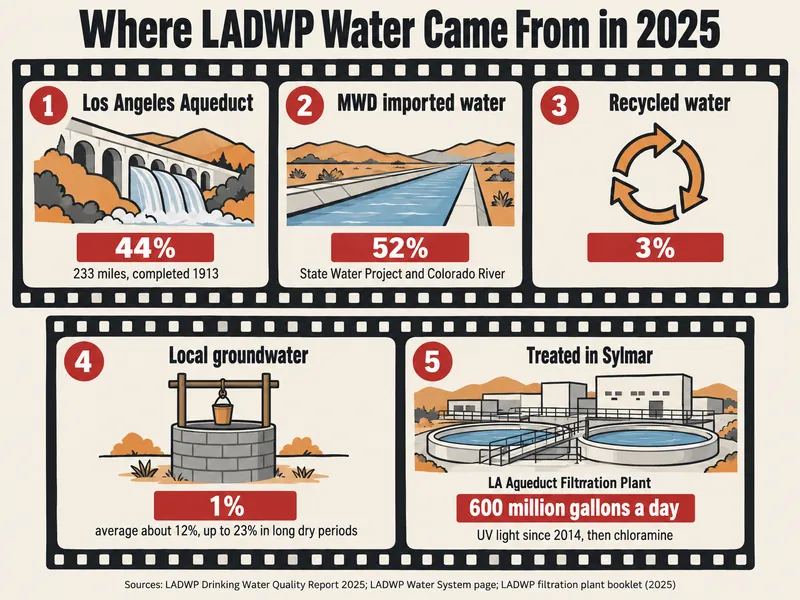
San Fernando Valley water comes mostly from far away: in 2025, LADWP drew 44% from the Los Angeles Aqueduct and 52% from MWD imports, with local wells supplying just 1%.
Call sheet: what this page covers
- What share of San Fernando Valley water comes from the Los Angeles Aqueduct?
- What does MWD imported water add?
- Why does San Fernando Valley water use so little groundwater?
- Where is San Fernando Valley water treated?
- Do Burbank and Glendale get the same water?
- Why does San Fernando Valley water's mix change from year to year?
- Still asking
Before you scroll
- LADWP's 2025 supply was 44% Los Angeles Aqueduct, 52% MWD imported water, 3% recycled and 1% groundwater, per its 2025 Drinking Water Quality Report.
- The aqueduct runs 233 miles from the Eastern Sierra and was completed in 1913, according to LADWP's water system page.
- In dry periods the San Fernando Basin has averaged 12% of LADWP's supply and reached 23%.
- The LA Aqueduct Filtration Plant in Sylmar treats up to 600 million gallons a day, with UV disinfection since 2014.
- Glendale's 2025 water was 63.3% imported, 31.3% local groundwater and 5.4% recycled.
- The City of San Fernando runs on Sylmar Basin wells, with MWD water only as an emergency backup.
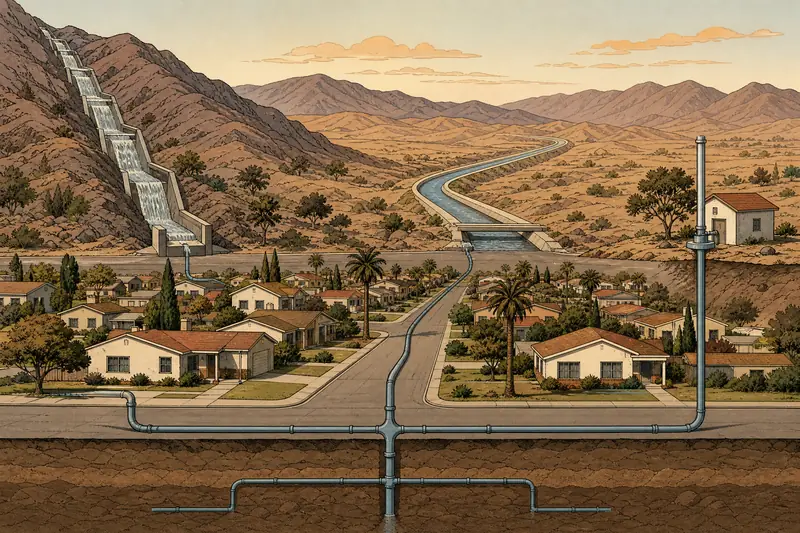
Valley tap water arrives by three routes: a century-old aqueduct from the Eastern Sierra, imported water bought from the Metropolitan Water District of Southern California (MWD), and wells in the groundwater basins under the Valley floor. Each supplier mixes them differently, which explains much of the difference in taste and hardness from one city to the next.
What share of San Fernando Valley water comes from the Los Angeles Aqueduct?
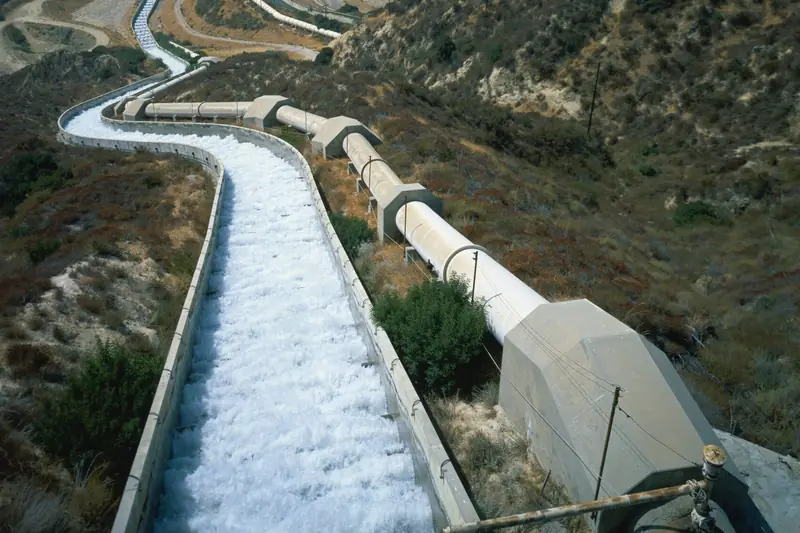
In 2025 the Los Angeles Aqueduct supplied 44% of LADWP's water, city-wide. LADWP's water system page says the aqueduct runs 233 miles north of Los Angeles, carries runoff from the Eastern Sierra, and was completed in 1913. LADWP's filtration plant booklet adds that the water flows by gravity from the Mono Basin and Owens Valley.
LADWP also manages nearly 315,000 acres of land in Inyo and Mono counties to protect that supply.
What does MWD imported water add?
MWD water made up 52% of LADWP's 2025 supply, a blend of State Water Project water from Northern California and Colorado River water. LADWP buys it wholesale; its conservation page notes that over 80% of LADWP's water is imported once the aqueduct is counted. For the Valley, the key MWD plant is the Joseph Jensen plant: MWD's 2025 water quality report says it "supplements local water supplies in the San Fernando Valley, Ventura County and central Los Angeles."
Jensen water is harder than aqueduct water: 140 mg/L against 103 mg/L in 2025. The hardness page has the full comparison by supplier.
Why does San Fernando Valley water use so little groundwater?
Contamination is the main reason. LADWP's water system page says historical contamination has affected nearly 50% of its groundwater wells in the San Fernando Basin, and its 2021 remediation brochure counted 115 wells in 9 well fields with only 41 reliably operable. Solvents such as TCE and PCE, plus 1,4-dioxane and chromium-6, led EPA to add parts of the basin to its Superfund list in 1986; the chromium-6 page covers that history.
Groundwater was just 1% of LADWP's supply in 2025, but the basin matters in droughts: LADWP says it has averaged 12% of supply during dry periods and up to 23% in extended dry periods. Three treatment plants, Tujunga Central plus North Hollywood West and Central, were being built and commissioned in 2025-2026 according to LADWP. Its 2024-25 Briefing Book says together they will let LADWP pump 104,000 acre-feet a year, about 20% of LA's water use.
Where is San Fernando Valley water treated?
Most LADWP water for the Valley is treated at the Sylmar filtration plant, formally the Los Angeles Aqueduct Filtration Plant. The plant opened in 1987 and treats up to 600 million gallons a day; LADWP's booklet says water from the Eastern Sierra and much of the water bought from MWD is treated there. The process runs through ozone and filtration, then UV disinfection (a facility commissioned in May 2014), and finally chlorine plus ammonia to form chloramine.
MWD water that does not pass through Sylmar is treated at MWD's own plants; LADWP's report names Weymouth, Diemer and Jensen as the plants serving the LA area. Local well water is treated at well-field plants such as the granular activated carbon plant at the Pollock Well Field (since 1999) and the Tujunga plant (2009). Why chloramine is the final step is explained on the chloramine page.
Do Burbank and Glendale get the same water?
No. Burbank, Glendale and San Fernando each run their own systems with their own mixes. Glendale's 2025 water quality report says 63.3% of its water was bought from MWD, 31.3% came from San Fernando Basin groundwater and 5.4% was recycled water. Its groundwater passes through the Glendale Water Treatment Plant, which uses ion exchange, air stripping and activated carbon.
Burbank says it "relies on 100% imported water" and has no local water rights, yet it pumps and treats groundwater at the Burbank Operable Unit. Its 2025 report explains the link: Burbank stores State Water Project water in the ground at spreading basins and pumps it back out. In 2026 that storage stalled, because LA County Public Works has not let Burbank spread water there over concern about invasive golden mussels; Burbank says the mussels are not in its own system.
The City of San Fernando draws from Sylmar Basin wells. Its 2025 report lists an MWD emergency connection and an LADWP connection used only in extreme emergencies, and says the city serves about one billion gallons a year to some 23,946 people.
Why does San Fernando Valley water's mix change from year to year?
The mix changes because each source depends on weather and on what can be pumped safely. The aqueduct carries Eastern Sierra runoff, so wet and dry years on the far side of the mountains change how much it can deliver. When imported water is scarce, LADWP leans harder on the San Fernando Basin, which is why the groundwater share has ranged from 1% in 2025 to as much as 23% in long dry spells.
The next big change is recycled water. LADWP's Los Angeles Groundwater Replenishment project broke ground on December 6, 2024 and is designed to produce up to 45 million gallons a day of purified recycled water to refill the basin at the Hansen Spreading Grounds, with operation expected in early 2028. Whatever the mix, the yearly tests decide whether it passes: see is LA tap water safe to drink, or the tap water folder for every supplier side by side.
Where the water came from
- 44%LADWP supply from the Los Angeles Aqueduct, 2025LADWP Drinking Water Quality Report 2025
- 52%LADWP supply bought from MWD, 2025LADWP Drinking Water Quality Report 2025
- 233 milesLength of the Los Angeles Aqueduct, completed 1913LADWP Water System page
- 600 MGDTreatment capacity of the LA Aqueduct Filtration Plant, SylmarLADWP filtration plant booklet (2025)
- 31.3%Glendale's 2025 supply from local groundwaterGWP 2025 Water Quality Report
| Supplier | Imported | Local groundwater | Recycled | Notes |
|---|---|---|---|---|
| LADWP (2025, city-wide) | 44% LA Aqueduct + 52% MWD | 1% | 3% | Groundwater averages 12% in dry periods |
| Glendale Water & Power (2025) | 63.3% MWD | 31.3% | 5.4% | Groundwater treated at the Glendale plant |
| Burbank Water and Power | MWD water rights | Pumped at the Burbank Operable Unit | not given | Report values are a blend of MWD and groundwater |
| City of San Fernando (2025) | MWD for emergencies only | Sylmar Basin wells | none listed | About one billion gallons a year |
Where this page comes from
This page relies on LADWP's 2025 Drinking Water Quality Report, its water system page, its 2025 filtration plant booklet, its 2021 San Fernando Basin remediation brochure and 2024-25 Briefing Book; MWD's 2025 water quality report; and the 2026 reports of Burbank, Glendale and San Fernando (2025 data), read in October 2026. LADWP's new groundwater plants are described as being built and commissioned because their October 2026 status could not be confirmed. Suppliers outside these four, such as those serving Calabasas, are not covered.
Still asking
Does any Valley water come from the Colorado River?
Yes, through MWD, which blends Colorado River and State Water Project water. LADWP's 2025 report counts both under its 52% MWD share without splitting them.
Is the water in the Sylmar cascades what comes out of my tap?
It is the same aqueduct water, but it is treated first at the filtration plant in Sylmar before entering LADWP's pipes.
What is the San Fernando Basin?
It is the groundwater basin beneath the eastern Valley, pumped by LADWP, Burbank and Glendale. Much of it has been under EPA cleanup since the 1980s.
Why did the Valley's groundwater share drop so low in 2025?
LADWP's report gives the 1% figure without a reason. Its own pages tie groundwater use to contamination limits on many wells and to how much imported water is available.
Will recycled water end up in Valley taps?
LADWP plans for purified recycled water to soak into the basin at the Hansen Spreading Grounds from early 2028, then be pumped out later as groundwater. It is designed to serve 500,000 customers.
Does Glendale belong to MWD?
Yes. Glendale's water quality page says it was one of the 13 founding cities of MWD in 1928, and MWD remains its main source.
Does it matter which source reaches my house?
For hardness it does: aqueduct water averaged 103 mg/L in 2025 and Jensen MWD water 140 mg/L. Either way, LADWP's report finds 2025 compliance with every primary standard across its sources.
That is the end of this page. Back to all five Shutoff Valley folders.