Descaling a Tankless Water Heater
Descaling a tankless water heater means pumping white vinegar through its heat exchanger; Rinnai asks for it once a year wherever hardness tops 60 mg/L, which covers every Valley supplier.
Call sheet: what this page covers
Before you scroll
- Rinnai's SENSEI RX manual asks for a residential flush once a year once hardness passes 60 mg/L (about 4 gpg), and requires water treatment above 200 mg/L.
- Every Valley supplier is above that first line: LADWP's Valley sources measured 103-140 mg/L in 2025, the City of San Fernando 190 mg/L and Burbank 286 mg/L.
- The Rinnai procedure uses 4 gallons of undiluted white vinegar, a small pump and about 60 minutes of circulation at 4 gallons per minute.
- An "LC" code on a Rinnai display means scale is building and the unit must be flushed; Rinnai says scale damage is not covered by its warranty.
- A. O. Smith notes tankless heaters skip tank flushing but "many tankless water heaters require descaling."
- Tankless units last about 15-20 years or more, per Rheem and A. O. Smith, with that kind of upkeep.
Why do tankless heaters need descaling?
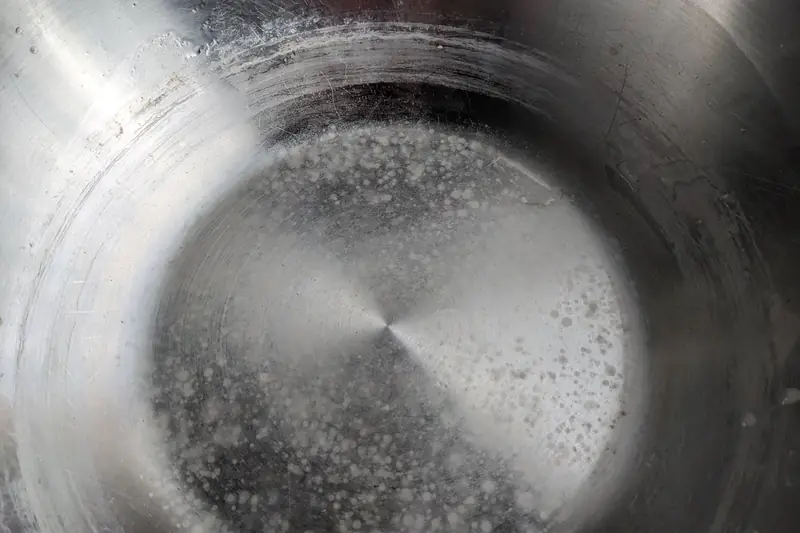
A tankless heater pushes water through a narrow heat exchanger, and hard water leaves calcium scale on its hot inner surfaces. Rinnai's SENSEI RX manual says that "failure to flush the appliance will cause damage to the heat exchanger," and that "damage caused by lime/scale build-up is not covered by the water heater's warranty."
Scale forms faster at higher settings: Rinnai notes buildup "can be accelerated if the water heater is set at a high temperature." A tank heater has sediment to drain, but a tankless unit has no tank, so the cure is a chemical flush that dissolves the crust instead.
How often should you descale a tankless water heater?
Rinnai sets the schedule by hardness. Its water treatment table (Table 3, pages 11-12) calls 0-60 mg/L (0-4 gpg) soft and needing no flushing; from 61 mg/L up, it recommends a softener or its Scale Cutter conditioner and a flush "Residential: Once/Year; Commercial: Twice/Year." Above 200 mg/L (12+ gpg), treatment is "Required," and 200 mg/L is the maximum total hardness the manual lists for the unit.
Valley water lands in several of those rows. LADWP's report puts its Valley sources at 103-140 mg/L, which Rinnai calls slightly to moderately hard. San Fernando's 190 mg/L falls in Rinnai's very hard band. Burbank's blend at 286 mg/L and Glendale's local groundwater plant at 350 mg/L before blending sit above the 200 mg/L ceiling. Water reports print hardness in ppm, which equals mg/L. Other brands set their own intervals; check your manual, since this page quotes only Rinnai.
| Valley water | Hardness (2025) | Rinnai class | What the Rinnai manual says |
|---|---|---|---|
| LADWP, Aqueduct plant source | 103 mg/L | Slightly hard (61-120) | Treatment recommended; flush yearly |
| LADWP, MWD Jensen source | 140 mg/L | Moderately hard (121-160) | Treatment recommended; flush yearly |
| City of San Fernando | 190 mg/L | Very hard (161-200) | Treatment strongly recommended; flush yearly |
| Burbank Water and Power | 286 mg/L | Extremely hard (200+) | Treatment required |
| Glendale groundwater plant, before blending | 350 mg/L | Extremely hard (200+) | Treatment required |
Rinnai's scale is not the USGS one. On the USGS hardness scale, "very hard" starts above 180 mg/L, so the same water can carry different labels; the mg/L figure is what to compare.
What do you need for descaling?
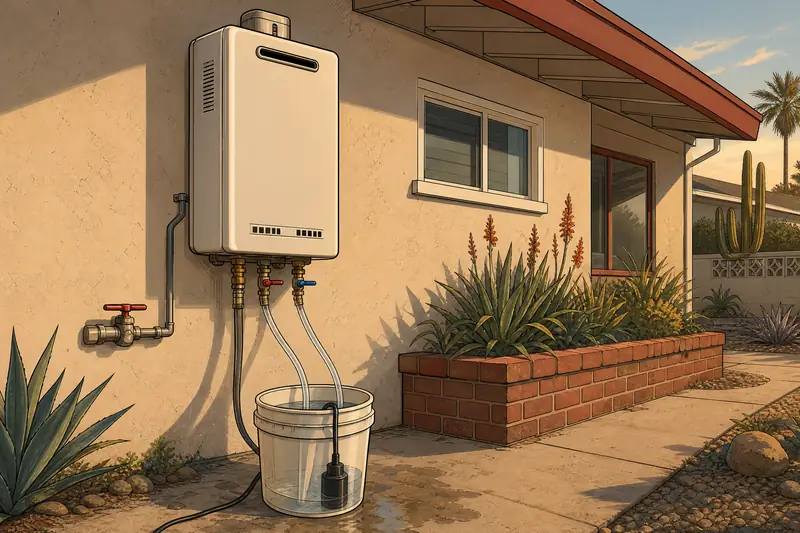
Rinnai's procedure calls for a pail, 4 gallons of "undiluted virgin, food grade, white vinegar," a small circulating pump and three hoses: one from the pump to the cold-side service valve, one from the pump inlet into the pail, and a drain hose from the hot-side service valve back into the pail. The heater also needs isolation valves with service ports, which Rinnai "strongly recommends" at installation for exactly this job.
If your heater has no service valves, adding them is plumbing work for a licensed plumber (C-36). Other makers' manuals may name a commercial descaler; the Rinnai manual names only vinegar, so check your own model's manual before using anything else.
How do you descale step by step?
The sequence below condenses section 6.3, "Flushing the Heat Exchanger," of the Rinnai SENSEI RX manual. It applies to that model; other units differ in the details, especially the control steps.
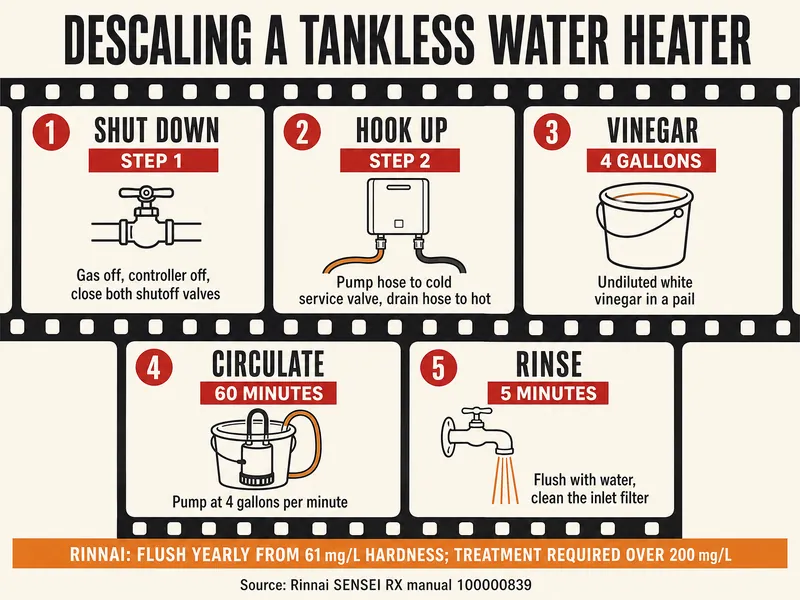
- Shut down. Turn off the gas supply and the controller, then close the hot and cold shutoff valves.
- Connect the hoses. Pump outlet to the cold-water service valve; drain hose to the hot-water service valve; both free ends into the pail of vinegar.
- Open both service valves so the vinegar can loop through the heat exchanger.
- Start descaling mode. On this model, remove the front panel and use the circuit-board buttons until "dES" shows; the display then counts down from 60.
- Circulate for at least 1 hour at about 4 gallons per minute.
- Rinse. Lift the drain hose into a sink or the yard, close the cold service valve, open the cold shutoff, and run fresh water through the unit for 5 minutes.
- Clean the inlet filter. Close the cold shutoff, remove the in-line filter at the cold inlet, rinse out the residue and refit it.
- Restore service. Reopen the valves, disconnect the hoses, refit the panel, restore gas and return the controller to normal mode.
What are signs of scale in a tankless heater?
The clearest sign is the unit telling you. Rinnai heaters can show "SS" (Service Soon) on a schedule the installer sets, and an "LC" code, which the manual says "indicates the unit is beginning to lime/scale up and must be flushed." Don't clear the code and carry on; flush the unit.
Without a code, the manual's general warning still applies: "Scale build-up will affect the performance of the water heater." Chalky crust at the fittings is another hint the water is depositing scale. A. O. Smith's maintenance checklist says its tankless units need a flush of mineral deposits, "especially in areas with hard water." The scale and spots page shows what Valley scale looks like on fixtures.
Can treated water reduce descaling?
Yes, and on the hardest Valley water Rinnai requires it. Its manual recommends "a water softener or Rinnai Scale Cutter" from 61 mg/L, strongly recommends one from 161 mg/L, and says one is "Required" above 200 mg/L. Scale Cutter feeds "a blend of scale control compounds into the cold water supply," Rinnai says.
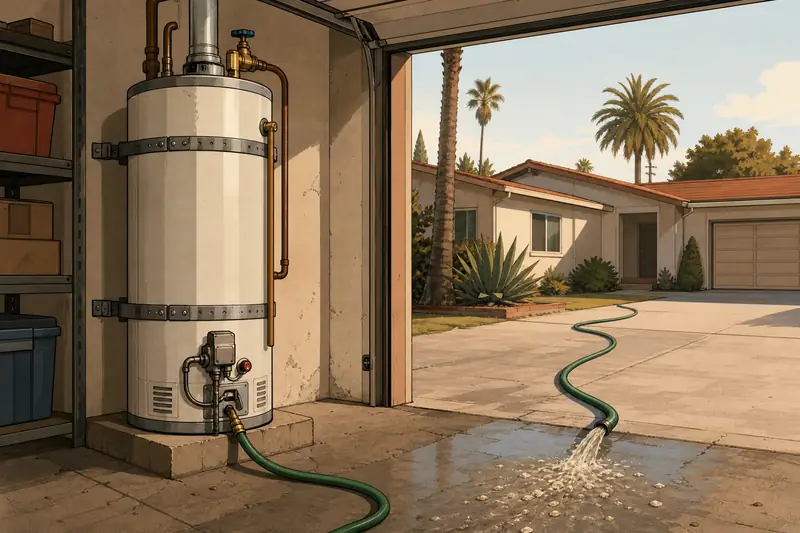
Treatment does not end the yearly flush in Rinnai's table; it sits beside it. Softening has its own trade-offs, set out on the do you need a softener page; salt-free conditioners are covered on the salt-free conditioner page. For tank heaters, the job is a drain-and-flush instead, as the tank flushing page shows.
Descaling in numbers
- 61 mg/LHardness at which Rinnai starts a yearly flushRinnai SENSEI RX manual, Table 3
- 200 mg/LHardness above which Rinnai requires treatmentRinnai SENSEI RX manual, Table 3
- 4 gallonsUndiluted white vinegar for one descaleRinnai SENSEI RX manual, section 6.3
- 15-20 yearsTypical tankless life with proper careRheem
Where this page comes from
The steps and intervals here come from Rinnai's SENSEI RX Residential Installation and Operation Manual (document 100000839), with tankless notes from A. O. Smith's maintenance pages and Rheem's lifespan article, and hardness from the 2026 water reports of LADWP, Burbank, Glendale and San Fernando on 2025 data; these were opened in October 2026. Not included: Navien's or other brands' intervals (not read), descaler product names, and service prices.
Still asking
Can you descale a tankless water heater without service valves?
Not in the way Rinnai describes. The flush loops vinegar through the unit's service ports, so a heater without isolation valves needs them added by a licensed plumber first.
Is vinegar safe for a tankless heat exchanger?
Rinnai's own procedure specifies undiluted white vinegar for its SENSEI RX models. For other brands, follow that maker's manual, which may name a different descaling solution.
How much vinegar does a tankless flush use?
Rinnai's procedure pours 4 gallons into the pail and circulates it for about an hour. The rinse that follows uses 5 minutes of fresh tap water.
What does the LC code mean on a Rinnai?
The manual says LC "indicates the unit is beginning to lime/scale up and must be flushed." Flush the heat exchanger soon after it appears.
Does Burbank water void a tankless warranty?
Rinnai lists 200 mg/L as the maximum total hardness and says scale damage is not covered. Burbank's 2025 average of 286 mg/L is above that, so Rinnai's manual calls for treatment there.
Should the inlet filter be cleaned between descales?
Rinnai's procedure cleans the cold-water in-line filter as part of each flush, after the unit has drained from the rinse.
Can a tankless heater be descaled more than once a year?
Yes. Rinnai's table lists twice a year for commercial use, and the SS reminder can be set to a shorter interval where water is very hard.
That is the end of this page. Back to the full list of Valley water and plumbing pages.