Emergency Water Storage for Earthquakes
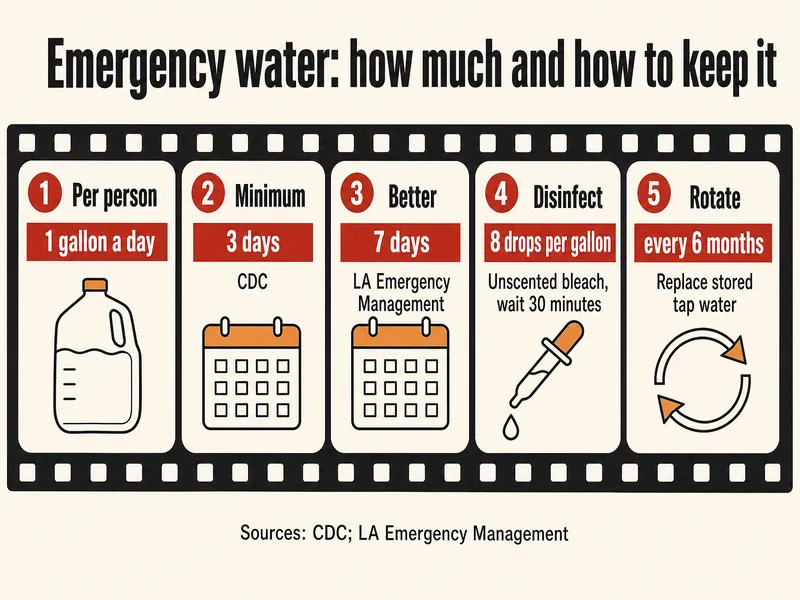
Emergency water storage for a Valley earthquake starts at a gallon a day for each person, for no less than 3 days, and Los Angeles emergency planners suggest enough for up to 7 days, pets included.
Call sheet: what this page covers
Before you scroll
- The CDC sets the floor at 1 gallon per person per day for 3 days and suggests a 2-week supply if possible.
- LA Emergency Management's kit checklist says 1 gallon per person per day "for up to 7 days," with the same rule for children and pets.
- Stored tap water should be replaced every 6 months and kept at 50 to 70°F, according to the CDC.
- A restrained, undamaged water heater typically holds about 40 gallons of usable water (FEMA P-530, 2020).
- To disinfect, the CDC gives 8 drops of unscented 5 to 9 percent bleach per gallon, then a 30-minute wait.
- At Valley elevations, boiling for 1 minute is enough; the CDC's 3-minute rule starts above 6,500 feet.
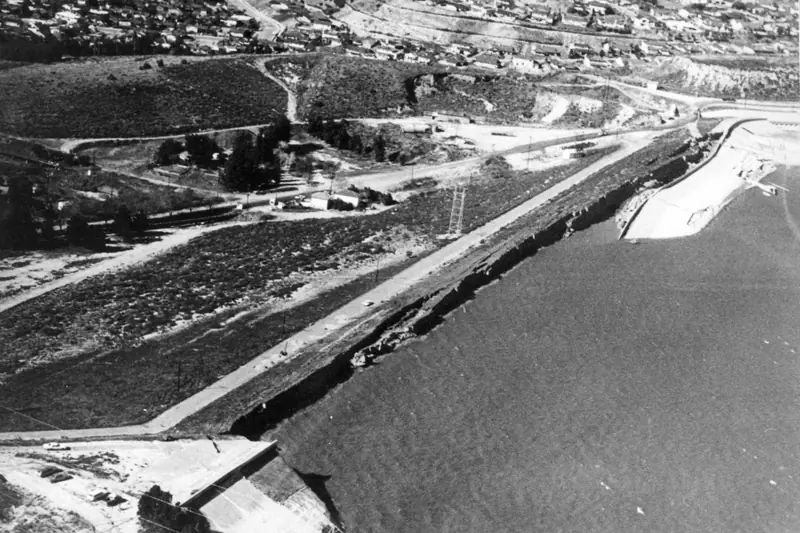
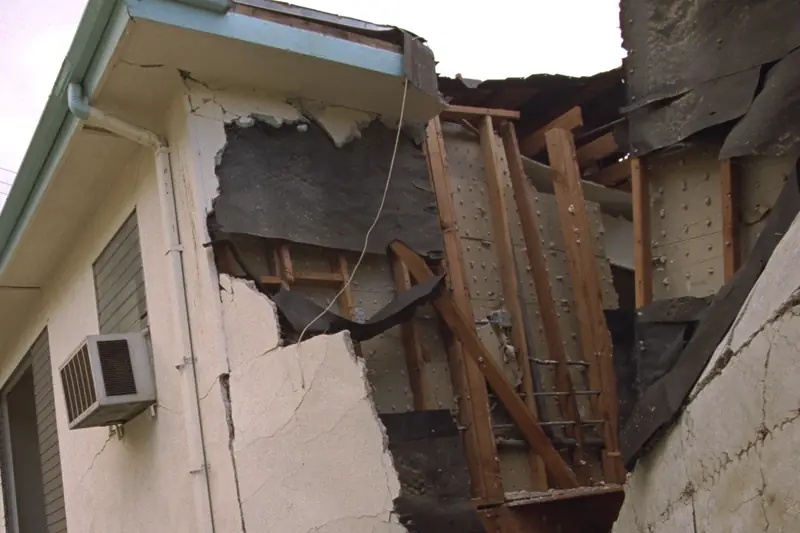
After a large quake, broken mains can leave taps dry or unsafe for days. In 1994, NIST's fire report says, much of the west and north San Fernando Valley had no hydrant pressure at all. Stored water is the cheapest piece of quake readiness and the one most households fall short on.
How much emergency water should you store?
Plan on one gallon for each person each day, for 3 days at minimum and ideally 7 days to 2 weeks. The gallon covers drinking plus basic washing; Ready.gov puts drinking alone at about three-quarters of a gallon a day for a normally active person.
The agencies differ on the number of days. The CDC says 3 days as a minimum and 2 weeks if you can, the LA Emergency Management checklist says up to 7 days, Ready LA plans for 3 to 7, and the city's 2017 council preparedness handbook asked for at least two weeks. Glendale's fire department tells residents to be ready to be on their own for up to 7 days.
Water storage numbers
- 1 gallonper person per day, drinking and sanitationCDC
- 7 dayshow long LA Emergency Management's checklist plans forLA Emergency Management
- 6 monthshow often to replace stored tap waterCDC
- 8 dropsof 5-9% unscented bleach to disinfect 1 gallonCDC
| Household | 3 days (CDC minimum) | 7 days (LA EMD) | 14 days (CDC "if possible") |
|---|---|---|---|
| 1 adult | 3 gallons | 7 gallons | 14 gallons |
| 2 adults | 6 gallons | 14 gallons | 28 gallons |
| 2 adults, 2 children | 12 gallons | 28 gallons | 56 gallons |
| 2 adults, 2 children, 1 dog | 15 gallons | 35 gallons | 70 gallons |
How should you store emergency water?
The simplest store is commercially bottled water left sealed in its original container, kept somewhere cool and dark. If you fill your own, use food-grade containers; the 2006 Red Cross booklet written with FEMA, Food and Water in an Emergency, rules out milk and juice jugs, because milk protein and fruit sugar cannot be fully rinsed out, and glass, because it breaks.
Clean each container with dish soap, then sanitize it with 1 teaspoon of unscented bleach in a quart of water, swished over every surface. Fill it straight from the tap: the same booklet says chlorinated utility water needs nothing added, and every Valley supplier disinfects with chloramine or chlorine. Write the date on the cap and swap the water every 6 months.
Where you keep it matters in a quake. Five-gallon jugs on a high garage shelf can fall, and a closet on the ground floor, away from the water heater and the car, is easier to reach after shaking. Spreading water over two spots helps if one part of the house is damaged.
Can you drink water from the water heater?
Yes, if the tank stayed upright and undamaged. The CDC lists water from your home's tank water heater as a safe indoor source when you have no bottled or treated water, and FEMA P-530 puts the usable volume at about 40 gallons, "provided the heater has been properly restrained." That is one more reason to check the water heater straps now.
To draw it, start by shutting off the tank's gas or electricity, as the Red Cross booklet directs; then close the cold water intake valve at the tank, open a hot water faucet to let air in, and open the drain valve at the bottom. The tank must be full again before its burner or elements come back on, and if the gas was shut off, a professional has to restore it. Close the main water shutoff early so the tank does not drain back through broken street lines. The first water out may carry sediment; letting it settle helps, and a tank flushed every year, as makers suggest in the flushing notes, gives cleaner water.
How do you disinfect water after a quake?
Boil it or treat it with bleach. The CDC says to bring clear water to a rolling boil for 1 minute; its 3-minute rule applies only above 6,500 feet, far higher than any Valley neighborhood.
Without power or gas, use unscented household bleach. The CDC gives 8 drops per gallon for bleach that is 5 to 9 percent sodium hypochlorite, doubled if the water is cloudy, colored or very cold, then a wait of at least 30 minutes. EPA lists 6 drops per gallon for 8.25 percent bleach and says the water should smell slightly of chlorine afterward. Older booklets call for 1/8 teaspoon, about 16 drops, because they were written for weaker bleach; check the label on your bottle.
Neither method removes chemicals or metals. If officials say the water is contaminated with something other than germs, use stored water and wait for their instructions.
What about pets and medical needs?
Count every pet as a person: LA Emergency Management's checklist says to "apply the same rule for children and pets," so a dog adds a gallon a day. Ready.gov notes that children, nursing mothers and sick people may need more, and that water needs can double in very hot weather, which in the Valley means much of the year.
Medical needs take a plan made in advance. LADWP's 2025 water quality report says people using equipment such as dialysis machines must remove chloramine from tap water, so home dialysis patients should ask their care team how to store or treat emergency water. Fish ponds and aquariums also need chloramine treatment before tap water goes in, a point covered on the chloramine page.
Where else can you find emergency water in a house?
Beyond the water heater, the water left in your pipes is usable. The Red Cross booklet says to open the highest faucet in the house to let air in, then draw water from the lowest one; ice cubes count too.
The CDC adds toilet tank water, not bowl water, if it is clear and has not been chemically treated; the older Red Cross booklet advised against flush tanks, so treat that water before drinking it. Glendale's fire department mentions canned vegetables as a source. Pool and spa water is for washing and flushing only, never drinking, and the CDC says never to use water from a home heating boiler or radiators.
Where this page comes from
Based on the CDC's pages on creating an emergency water supply (June 2025), finding clean water (June 2025) and making water safe (September 2024); EPA's emergency disinfection page; Ready.gov's Water page; LA Emergency Management's kit checklist, Ready LA's multifamily page and the 2017 council handbook; Glendale Fire Department's earthquake page; the 2020 FEMA P-530 home safety handbook; the Red Cross food and water booklet; NIST-GCR-98-743; and LADWP's 2025 water quality report, read in October 2026. The CDC and Red Cross figures conflict on bleach drops; this page uses the current CDC and EPA doses. Left out: brand-name storage products, water filters for emergencies and shelf-life claims for commercial water beyond the label date.
Still asking
Does stored tap water go bad?
The CDC says to replace water you stored yourself every 6 months. Commercially bottled water should be kept sealed and used by the date on the label.
Can I store water in old milk jugs?
No. The Red Cross booklet says milk protein and fruit sugar cannot be fully removed from those jugs and can feed bacteria; use food-grade containers or well-rinsed 2-liter soda bottles.
Do I need to add bleach to tap water before storing it?
Not if it comes from a chlorinated utility supply, according to the Red Cross booklet. Every Valley utility disinfects its water, so fill, cap, date and store it.
How many gallons does a family of four need for a week?
At 1 gallon per person per day, 28 gallons, plus 7 more for each pet. FEMA P-530 notes that a family of four needs 12 gallons for 3 days.
Is it safe to drink water heater water if the tank tipped over?
Not if the tank moved or its fittings are broken. FEMA's 40-gallon figure assumes a restrained, undamaged heater, and a tipped tank may also have a damaged gas line, so leave it alone and check for gas first.
Should I keep water in the car too?
FEMA and the Red Cross suggest keeping emergency supplies in each vehicle and at work. A few sealed bottles in the trunk help if a quake strikes while you are away from home.
Can I use camping water tablets instead of bleach?
Ready.gov and the Red Cross booklet recommend boiling or plain unscented bleach and advise against water treatment products whose only active ingredient is not sodium hypochlorite. A filter's own certification decides what it removes, so read its label.

That is the end of this page. Back to the Shutoff Valley front page.