Chloramine Filters for Valley Homes
Chloramine filters for Valley homes rely on catalytic carbon, because chloramine breaks down slowly on ordinary carbon: the Water Quality Association puts the contact time at about 5 minutes, against under a minute for chlorine.
About the shop links on this page: Shutoff Valley shares its owners with SoftPro Water Systems and Quality Water Treatment, the two water-treatment shops linked on this page. What a shop says about its own products is labeled as the shop's claim. How shop links work here
Call sheet: what this page covers
- Why is chloramine harder to filter than chlorine?
- What is catalytic carbon in chloramine filters?
- Whole-house or point-of-use chloramine filter?
- Which certifications cover chloramine reduction?
- How long does a chloramine filter last?
- What does a chloramine filter not remove?
- Where do the shops' carbon filters fit?
- Still asking
Before you scroll
- LADWP reported an average total chlorine residual of 1.7 mg/L for 2025, with readings from 1.4 to 2 against a 4 mg/L ceiling, in its 2025 water quality report.
- Ordinary carbon can need a bed contact time of 10 minutes or more to break chloramine down, says the Water Quality Association; catalytic carbon needs about 5.
- Chloramine reduction is its own claim under NSF/ANSI 42; a chlorine claim alone does not cover it.
- California's device registration does not cover chloramine filters at all, because NSF/ANSI 42 claims are aesthetic, per the State Water Board.
- Burbank's chloramine residual averaged 2.1 ppm in 2025 (0.2-3.4), the highest average of the Valley suppliers.
- A chloramine filter does not soften water, lower fluoride or remove lead unless the exact model is certified for it.
Most Valley taps deliver water disinfected with chloramine, a blend of chlorine and ammonia that lasts longer in pipes than chlorine alone. Filtering it out is a taste and comfort choice for most homes, and a must for a few uses such as home dialysis and fish tanks. The hard part is that chloramine needs more carbon and more time than chlorine, which changes how a filter should be sized. For what chloramine is and why the utilities use it, start with chloramine in LADWP water.
Why is chloramine harder to filter than chlorine?
Chloramine is harder to filter because carbon has to break it down chemically rather than catch it, and that reaction is slow. The Water Quality Association's chloramine technical sheet describes chloramines as small, stable molecules with no net charge, which makes them "difficult to remove by distillation, reverse osmosis, and ion exchange resins."
Free chlorine is quick work for carbon. WQA's carbon technical sheet says dechlorination needs a contact time of only 30-40 seconds, and that a chloramine filter "has to be sized about four times the size of a regular GAC filter used for chlorine."
Chloramine by the numbers
- 1.7 mg/LLADWP average total chlorine residual, 2025 (range 1.4-2)LADWP 2025 water quality report
- 2.1 ppmBurbank chloramine residual average, 2025 (range 0.2-3.4)Burbank Water and Power 2025 water quality report
- 4 mg/LFederal ceiling (MRDL) for chloramine, measured as chlorineWater Quality Association
- 30-40 secCarbon contact time needed for free chlorineWater Quality Association
- About 5 minContact time for chloramine on catalytic carbonWater Quality Association
What is catalytic carbon in chloramine filters?
Catalytic carbon is activated carbon treated to speed up the reaction that splits chloramine into chloride, ammonia and nitrogen. WQA notes that sellers may describe it by a "peroxide number" alongside the usual iodine number, and that catalytic carbon removes chloramine better at higher pH.
Valley water sits on the higher side of neutral: LADWP's Valley sources averaged pH 7.7 to 8.3 in 2025, and Burbank's averaged 8.4. That suits catalytic carbon, though pH is only one factor next to contact time and the age of the media.
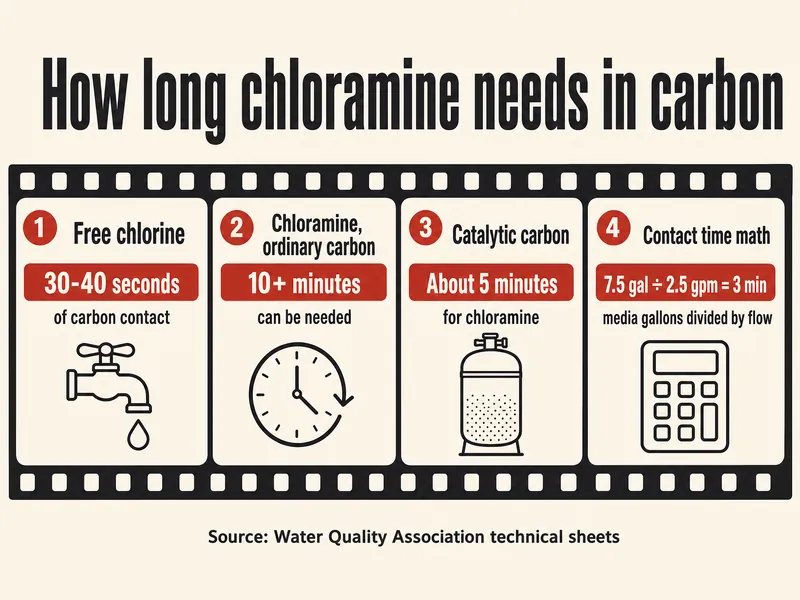
Contact time is simple arithmetic. WQA's example: one cubic foot of carbon holds about 7.5 gallons of media, so water running through it at 2.5 gallons per minute (gpm) spends 3 minutes in the bed. A 1.5 cubic foot tank holds about 11 gallons of media; at WQA's 5 minutes for catalytic carbon, that tank would be sized for roughly 2.2 gpm of flow, and less contact at higher flow.
That arithmetic is a planning figure, not a pass or fail line. Ask the seller what flow rate the tank was sized for and what chloramine level it was tested against.
Whole-house or point-of-use chloramine filter?
A whole-house (point-of-entry) tank treats every tap, shower and appliance; a point-of-use filter treats one faucet. The table below shows what each Valley supplier uses, which sets how much chloramine a filter has to deal with.
| Supplier | 2025 residual | Disinfectant | Source |
|---|---|---|---|
| LADWP (Valley neighborhoods of LA) | 1.7 mg/L average, 1.4-2 | Chloramine | LADWP 2025 report, first table |
| Burbank Water and Power | 2.1 ppm average, 0.2-3.4 | Chloramine | BWP 2025 report |
| Glendale Water & Power | 1.25 ppm city-wide average, 0-3.1 | Chlorine and chloramine | GWP 2025 report, p.12 |
| City of San Fernando | See the city's report | Chlorine on its wells; chloramine when blending MWD water | San Fernando 2025 report, p.4 |
Reports print these as ppm, which is the same as mg/L at these levels. A whole-house tank makes sense when the goal is the shower, the laundry or the smell at every tap. It also protects rubber parts: LADWP's water quality FAQ notes that chlorine or chloramine slowly breaks down the black rubber lining of flexible supply hoses, and says newer hoses carry disinfectant-resistant linings.
A point-of-use filter makes sense when the goal is drinking water, coffee or an aquarium top-up. Its low flow, often under 1 gpm, gives the carbon more time per gallon. Before buying either, try LADWP's at-home fix for a bleachy taste: remove the aerators and run every faucet for 5 minutes, since the taste often comes from chloramine reacting with buildup in home plumbing.
Which certifications cover chloramine reduction?
NSF/ANSI 42 carries a separate "Chloramine Reduction" claim, and only a model listed for that claim has been tested for it. NSF's chloramine reduction listing, read on October 27, 2026, lists countertop, faucet-mount, plumbed-in, refrigerator and commercial modular units, each with a rated flow and service cycle; no residential whole-house tank appeared on it.
Three things trip buyers up:
- Chlorine is not chloramine. Many listings show "Chlorine Reduction" only. A chlorine claim says nothing about chloramine.
- Materials marks are not reduction claims. NSF/ANSI 61 and 372 cover parts and lead-free materials, not what the filter takes out.
- California registration does not apply. The State Water Board's device FAQ says models certified only to NSF/ANSI 42 are aesthetic and fall outside its registration program.
No chloramine reduction certification was found for the two shops' whole-house carbon tanks; their chloramine wording is the shops' own claim.
How long does a chloramine filter last?
A certified filter lasts its rated service cycle in gallons, and an uncertified tank lasts as long as its carbon keeps reacting, which only a test can show. Each NSF/ANSI 42 listing pairs the claim with a flow rate and a gallon rating; one countertop model on NSF's chloramine list, for example, is rated at 0.7 gpm for 1,320 gallons.
The State Water Board's consumer page puts it plainly: replace the element after the stated number of gallons, or the device stops reducing contaminants. For a whole-house tank with no certified gallon rating, a total chlorine test before and after the tank, using the DPD method WQA lists, shows whether chloramine is getting through. The home testing page covers what a kit can and cannot tell you.
What does a chloramine filter not remove?
A carbon chloramine filter does not remove hardness, dissolved minerals, fluoride or nitrate, and it should not be relied on for lead unless the model carries an NSF/ANSI 53 or 58 lead claim. Carbon also leaves behind the products of the reaction: WQA says catalysis yields ammonia, chloride and nitrogen, which ion exchange or reverse osmosis can then reduce.
LADWP's 2025 report singles out two uses where removal matters. Anyone running home dialysis equipment "should make necessary adjustments to remove chloramines," so follow the dialysis provider's instructions rather than a household filter. Fish keepers need treatment too; LADWP's FAQ says pet-store neutralizers and granular activated carbon remove both chlorine and chloramine.
For scale, look elsewhere: Burbank's water averaged 286 mg/L hardness (about 16.7 gpg) in 2025, and carbon leaves every bit of it in. Hardness is a softener question, and lead is covered on lead in Valley tap water.
Where do the shops' carbon filters fit?
The two shops linked here sell upflow tanks of catalytic carbon that, in the shops' words, handle both chlorine and chloramine. SoftPro's Chlorine+ whole-house filter (sold by SoftPro Water Systems, which shares owners with this site) comes as a 1.5 cubic foot tank at the shop's listed price of $1,097 in October 2026; Quality Water Treatment lists a 1.0 cubic foot size at $917 and a 1.5 cubic foot size at $1,097.
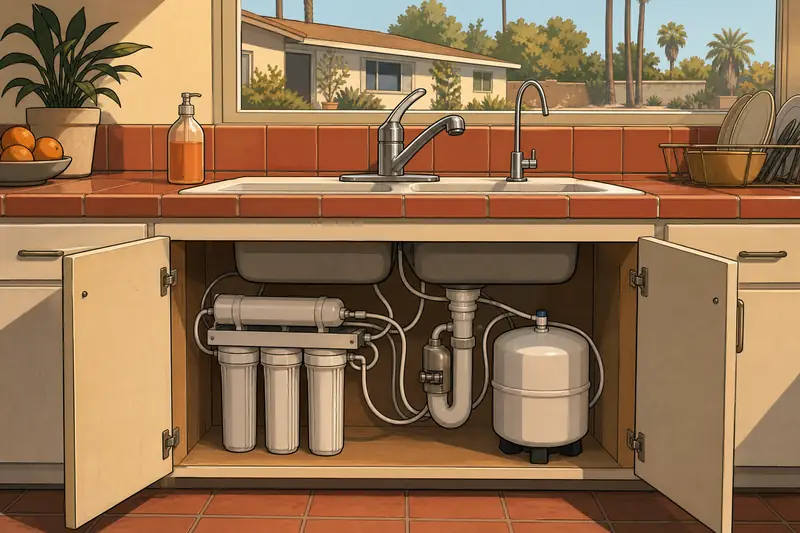
Those are optional comfort upgrades. Read your supplier's report first, decide whether the goal is the whole house or the kitchen tap, and use the contact-time arithmetic above when comparing tank sizes. A drinking-water-only goal may be better met by an under-sink reverse osmosis system with a carbon stage.
Where this page comes from
This page is based on LADWP's water quality report for calendar 2025 (released July 2026), the matching 2025 reports from Burbank, Glendale and San Fernando, LADWP's water quality FAQ and at-home pages, the Water Quality Association's chloramine (2014) and granular activated carbon (2016) technical sheets, NSF's NSF/ANSI 42 chloramine reduction listing and the State Water Board's device registration pages, all read in October 2026. Shop prices are the listed prices checked October 26, 2026. Left out: health claims about chloramine, removal percentages, and any filter lifespan in months, because no certified figure exists for the whole-house tanks.
Still asking
Is chloramine a reason to filter drinking water?
For most people it is a taste and odor question. WQA's technical sheet says chloramines are not generally a drinking water health concern for people, and LADWP's FAQ says the water it delivers does not need more treatment; the exceptions are dialysis and fish.
Will a refrigerator filter handle chloramine?
Only if that exact cartridge is listed for chloramine reduction under NSF/ANSI 42. Some refrigerator filters appear on NSF's chloramine list; many others carry a chlorine claim only.
What flow should a whole-house chloramine tank handle?
Add up what runs at once. California caps showerheads at 1.8 gpm and bathroom faucets at 1.2 gpm, so two showers and a faucet already reach 4.8 gpm. By WQA's arithmetic, a 1.5 cubic foot tank at that flow gives the water a little over 2 minutes of contact.
Does a chloramine filter change the water's pH or hardness?
Carbon does not soften water, so hardness stays the same. WQA notes the reaction produces small amounts of ammonia and chloride, which are not hardness minerals.
Is a shower filter enough for chloramine?
WQA's carbon sheet says a 10-inch cartridge at 0.5 gpm gives about 25 seconds of contact, and a shower runs up to 1.8 gpm. Unless a shower filter is certified for chloramine reduction at shower flow, expect little effect.
Should a Glendale home size a filter differently from an LADWP home?
Glendale's residual averaged 1.25 ppm in 2025 against LADWP's 1.7 mg/L, and Glendale uses both chlorine and chloramine. Size for chloramine either way, since parts of the system carry it.
How can you tell when a whole-house carbon tank is spent?
Test total chlorine at the first tap after the tank and compare it with a sample from a hose bib before the tank. When the two readings move close together, the carbon is no longer doing its job.
That is the end of this page. Back to all five Shutoff Valley folders.