Galvanized Pipes in Older Valley Homes
Galvanized pipes in older Valley homes rust from the inside: LADWP says the steel swells as it corrodes and sheds scale, and that replacing the pipe is the only permanent cure for rusty water.
Call sheet: what this page covers
Before you scroll
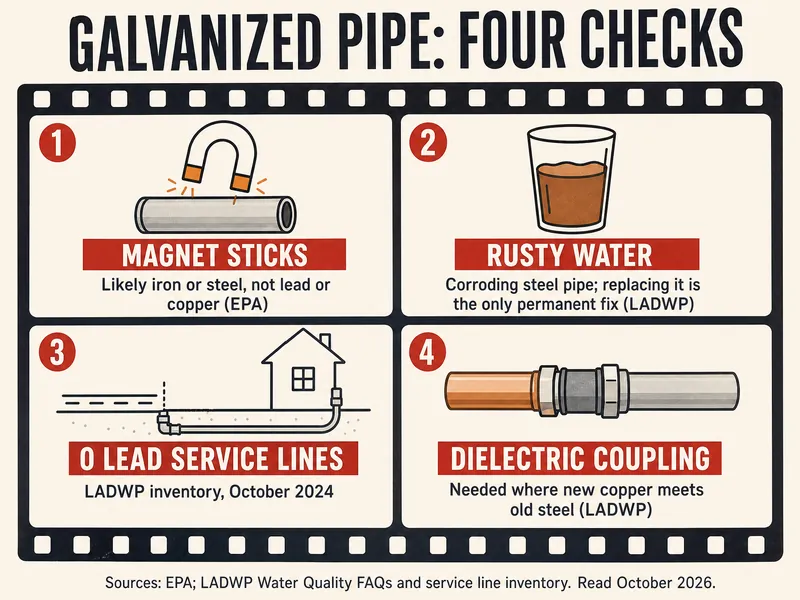
- A magnet sticks to galvanized steel but not to lead or copper, and copper scratches yellow-orange, according to EPA researchers.
- LADWP's FAQ says galvanized pipes "will corrode over time" and swell inside, which breaks loose mineral scale that clogs screens.
- LADWP found no lead service lines and no "galvanized requiring replacement" lines, customer-owned ones included, in its October 2024 inventory.
- EPA warns that lead particles can attach to galvanized pipe that once sat downstream of a lead line, the reason EPA's rule treats such pipe as needing replacement.
- Joining new copper straight to old steel can make the steel rust faster; LADWP calls for a dielectric coupling between them.
- The 2025 California Plumbing Code still lists galvanized steel (ASTM A53) for water piping, next to copper, CPVC, PEX and PE-RT.
How do you tell if your house has galvanized pipes?
Find a bare stretch of supply pipe, put a magnet on it and scratch it lightly with a coin: if the magnet sticks and the scratch shows silver, it is galvanized steel. EPA researchers describe the test for service lines: copper scratches "yellow orange," lead and galvanized iron both scratch shiny silver, and "if the magnet sticks to the pipe, it's likely iron and not lead" (EPA).
Good places to look are where the line comes out of the ground at the house, the pipes above the water heater, and under sinks. Galvanized joints are threaded, with a visible ring where pipe screws into fitting, while copper is soldered and PEX is clamped or crimped. Many Valley houses have a mix, with galvanized left in one wing after a past repair.
What goes wrong with old galvanized pipes?
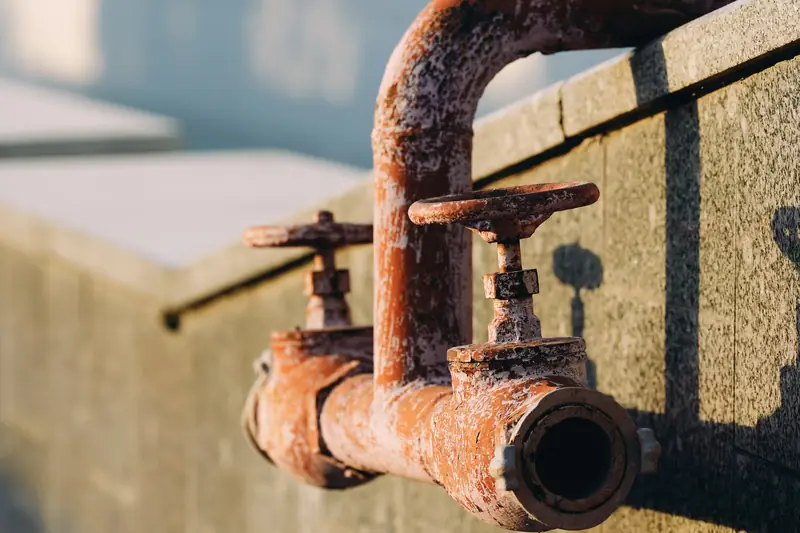
Old galvanized pipes rust from the inside, narrowing the bore and releasing rust and scale. LADWP's water quality FAQ puts it plainly: galvanized steel pipes "will corrode over time. As they corrode, they swell up on the inside causing these built-up minerals to flake off." The flakes are often mistaken for sand and clog washing machine inlet screens and showerheads.
The second sign is brown, red, orange or yellow water. LADWP says this water "is not a health concern," but it shows the pipes are corroding, and they "can eventually begin leaking." To tell a street problem from a house problem, LADWP suggests filling a white container at the front hose bibb near the main shutoff: if that water is clear and the indoor taps are not, the cause is inside.
Valley water chemistry plays a part in how much scale lines the pipe. LADWP's Valley sources averaged about 103-140 mg/L (6-8 gpg) of hardness in 2025, while Burbank Water and Power's 2025 report printed 286 mg/L (16.7 gpg). LADWP also warns that if you add a water softener, "the softer water can begin to re-dissolve the minerals on the pipes," so a burst of flakes after a softener goes in is not unusual. The hardness page has every supplier's figure.
Can galvanized pipes hold lead?
Galvanized pipes can hold lead only if lead reached them, and in LADWP's system the usual source is absent. EPA's lead infographic explains that "lead particles can attach to the surface of galvanized pipes" and later enter drinking water. Under EPA's Lead and Copper Rule Improvements, a galvanized line counts as "requiring replacement" if it is, or ever was, downstream of a lead service line.
LADWP finished its service line inventory in October 2024 and found "no lead service lines or galvanized pipes requiring replacement service lines," including privately owned ones (LADWP water quality page). Burbank Water and Power's 2025 report also says it has no lead service lines. Lead at a tap in a Valley home is more likely to come from pre-1986 solder or older brass fixtures.
If you want a number for your own tap, a certified lab test is the way to get one; LADWP's 2023 tap sampling found a 90th percentile of 3.9 ppb against the 15 ppb action level. The lead page and home testing page cover both.
Do insurers and buyers care about galvanized pipes?
Insurers and buyers do ask about galvanized pipes, but this site found no California or Los Angeles rule that requires replacing galvanized supply pipe before a sale. Coverage turns on how damage happens: the California Department of Insurance lists "sudden & accidental water damage" among perils typically covered and "water damage cause by seepage or leaks," "wear and tear or maintenance" and "neglect" among those generally excluded. Ask your own carrier how it treats older steel piping.
A sale in Los Angeles does trigger other plumbing items. The seller certifies that the water heater is braced (Health and Safety Code §19211), a seismic or excess-flow gas valve is required before sale under LAMC 94.1216, and noncompliant toilets, showerheads and faucets must be disclosed. The water heater strap page and seismic gas valve page explain each.
Can you replace galvanized pipes in sections?
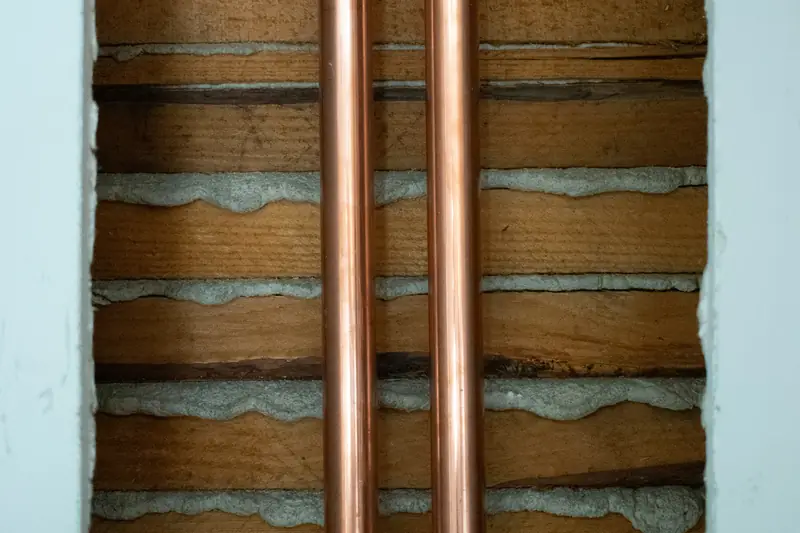
You can replace galvanized pipe in sections, but LADWP cautions that partial replacement "can improve the problem, or it can actually make it worse." When new copper is joined directly to old steel, "the copper can cause the steel to rust even more than before," which a dielectric coupling between the two metals avoids.
In Los Angeles, replacing plumbing needs a permit under LAMC 94.103.1.1. On a detached single-family home, a certified licensed contractor may replace "defective domestic water piping within the dwelling" with pipe of equal size and quality and file a Certificate of Compliance instead (LAMC 94.103.1.2.12). Repairing a leak needs no permit when it does not require removing fixtures or any part of the drainage system (LAMC 94.103.1.2.3). Section-by-section work makes sense when one run is failing and the rest tests sound; when rust shows at taps all over the house, most owners start pricing a full repipe.
What replaces galvanized pipes?
Copper and PEX replace most galvanized pipe in Valley homes, and the 2025 California Plumbing Code's Table 604.1 also allows CPVC, PE-RT, stainless steel and galvanized steel itself. Copper water piping must be at least Type L, with thinner Type M allowed aboveground in a building (§604.3). Buried PEX needs a sleeve, and §604.13 keeps PEX out of the 18 inches of pipe nearest a water heater.
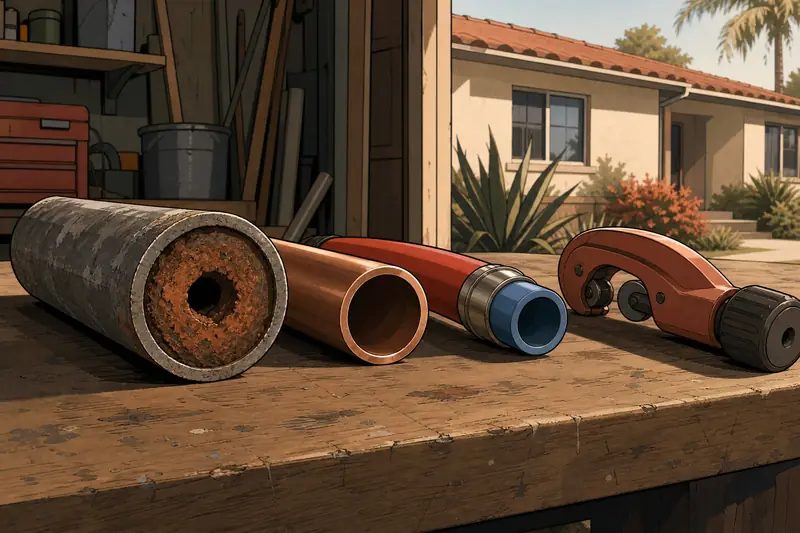
The trade-offs between the two main choices, including chloramine and quake questions, are on the copper vs PEX page.
Galvanized pipe facts with sources
- 0lead service lines found by LADWP, customer-owned lines included (October 2024)LADWP Water Quality page
- 3.9 ppbLADWP lead at the tap, 90th percentile, 2023 sampling (action level 15)LADWP 2025 Drinking Water Quality Report, p.12
- 286 mg/Lhardness of Burbank tap water, 2025 average, about 16.7 gpgBWP annual report on 2025 data
- Type Lthinnest copper allowed for most water piping2025 California Plumbing Code §604.3
| Material | Magnet | Scratch color | Other clue | Allowed for new water piping? |
|---|---|---|---|---|
| Galvanized steel | Sticks | Shiny silver | Threaded | Yes (ASTM A53) |
| Copper | Does not stick | Yellow-orange | Soldered or pressed | Yes, Type L minimum |
| Lead | Does not stick | Shiny silver | Dull, soft metal | No (lead-free rule, §604.2) |
| PEX | Does not stick | Plastic, no metal | Crimp, clamp or expansion rings | Yes (ASTM F876) |
Where this page comes from
Based on LADWP's Water Quality FAQs and service line inventory statement, LADWP's 2025 Drinking Water Quality Report (published July 2026), Burbank Water and Power's 2025 report, EPA's lead infographic (2017), EPA's LCRI service line summary (October 2024), EPA researchers' scratch-and-magnet description, the 2025 California Plumbing Code, the Los Angeles Municipal Code (Ordinance 188,797) and the California Department of Insurance homeowners guide, all read in October 2026. Left out: any lifespan in years for galvanized pipe, repair or repiping prices, and insurer-specific underwriting rules: no primary source covered them.
Still asking
Is rusty water from galvanized pipes safe to drink?
LADWP says rust-colored water from home plumbing "is not a health concern," though it is unpleasant and shows the pipes are corroding. Run cold water until it clears and look at where the rust starts.
Should you run hot water when the water looks rusty?
No. LADWP advises against using hot water while water is discolored, because it draws rusty water into the water heater tank, which may then need flushing. Run cold water until it clears.
Can a water softener clean out galvanized pipe?
LADWP says softer water can re-dissolve mineral deposits on pipe walls and loosen flakes. That can release scale, but it does not undo rust, and the steel keeps corroding.
Does a magnet test work on painted pipe?
A magnet still sticks to painted steel, but a scratch test needs bare metal, so scratch a small spot on the pipe itself. EPA notes the scratch test alone cannot separate lead from galvanized iron.
Is galvanized pipe still legal in California?
Yes. The 2025 California Plumbing Code still lists galvanized steel to ASTM A53 for water distribution, though copper and PEX are what most repipes use.
Will a buyer's inspector flag galvanized pipe?
Inspectors usually note the material, and buyers and insurers may ask about it. No state or Los Angeles rule requiring replacement at sale was found.
That is the end of this page. Back to the Shutoff Valley front page.