Seismic Gas Shutoff Valves in Los Angeles
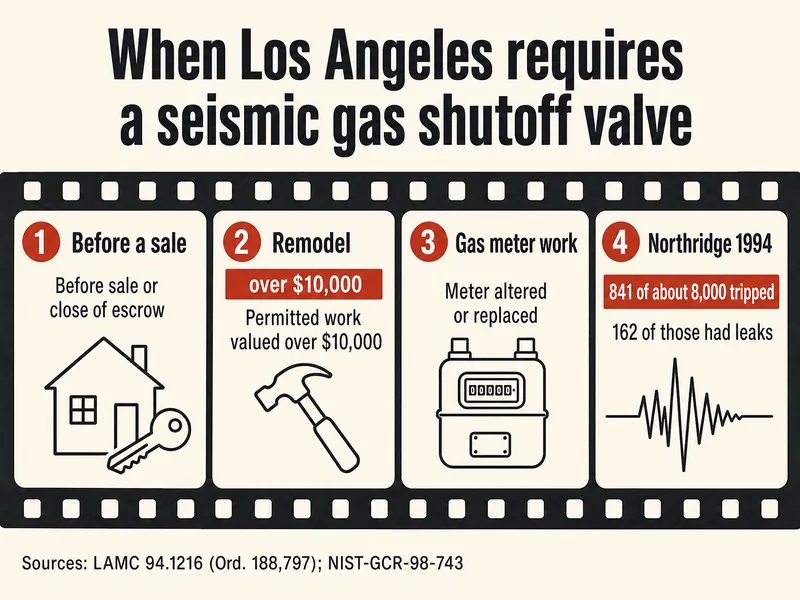
Seismic gas shutoff valves are required in Los Angeles before a home is sold, for permitted residential work valued over $10,000, and when the gas meter is altered or replaced, under LAMC 94.1216.
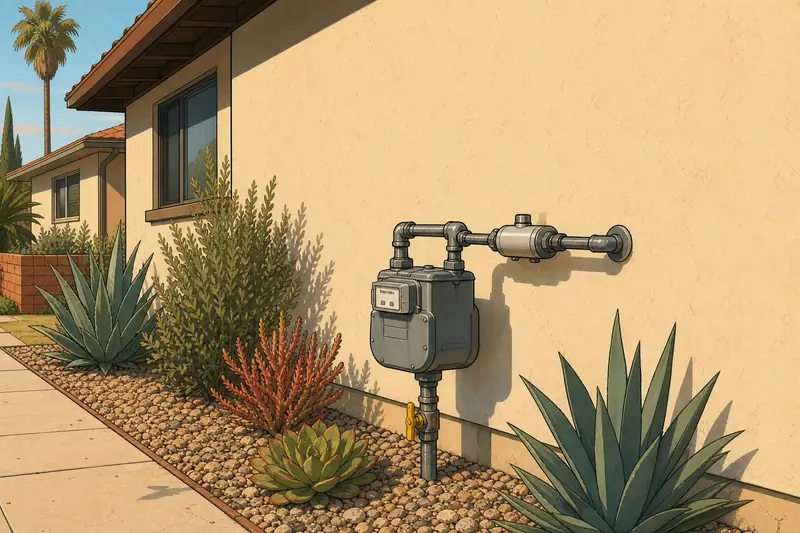
Call sheet: what this page covers
Before you scroll
- LAMC 94.1216, added by Ordinance 188,797 and effective December 31, 2025, is the current rule; older LADBS papers cite it as 94.1217.
- Either a seismic valve or an excess flow valve satisfies the code, installed downstream of the gas meter on each fuel gas line.
- The valve must be certified by the State Architect, approved by LADBS's Mechanical Testing Laboratory and carry a 30-year warranty (LAMC 94.1216.3).
- SoCalGas will not install one, and any valve found on its own pipe and fittings is removed, under CPUC Decision 01-11-068 (effective February 10, 2002).
- In the 1994 Northridge earthquake about 841 of roughly 8,000 seismic valves in the region tripped, and 162 of those were at sites with leaks (NIST-GCR-98-743).
- No Burbank or Glendale ordinance requiring these valves was found; ask your building department.
A seismic gas shutoff valve is a small device on the house gas line that closes by itself when strong shaking hits, so a broken appliance connector cannot keep feeding gas into a damaged house. In the City of Los Angeles it is also a box to tick at sale and during bigger remodels.
When does Los Angeles require seismic gas shutoff valves?
Los Angeles requires a seismic gas shutoff valve or an excess flow valve in four cases, all spelled out in LAMC 94.1216.2. The first is any building with gas piping whose permit was first issued on or after September 1, 1995. The second is an existing home where an alteration or addition is valued at more than $10,000 and the residential permit was first issued on or after January 10, 1998.
The third is any work on the fuel gas piping that alters or replaces the gas meter. The fourth catches most owners: the code requires a valve "prior to entering into an agreement of sale, or prior to the close of escrow," and a condo sale needs one for the gas piping serving that unit. Valves installed before September 1, 1995 are exempt as long as they are maintained.
Gas valve numbers
- $10,000value of permitted residential work above which LA requires a valveLAMC 94.1216.2
- 30 yearswarranty an approved valve must carry in Los AngelesLAMC 94.1216.3.5
- 841of about 8,000 regional seismic valves tripped in the 1994 Northridge quakeNIST-GCR-98-743
- 151,000gas customers lost service after Northridge, 81 percent by their own shutoffNIST-GCR-98-743
How does a seismic gas valve work?
A seismic gas valve pairs a motion sensor with a shutoff, and the code defines it as a system that closes the gas "in the event of a severe seismic disturbance." Once it closes, it stays closed until someone resets it, which is why state law cares about how the reset works.
State law puts guardrails on the device itself. The Health and Safety Code requires every new seismic gas shutoff device sold in California to be certified by the State Architect before sale (§ 19203) and to allow "ease of consumer or owner resetting" (§ 19202). LA adds that the valve be mounted rigidly to the exterior and meet California Referenced Standard 12-16-1.
What is an excess flow valve?
An excess flow valve closes on flow, not motion: LAMC 94.1216.1 defines it as a shutoff "activated by significant gas leaks or overpressure surges downstream of the valves." It meets the same LA requirement as a seismic valve and follows its own state standard, 12-16-2.
Do not confuse it with the utility's excess flow valve. SoCalGas fits its own EFV on the underground service line, and its safety page says that device will not protect against appliance malfunctions, small punctures or "pipeline damage from earthquakes," and does not stop the gas completely. A house-side valve is a separate, owner-paid part.
| Device | Where it sits | What closes it | Who resets or reopens it |
|---|---|---|---|
| Seismic gas shutoff valve | House line, downstream of the meter | Strong shaking | Owner per maker's instructions; SoCalGas suggests a professional |
| Excess flow valve (house side) | House line, downstream of the meter | A large leak or pressure surge | Owner per maker's instructions or a professional |
| Utility EFV | SoCalGas service line underground | Line damage or a big jump in flow | SoCalGas only |
| Meter service valve | Riser 6 to 8 inches above ground | A wrench, by hand, only for a leak | SoCalGas only |
Who can install a seismic gas valve?
In Los Angeles a contractor licensed in the right class installs it, with one exception: an owner who qualifies as a "Qualified Installer" may install one on the single-family home they live in (LAMC 94.1216.3.1 and 94.219). The CSLB's C-36 plumbing classification lists gas earthquake valves among the devices plumbers install and maintain.
The installation needs an LA building permit and an inspection, according to LADBS Information Bulletin P/GI 2023-002. Placement is the other rule that trips people up. Under Health and Safety Code § 19201, customer-owned piping starts downstream of the meter and its service tee, and SoCalGas's page on earthquake and excess-flow valves says its facilities run up to the last elbow or tee before your house line. Valves are also barred from curb meter vaults.
How is a tripped valve reset?
A tripped seismic valve can be reset by following the maker's instructions, but SoCalGas recommends having a qualified professional or SoCalGas reset it, check the appliances and relight the pilots. The reason is what happens downstream: every pilot light went out when the gas stopped, and a leak the shaking caused is still there when the gas comes back.
Expect to wait. SoCalGas warns that after a major emergency it may take "many days or even weeks" for someone to arrive, and that it charges a fee when a valve tripped for a reason other than an earthquake Never turn the meter's own service valve back on yourself; under CPUC General Order 112-E only SoCalGas or its certified contractors may operate it. The after-the-shaking checklist covers what to look for before calling.
What about Burbank and Glendale?
No seismic gas valve ordinance for Burbank or Glendale was found in the municipal code pages read for this site, so do not assume a sale there triggers one; ask the city's building department and your escrow officer. State law lets cities pass such rules (H&SC §§ 19180-19183), and SoCalGas notes that some insurance companies require a valve too.
The safety advice is the same everywhere in the Valley. Glendale's fire department says to shut off the main gas valve only if you suspect a leak and to wait for the gas company to turn it back on. A strapped water heater with a flexible gas connector does as much as any valve; see water heater straps and the quake-ready plumbing overview.
Where this page comes from
Based on LAMC 94.1216 and 94.219 (Ordinance 188,797, effective December 31, 2025) read on amlegal, Health and Safety Code §§ 19180-19183 and 19200-19204 on leginfo, the CSLB C-36 classification, NIST-GCR-98-743 (1998) on Northridge fires and gas, the Glendale Fire Department's earthquake page, and two SoCalGas safety pages, all read in October 2026. LADBS Information Bulletin P/GI 2023-002 was read from an archived copy because the live LADBS site blocks automated reading; its wording may since have changed. Left out: valve brands, prices and LADBS permit fees, which could not be read.
Still asking
Does a seismic gas valve have to be on the outside of the house?
In Los Angeles, yes in most cases: LAMC 94.1216.3.2 says it must be mounted rigidly to the exterior of the building or another approved location. It sits on the house piping just past the meter, never on SoCalGas's fittings.
Will a sale fall through without a seismic gas valve?
The LA code makes the valve a condition before an agreement of sale or close of escrow, so plan it before listing. State law separately asks sellers to certify in writing that the water heater is braced (Health and Safety Code § 19211).
Can an old seismic valve from the 1990s still count?
Valves installed before September 1, 1995 are exempt under LAMC 94.1216 as long as they are maintained. A valve installed later must meet the current certification and warranty rules.
Does every gas line need its own valve?
The LA code says the valve goes downstream of the gas utility meter on each fuel gas line. Most houses have one line from one meter, so one valve covers the whole house.
Will an aftershock trip the valve again?
It can. Once reset, a seismic valve trips whenever shaking passes its set level, so a strong aftershock can close it again.
Is an excess flow valve cheaper or easier than a seismic valve?
LA accepts either one, and both must be State Architect certified with a 30-year warranty. Which suits a house depends on its gas load and layout, so ask the installer to explain the choice; no price figures from a primary source were found.
Can I shut the gas off at the meter instead of installing a valve?
You can shut it off in an emergency with a 12-inch or larger wrench, a quarter turn until the valve sits crosswise to the pipe, but only if you smell or hear gas. It does not satisfy LA's code, and only SoCalGas may turn it back on.
That is the end of this page. Back to the full list of Valley water and plumbing pages.