San Fernando Valley Water Hardness by Supplier
San Fernando Valley water hardness ran from about 103-140 mg/L (6-8 gpg) on LADWP water to 286 mg/L in Burbank and 350 mg/L at Glendale's groundwater plant in 2025.
About the shop links on this page: Shutoff Valley shares its owners with SoftPro Water Systems and Quality Water Treatment, the two water-treatment shops linked on this page. What a shop says about its own products is labeled as the shop's claim. How shop links work here
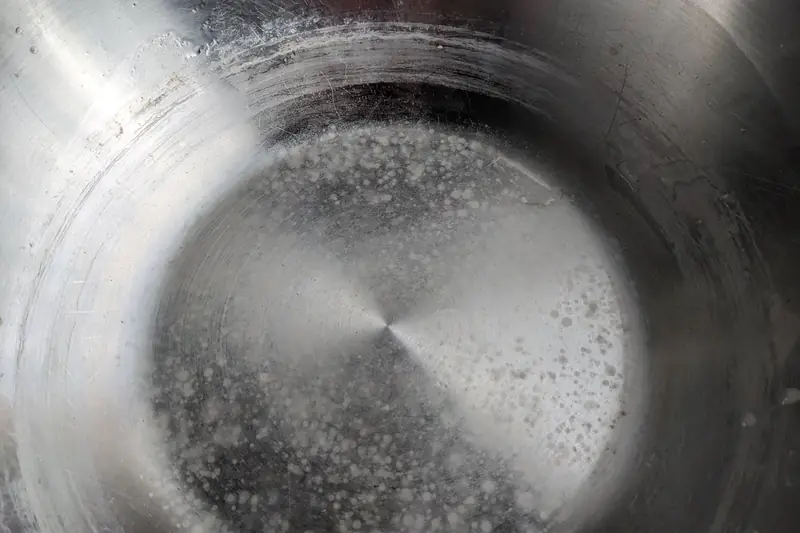
Call sheet: what this page covers
Before you scroll
- LADWP's three Valley sources averaged 103, 115 and 140 mg/L in 2025, per Table III of its 2025 Drinking Water Quality Report.
- Burbank's blended water averaged 286 mg/L, printed as 16.7 gpg, with a 2025 range of 148-300 mg/L.
- Glendale prints no single figure: its groundwater plant measured 350 mg/L and its MWD Weymouth water averaged 234 mg/L.
- San Fernando's city water measured 190 mg/L in 2025, roughly 11.1 gpg.
- The USGS calls anything over 180 mg/L very hard, and says hardness is not a health concern but can be a nuisance.
- Rinnai's tankless manual calls for treatment above 200 mg/L and a yearly flush from 61 mg/L up.
Hardness is the dissolved calcium and magnesium in water, reported "as calcium carbonate". It does not make water unsafe; it decides how fast scale builds on faucets, shower glass, kettles and water heaters. The number that matters to you is your own supplier's, so each one is listed below from its 2026 report on 2025 data.
How hard is LADWP's San Fernando Valley water?
LADWP water in the Valley is moderately hard to hard: about 103-140 mg/L (6-8 gpg) in 2025, depending on the source. LADWP's report says three of its table columns apply to the Valley, and Table III gives each one's hardness: the LA Aqueduct Filtration Plant averaged 103 mg/L (range 96-117), the Northern Combined Wells 115 mg/L (78-151), and MWD water from the Jensen plant 140 mg/L (137-142).
Which of these reaches your house shifts with LADWP's supply mix, so think of your water as somewhere in that band rather than one fixed number. LADWP's own water quality FAQ rates water under 4 gpg soft, 4-7 gpg medium-hard and over 7 gpg hard. That FAQ's older table, from 2022, gave the Valley and Western LA an average of 8.6 gpg (147 mg/L); treat it as history rather than mixing it with the 2025 figures.
Why is Burbank and Glendale water so much harder?
Burbank and Glendale lean more on groundwater and on harder MWD supplies, and groundwater picks up minerals as it moves through soil and rock, as the USGS explains. Burbank Water and Power's 2025 water quality report (2025 data, published June 2026) prints the average of its blend of MWD water and groundwater treated at the Burbank Operable Unit: 286 mg/L, or 16.7 gpg.
Glendale's 2025 water was 31.3% San Fernando Basin groundwater, according to its 2025 water quality report. Its treatment plant measured 350 mg/L (about 20.5 gpg), while the MWD water it buys averaged 234 mg/L from the Weymouth plant and 140 mg/L from Jensen. Glendale prints no blended figure, so the water at any one Glendale home falls somewhere among these numbers. The City of San Fernando pumps the Sylmar Basin and reported 190 mg/L. More on how each supplier mixes its sources is on where Valley water comes from.
How do mg/L and grains per gallon compare?
One grain per gallon equals 17.1 mg/L, so divide mg/L by 17.1 to get gpg. Water reports print hardness in mg/L or ppm (the same thing at these levels), while softener makers and test kits usually use gpg. Glendale's report gives the same rule in a footnote.
Some worked examples: LADWP's 103 mg/L is about 6.0 gpg, Jensen's 140 mg/L about 8.2 gpg, the City of San Fernando's figure works out near 11.1 gpg, and Glendale's plant water at 350 mg/L about 20.5 gpg. Burbank prints 16.7 gpg itself. The USGS scale runs soft at 0-60 mg/L, moderately hard at 61-120, hard at 121-180 and very hard over 180.
What does hard water do to fixtures and heaters?
Hard water leaves scale wherever water is heated or evaporates. The USGS notes that heating hard water forms calcium carbonate deposits that can shorten equipment life, lower the efficiency of electric water heaters and clog pipes, and leave spots on dishes. Glendale's report says the white, chalky residue on fixtures comes from hardness and that mild vinegar removes fresh deposits.
Water heater makers build hardness into their maintenance advice. A. O. Smith lists a yearly tank flush and suggests service twice a year on hard water. Rinnai's SENSEI RX manual says water from 61 mg/L should be treated and the heater flushed once a year, and above 200 mg/L treatment is required. See water heater life in hard water and descaling a tankless heater.
Does Valley water hardness change through the year?
It can, because suppliers blend sources in different proportions over time, but the reports print yearly averages and ranges rather than monthly figures. Burbank's 2025 range of 148-300 mg/L shows how far one blend can swing. LADWP's Northern Combined Wells ranged from 78 to 151 mg/L.
LADWP also says most areas of the City can receive any of its supplies during repairs, maintenance or emergencies. If your kettle scales faster one season than another, a home hardness test is the simplest way to see your own number; testing tap water at home covers drop-test kits.
When is Valley water hardness high enough to treat?
There is no rule; it is a comfort and maintenance choice, and the City of San Fernando's report calls hardness "a quality issue, not a safety concern". On LADWP water at 6-8 gpg, many households manage scale with cleaning and regular heater flushing. On Burbank, San Fernando or Glendale water at 11-20 gpg, scale builds faster, and Rinnai's 200 mg/L line is crossed in Burbank and at Glendale's plant.
Options include a salt-based softener, a salt-free conditioner that reduces scale but leaves the minerals in, or simply more frequent descaling. LADWP's FAQ notes that softened water is more corrosive to plumbing, and A. O. Smith's manual warns that artificially softened water can shorten tank life, so anode checks matter more. No rule restricting softeners in the San Fernando Valley was found on the sewer agency and city pages read in October 2026; check with your city before installing. Read do you need a softener, softener sizing and whether softeners are allowed before buying.
If you do choose a salt softener, the SoftPro shops list city-water models in 32,000, 48,000 and 64,000 grain sizes: the ECO City softener (sold by SoftPro Water Systems, which shares owners with this site) at $967-2,677 and the Elite HE softener for city water (sold by Quality Water Treatment, which shares owners with this site) at $1,367-2,827, the shops' listed prices in October 2026.
Valley hardness, 2025 data
- 103 mg/LAqueduct filtration plant water, LADWP (about 6.0 gpg)LADWP Drinking Water Quality Report 2025, Table III
- 140 mg/LLADWP MWD Jensen water average (about 8.2 gpg)LADWP Drinking Water Quality Report 2025, Table III
- 286 mg/LBurbank blended water, printed as 16.7 gpgBWP 2025 Annual Water Quality Report
- 350 mg/LGlendale Water Treatment Plant groundwaterGWP 2025 Water Quality Report, p.15
- over 180 mg/LVery hard on the USGS scaleUSGS Water Science School
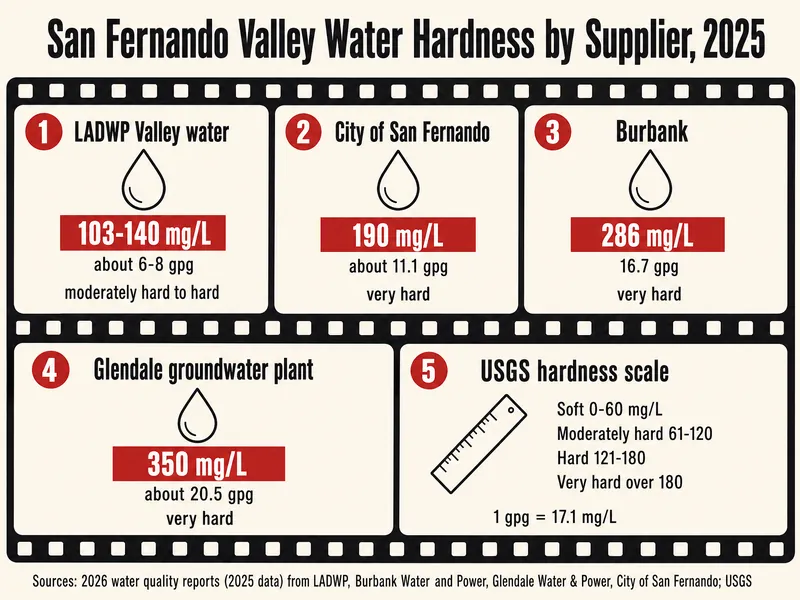
| Supplier and source | Average | Range | gpg | USGS class |
|---|---|---|---|---|
| LADWP, aqueduct filtration plant (Sylmar) | 103 mg/L | 96-117 | about 6.0 | moderately hard |
| LADWP, Northern Combined Wells | 115 mg/L | 78-151 | about 6.7 | moderately hard |
| LADWP, MWD Jensen water | 140 mg/L | 137-142 | about 8.2 | hard |
| San Fernando (city wells) | 190 mg/L | single value | about 11.1 | very hard |
| Glendale, MWD Weymouth water | 234 mg/L | 189-280 | about 13.7 | very hard |
| Burbank Water and Power, blended | 286 mg/L | 148-300 | 16.7 (printed) | very hard |
| Glendale Water Treatment Plant | 350 mg/L | single value | about 20.5 | very hard |
Where this page comes from
Figures come from the 2026 water quality reports (calendar 2025 data) of LADWP (Table III), BWP, GWP (p.15) and San Fernando, LADWP's water quality FAQ, the USGS Water Science School page on hardness, A. O. Smith's maintenance guide and manual, and Rinnai's SENSEI RX manual, read in October 2026. The gpg figures marked "about" are calculated as mg/L divided by 17.1. Store prices are the shops' listed prices in October 2026. Not included: installed prices, savings estimates and any claim that hardness or softening affects health, since no primary source backs them.
Still asking
What is the hardness of LADWP water in Van Nuys or Northridge?
LADWP does not publish hardness by neighborhood. Its Valley columns sat between 103 and 140 mg/L in 2025, which is 6 to 8 gpg, and the source reaching your street can change with the supply mix.
Is Burbank tap water hard?
Yes. Burbank Water and Power's 2025 blend averaged 286 mg/L (16.7 gpg), which is very hard on the USGS scale, with a range of 148-300 mg/L.
What is Glendale's water hardness in gpg?
It depends on the source: about 20.5 gpg for water from the Glendale Water Treatment Plant, about 13.7 gpg for MWD Weymouth water and about 8.2 gpg for Jensen water.
Do tankless water heaters need treated water in the Valley?
Rinnai's SENSEI RX manual recommends treatment and a yearly flush from 61 mg/L of hardness, and requires treatment above 200 mg/L. Every Valley source in the 2025 reports is above 61 mg/L, and Burbank's blend and Glendale's plant water are above 200.
Can I measure my own hardness?
Yes. A drop-test kit or test strips give a gpg reading in minutes. A TDS meter measures total dissolved solids, which is not the same thing as hardness.
Does boiling water remove hardness?
The USGS notes that heating hard water forms calcium carbonate deposits, which is the chalky layer inside a kettle. That scale stays on the pot; it does nothing for the water in your pipes.
Is hard water bad for you?
The USGS says hardness is not a health concern but can be a nuisance. This site makes no health claims either way about hard or softened water.
That is the end of this page. Back to all five Shutoff Valley folders.