Folder 03 · 8 pages
Old Pipes and Leaks in Valley Homes
Old pipes and leaks in Valley homes come down to a few owner-side rules: LADWP's job ends at the meter, the sewer lateral is yours to the city main, and the code caps house pressure at 80 psi.
Before you scroll
- Every pipe past the meter is the owner's to maintain, under the LADWP water service guide.
- In Los Angeles the owner repairs the sewer lateral from the property line to the main in the street, tree roots included (LA Bureau of Engineering).
- The 2025 California Plumbing Code, in force since January 1, 2026, requires a pressure regulator where street pressure tops 80 psi (§608.2).
- An average household's leaks waste more than 9,300 gallons a year, and 9 percent of homes leak 50 gallons or more a day (EPA WaterSense).
- LADWP found no lead service lines, including customer-owned ones, in its October 2024 inventory.
This folder covers the pipes between the curb meter and the street sewer main: what they are made of, how they fail, and which rules apply when you fix them. Shutoff Valley is a reading site, not a plumbing company.
Which Valley homes have old pipes?
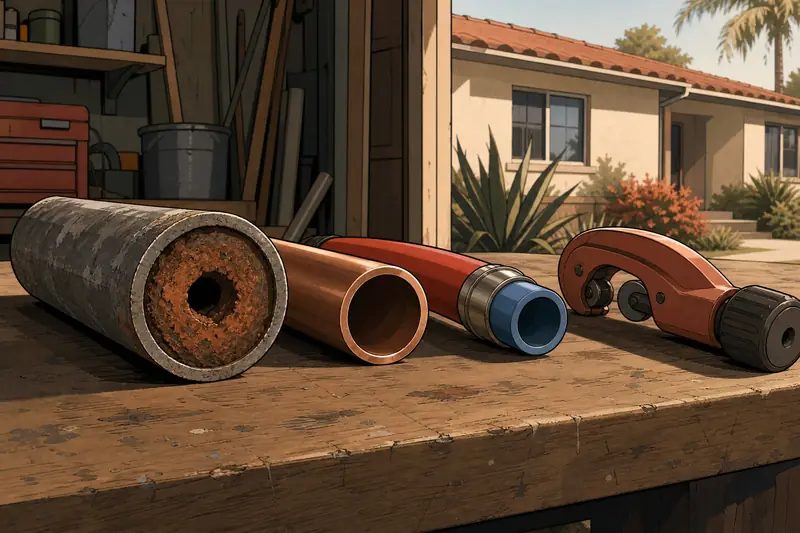
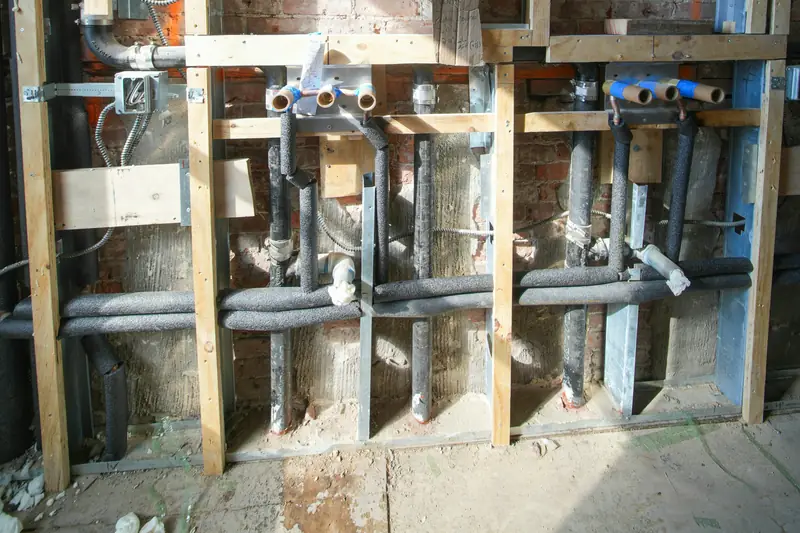
Any house still on its original supply piping can have old pipes, and the material tells you more than the age. Galvanized steel, copper and, since California approved it statewide in 2010, PEX all show up in Valley houses. The scratch-and-magnet test EPA describes sorts them in a minute: a magnet sticks to galvanized steel, and copper scratches yellow-orange.
LADWP's own lead and copper sampling targets single-family homes built between 1982 and 1987 with original plumbing, because they "are expected to have copper pipes plumbed with lead solder" (LADWP 2025 water quality report, p.12). EPA notes that solder made or installed before 1986 contained high lead levels, so houses plumbed before then are the ones to look at.
When is repiping old pipes worth it?
Repiping is worth pricing when leaks repeat, rusty water keeps coming back, or pressure drops at several fixtures at once. LADWP's FAQ says that for water discolored by rusty galvanized pipe "the only permanent solution is to replace them." One pinhole leak in copper is a repair; a pattern of them is the usual reason to compare whole-house bids.
A repipe in Los Angeles needs a plumbing permit, and only a licensed contractor in the right class, or an owner who qualifies under LAMC 94.219, may do the work. The CSLB C-36 classification covers water piping "from the property owner's side of the utility meter."
Why do leaks start under slabs?
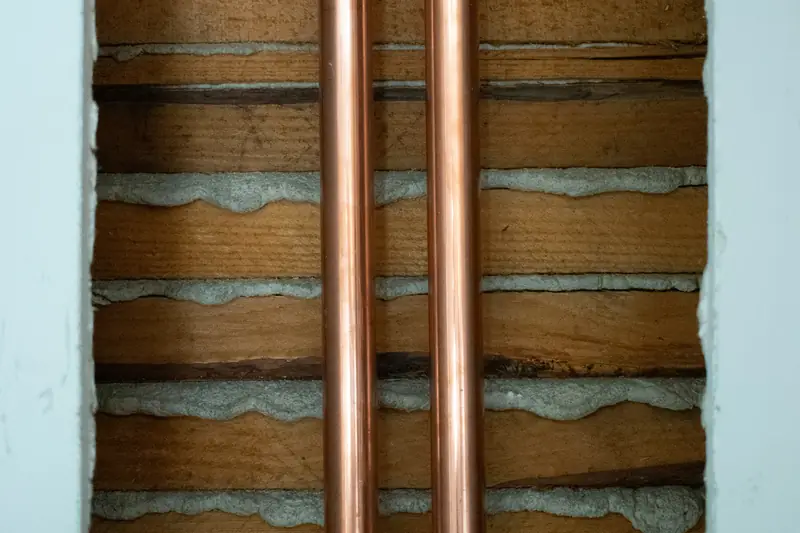
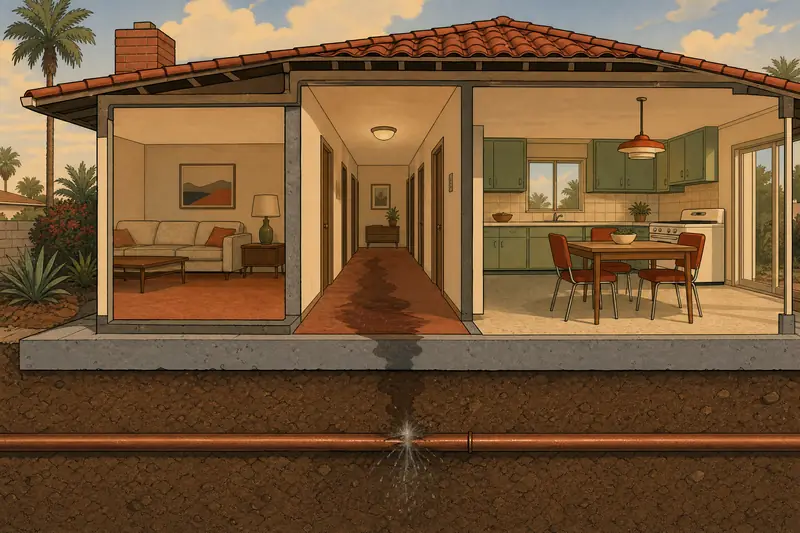
Most Valley ranch houses sit on concrete slabs, so supply lines often run under or through the floor where a leak stays hidden. The first clue is usually the water meter or the bill, not a puddle. EPA's test is simple: read the meter, use no water for two hours, and read it again; "if the meter changes at all, you probably have a leak."
The City of San Fernando's 2025 water quality report gives a shorter version: shut off every tap and appliance and check the meter after 15 minutes.
How high should water pressure be?
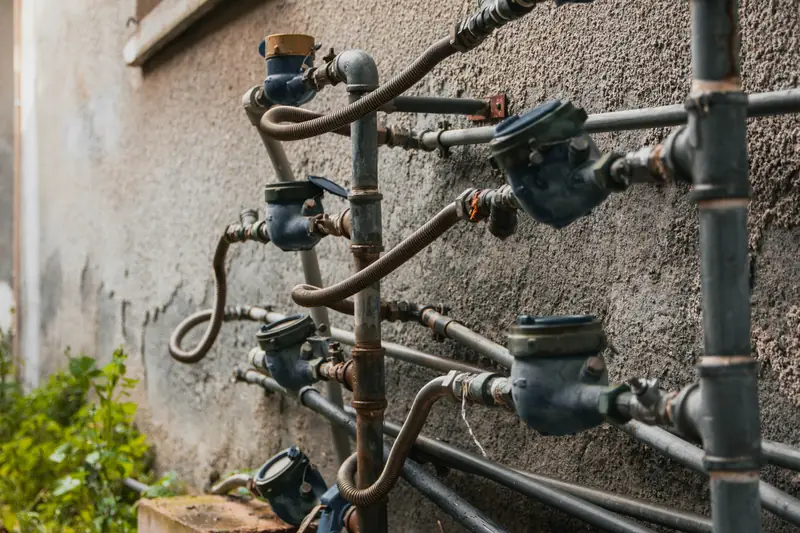
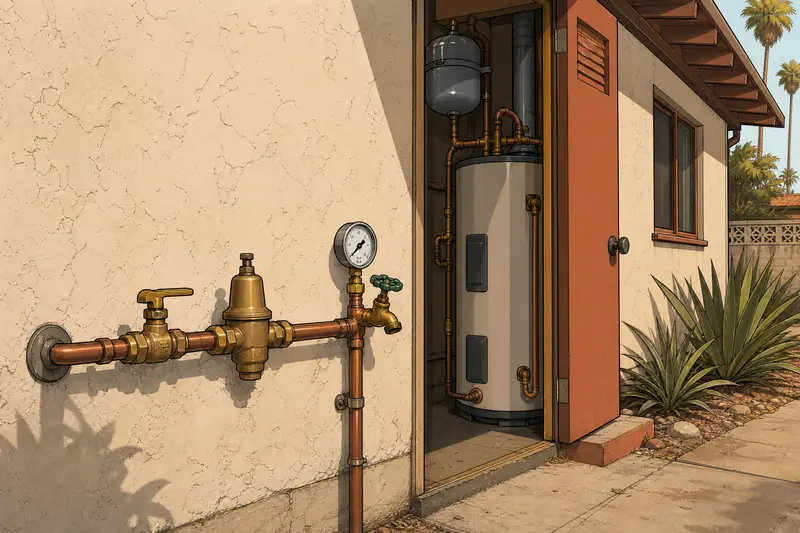
House water pressure should be 80 psi or less: the 2025 California Plumbing Code requires a regulator where static street pressure exceeds 80 psi (§608.2). LADWP's rules promise at least 25 psi at the service connection and publish no maximum, so the only way to know is to test at a hose bibb with a gauge.
A regulator closes the system, and §608.3 then requires an expansion tank (or an equivalent device) so heated water has somewhere to go. Pressure also comes up in pinhole-leak research: failure reports reviewed by Virginia Tech in 2006 linked pressure over 80 psi and fast flow to erosion corrosion in copper.
Who owns the sewer line?
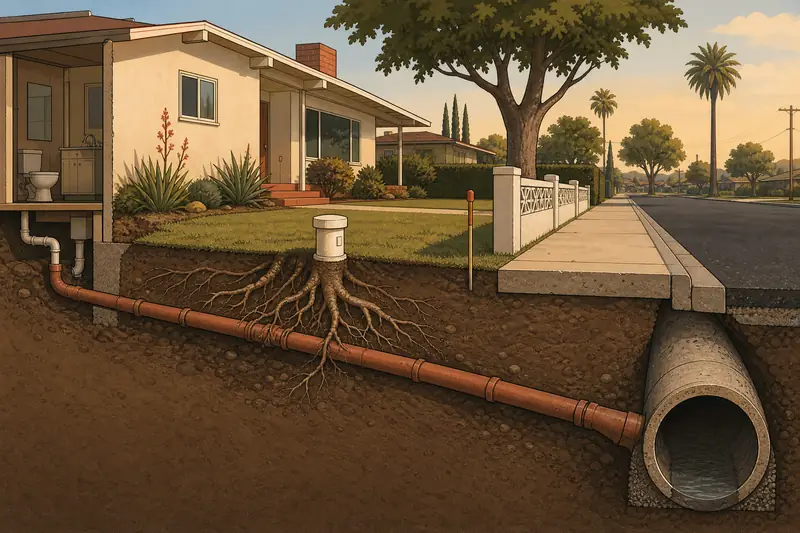
In Los Angeles the property owner is responsible for the whole house connection: the building sewer on the lot and the lateral from the property line to the mainline sewer. The LA Bureau of Engineering adds that laterals "obstructed by tree roots, whether on private property or within the public right-of-way are the responsibility of the property owner."
A backwater valve is required by CPC §710.1 where fixtures sit lower than the next upstream manhole cover.
Who pays for which pipe and leak?
The owner pays for almost everything past the meter, and the table below sets out where the utility's part stops.
Pipes and leaks by the numbers
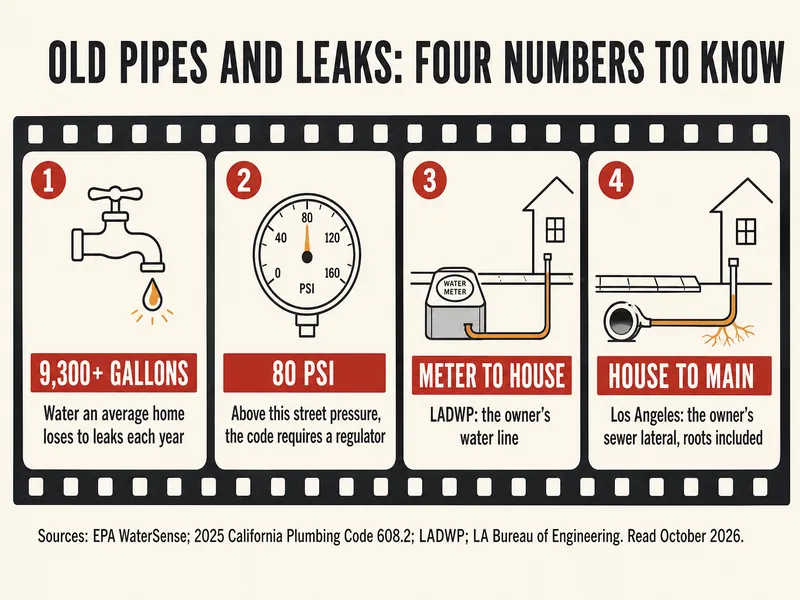
- 9,300+ galwater an average household loses to leaks each yearEPA WaterSense, Fix a Leak Week
- 80 psistreet pressure above which a regulator is required2025 California Plumbing Code §608.2
- 25 psiminimum pressure LADWP generally keeps at the service connectionLADWP Rules Governing Water and Electric Service
- 0lead service lines LADWP found in its October 2024 inventoryLADWP Water Quality page
- $1,000ceiling of the minor-work license exemption, for jobs needing no permitCalifornia B&P Code §7048
| Pipe or part | Who owns and repairs it | Source |
|---|---|---|
| Water main, service lateral, curb valve and meter | LADWP | LADWP design standards (2025) and water service guide |
| Line from the meter to the house, and the house shutoff | Property owner | LADWP water service guide |
| Supply piping inside the house | Property owner; permit for replacement | LAMC 94.103.1.1 |
| Building sewer on the lot | Property owner | LA Bureau of Engineering |
| Sewer lateral, property line to street main (roots included) | Property owner; Bonded Sewer Contractor for street work | LA Bureau of Engineering |
Burbank requires a permit even for plumbing "repair and maintenance," according to its building permits page. The quake folder covers the main shutoff, and the water folder covers what flows through the pipes.
Where this page comes from
This folder page draws on the 2025 California Plumbing Code (IAPMO epub, in force January 1, 2026), the Los Angeles Municipal Code on amlegal (Ordinance 188,797), LADWP's rules, design standards (2025), water service guide and 2025 water quality report (published July 2026), the LA Bureau of Engineering S-permit manual, EPA WaterSense, CSLB, and a 2006 Virginia Tech thesis on copper pinhole leaks, each read in October 2026. Not included: repair and repiping prices (no primary source), lifespans in years for any pipe material, and LA Sanitation lateral rebate amounts, which could not be confirmed.
Still asking
Does LADWP fix a leak between the meter and the house?
No. Its service guide makes the owner responsible for every pipe past the meter. LADWP owns the service line and curb valve on the street side of the meter.
Do Valley homes have lead pipes?
LADWP found no lead service lines, including customer-owned lines, in its October 2024 inventory. Lead at a tap can still come from older solder or brass fixtures inside the house, which the lead page explains.
Can a homeowner repipe their own house in Los Angeles?
Yes, in some cases. LAMC 94.219 lets an owner-occupant of a single-family home do plumbing under a permit, with residence and frequency limits that the repiping page spells out.
What pressure should a Valley house have?
No more than 80 psi under the plumbing code, and LADWP aims to deliver at least 25 psi. A hose-bibb gauge reading is the only way to know your own number.
Who clears tree roots in a Los Angeles sewer lateral?
The property owner, whether the roots are on the lot or under the public right-of-way, according to the LA Bureau of Engineering.
How much water does a dripping toilet or faucet waste in a year?
EPA WaterSense puts the average household's leaks at more than 9,300 gallons a year. The leak-finding page walks through the meter and dye tests that find most of them.
That is the end of this page. Back to the full list of Valley water and plumbing pages.