Pinhole Leaks in Copper Pipes
Pinhole leaks in copper pipes have no single proven cause: researchers study water chemistry, pressure, flow speed, heat and installation, and a 2006 Virginia Tech review found no accepted theory or preventive measure.
Call sheet: what this page covers
Before you scroll
- A 2006 Virginia Tech thesis found that, for lack of "a single acceptable mechanistic theory," no preventive measure for copper pinhole leaks was available (Farooqi, Virginia Tech).
- In that study's weighted count of reported leaks, California ranked among the top five states, with Maryland, Ohio, Florida and Pennsylvania.
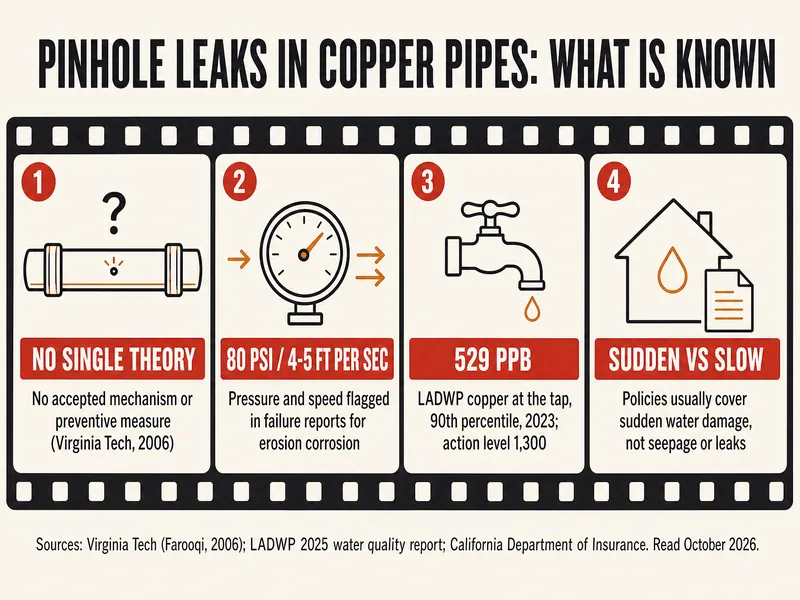
- Failure reports it reviewed tie erosion corrosion to pressure over 80 psi, flow over 4 to 5 feet per second and hot water above 160°F.
- California's 2025 Plumbing Code requires a pressure regulator where street pressure exceeds 80 psi (§608.2).
- Copper at LADWP taps measured 529 ppb at the 90th percentile in 2023, under the 1,300 ppb action level.
- The California Department of Insurance lists "sudden & accidental water damage" as typically covered and "seepage or leaks" as generally excluded.
What causes pinhole leaks in copper pipes?
The causes of pinhole leaks in copper pipes are still debated; water chemistry, flow speed, pressure, temperature and installation are all studied. A 2006 Virginia Tech master's thesis that pooled copper industry failure reports, utility data and surveys put it bluntly: "Due to the absence of a single acceptable mechanistic theory no preventive measure is available to date."
The factors that thesis examined include pH, alkalinity, hardness, dissolved oxygen, chlorine and chloramine, aluminum, corrosion inhibitors, pressure, velocity and temperature. For chloramine, the disinfectant LADWP, Burbank and Glendale use, its summary table lists the effect on copper pitting as "not known." It also notes that many researchers now think older lab reports over-blamed soldering flux, which leaves narrow bands of pits sometimes called "ghosts" of flux.
Pinholes are not a Valley oddity. An expert survey in the same study named 107 affected locations in 32 states, and California was listed first among the top five states in its weighted count of reported leaks. Because the cause is not settled, be wary of anyone selling a single explanation or a sure cure.
What are the signs of a pinhole leak?
The signs of a pinhole leak are a water meter that moves when nothing is running, a damp or stained spot on a wall or ceiling, and a hiss inside a wall. EPA's Fix a Leak Week test is the most reliable: read the meter, use no water for two hours, and read it again; "if the meter changes at all, you probably have a leak."
Blue-green stains are another clue. LADWP's water quality FAQ says "extreme copper plumbing corrosion" can tint water bluish-green and stain porcelain where a faucet drips. In a slab house, a pinhole under the floor can show up first as a wet carpet edge or a jump in the bill; the slab leak page and the hidden leaks page cover finding it.
Can one pinhole leak be patched?
One pinhole leak can be repaired, usually by replacing the damaged length of pipe, and a leak repair often needs no permit in Los Angeles. LAMC 94.103.1.2.3 exempts "repairing of leaks, except in gas piping," when the work leaves fixtures and drain lines in place (amlegal).
Close the main water shutoff first, then open a low faucet to drain the line. Who can do the repair matters: California's minor-work exemption lets someone without a contractor's license take a job only if the total is under $1,000, it needs no building permit, and they have no employees (B&P §7048, as amended effective January 1, 2026). Bigger jobs call for a licensed C-36 plumbing contractor.
Save the cut-out piece in a bag and note where it came from. Whether a leak started from inside or outside the pipe, on hot or cold, is what lab examinations of failed copper look at first.
When do repeated pinhole leaks mean repiping?
Repeated pinhole leaks point to repiping when they keep turning up in the same system, but no code or study sets a leak count that decides it. The Virginia Tech thesis built a cost model for the "optimal replacement" point and said plainly that "the decision to replace the plumbing is subjective to one's choice," with cost usually dominant.
Practical markers are leaks on the same line (hot or cold), leaks in different rooms within a short span, and damage costs that start to rival a repipe bid. If leaks cluster on the hot side, check the water heater setting and any recirculation pump before replacing everything. The repiping page covers permits and contracts, and the copper vs PEX page covers the choice of new pipe.
Does water pressure play a part in pinhole leaks?
Water pressure can play a part, along with flow speed and heat. Copper failure reports reviewed in the Virginia Tech thesis reason that pressure "greater than 80 psi" and velocities "greater than 4 to 5 feet per second" promote erosion corrosion, and that hot water above 160°F is often blamed too.
Under §608.2 of the 2025 state plumbing code, static street pressure over 80 psi calls for a regulator, and §608.3 then calls for an expansion tank once the regulator closes the system. LADWP promises at least 25 psi but publishes no maximum, so put a gauge on a hose bibb to find your number; the pressure regulator page walks through it.
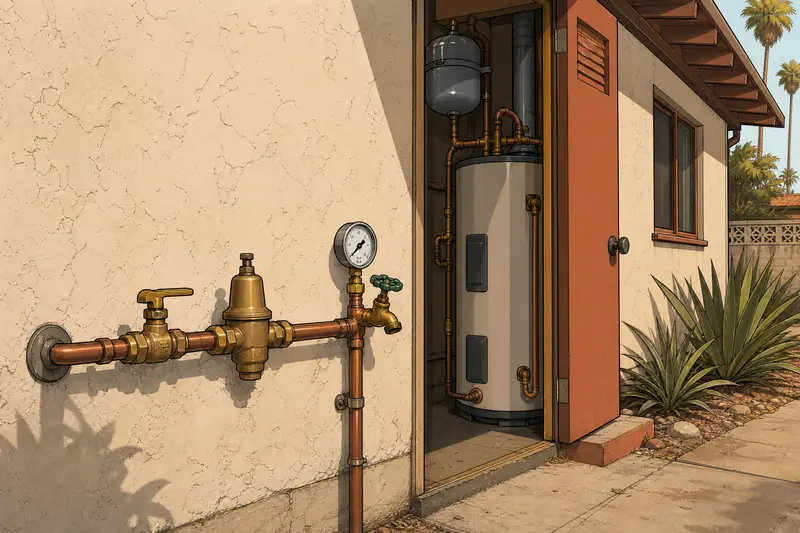
Heat and pumping matter too. LADWP's FAQ links copper corrosion to a water heater "set too high" and to hot-water circulating systems whose return line is too small or whose water "may be pumped too fast for your pipe size." DOE suggests a 120°F setpoint, which the water heater folder explains.
Who pays for pinhole leak damage?
The owner pays for pinhole leaks on the house side of the meter, because LADWP's service guide puts everything past the meter on the customer. Whether insurance pays for the damage depends on the policy and on how the water escaped.
The California Department of Insurance lists "sudden & accidental water damage" among perils a homeowners policy typically covers, and "water damage cause by seepage or leaks," "mold," and "wear and tear or maintenance" among those generally excluded. A pinhole that sprays suddenly and one that seeps for months can be treated differently, so photograph damage, keep the failed pipe and read your policy's water damage wording before you file. The Virginia Tech thesis lists denied insurance claims and higher premiums among homeowners' main worries about pinhole leaks.
Pinhole leak facts with sources
- 107locations in 32 states named as affected by copper pinhole leaks in a 2004 expert surveyVirginia Tech, Farooqi (2006), p.8
- 80 psipressure above which failure reports link copper to erosion corrosion, and the code requires a regulatorVirginia Tech (2006) p.11; 2025 CPC §608.2
- 4-5 ft/sflow speed above which erosion corrosion is reportedVirginia Tech, Farooqi (2006), p.11
- 529 ppbLADWP's 2023 tap copper result at the 90th percentile; the action level is 1,300 ppbLADWP report on 2025 data
- 9,300+ galwater the average household's leaks waste in a yearEPA WaterSense
| Factor | What the source says | Source |
|---|---|---|
| Pressure | Over 80 psi reasoned to promote erosion corrosion | Virginia Tech thesis, p.11 (from copper industry failure reports) |
| Flow speed | Over 4 to 5 feet per second reasoned to promote erosion corrosion | Virginia Tech thesis, p.11 |
| Hot water temperature | Over 160°F often blamed for erosion corrosion | Virginia Tech thesis, p.11-12 |
| Soldering flux | Bands of pits blamed on flux runs, likely over-characterized | Virginia Tech thesis, p.10-11 |
| Chloramine | Effect on copper pitting "not known" | Virginia Tech thesis, Table 5 |
| Electrical grounding, mixed metals | Can cause copper corrosion and blue-green water | LADWP water quality FAQ |
Where this page comes from
Based on Owais E. Farooqi's 2006 Virginia Tech master's thesis, An Assessment and Modeling of Copper Plumbing Pipe Failures due to Pinhole Leaks (abstract, pp.8-12, Table 5 and Chapter 3), LADWP's FAQ on water quality, its service guide and its July 2026 report on 2025 data, EPA WaterSense, the 2025 California Plumbing Code, LAMC 94.103, Business and Professions Code §7048 plus the state insurance department's residential guide; every source was read in October 2026. The thesis is older research reporting others' findings, so its figures are framed as what failure reports suggest, not settled cause. Left out: repair and repiping prices, epoxy lining claims, and any single-cause explanation.
Still asking
Does LADWP's water cause pinhole leaks?
No source this site found ties pinhole leaks to LADWP's water. LADWP's 2023 tap tests showed a 90th-percentile copper reading of 529 ppb, well under the 1,300 ppb action level, and the research on causes remains unsettled.
Are pinholes more common in hot or cold lines?
Both happen. Copper industry failure reports sort leaks into hot, cold and other categories, and heat above 160°F and fast recirculation are among the hot-side factors studied.
Can a clamp stop a pinhole leak for good?
A clamp can slow a leak until the section is replaced, but it does not stop the corrosion that made the hole. Replace the damaged length and note where it was.
Should the failed piece of pipe be kept?
Yes. It helps a plumber or lab see whether the pit started inside or outside the pipe, and it can support an insurance claim.
Does a water softener cause pinhole leaks?
The research reviewed for this page does not settle that question. The Virginia Tech review links very soft water with dissolved oxygen to erosion corrosion in some reports, but no rule or study found here blames home softeners in Valley water.
Is a pinhole leak under the slab handled differently?
The repair choice changes: crews either open the slab at the spot or reroute the line through walls and attic. The slab leak page compares the two.
Does a pinhole leak need a permit to fix in Los Angeles?
Usually not, if the fix does not involve removing fixtures or drainage parts (LAMC 94.103.1.2.3). Replacing larger sections of piping needs a plumbing permit.
That is the end of this page. Back to all five Shutoff Valley folders.