Salt-Free Water Conditioners: What They Do
Salt-free water conditioners reduce scale without removing hardness: the minerals stay in the water as tiny crystals, so Burbank's 286 mg/L water still tests 286 mg/L, but less of it sticks to heaters and fixtures.
About the shop links on this page: Shutoff Valley shares its owners with SoftPro Water Systems and Quality Water Treatment, the two water-treatment shops linked on this page. What a shop says about its own products is labeled as the shop's claim. How shop links work here
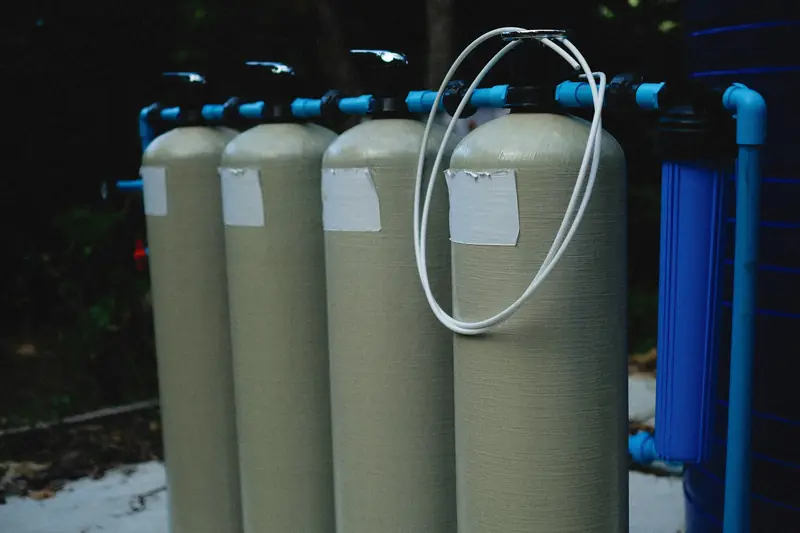
Call sheet: what this page covers
Before you scroll
- Nebraska Extension's NebGuide G2275 (December 2025) calls no-salt units "descalant devices," because they do not remove hardness from the water.
- Template-assisted crystallization (TAC) uses treated resin beads to convert hardness ions into microscopic crystals that do not form scale, per G2275.
- EPA WaterSense's 2026 softener guide suggests choosing salt-free models that meet the IAPMO/ANSI Z601 standard for scale reduction devices.
- G2275 says salt-free units do not handle bacteria, lead, nitrate, pesticides, iron or manganese.
- LA County Sanitation Districts list TAC units among acceptable alternatives in the Santa Clarita Valley, where salt softeners have been banned since 2003.
- Ion-exchange softening raises sodium roughly 8 mg/L for every gpg it strips out, per Nebraska Extension; TAC uses no salt and adds none.
How does a salt-free water conditioner work?
A salt-free water conditioner of the TAC type passes water through a bed of specially treated beads that coax calcium and magnesium into microscopic crystals. G2275 explains that the beads are fluidized, the agitation releases the crystals, and once released they are insoluble particles that "do not form scale on surfaces." The crystals travel on with the water.
The same NebGuide groups TAC with other no-salt approaches: electrically induced precipitation, electrochemical treatment and magnetic treatment. It calls magnetic devices "unproven technology without a strong scientific basis," so this page is about TAC only, the type the shops linked here describe and the type LA County Sanitation Districts name.
Is a salt-free conditioner a water softener?
No: a salt-free conditioner is not a water softener, because it leaves the hardness in the water. EPA's WaterSense softener guide says these units "condition" hardness ions instead of removing them, while an ion-exchange softener swaps them for sodium or potassium and brings water into the "soft" range under 1 gpg.
| Option | Removes hardness? | Salt or brine to the sewer | Water to the drain | Listed as acceptable in Santa Clarita (LACSD) |
|---|---|---|---|---|
| Ion-exchange salt softener | Yes, to under 1 gpg (G2275) | Yes | 20-70 gal per regeneration (EPA) | No |
| Salt-free TAC conditioner | No, converts it to crystals (G2275) | No | None in normal use | Yes |
| Portable exchange tank | Yes | No (recharged off site) | None at the house | Yes, swapped every 2-4 weeks |
| Under-sink reverse osmosis | Yes, at one tap | No | Yes, reject water | Yes |
Product names blur this. Quality Water Treatment titles its unit a "Salt-Free Water Softener," while SoftPro calls its versions conditioners. The test is simple: a softener lowers the hardness reading on a drop-test kit and a TAC unit does not.
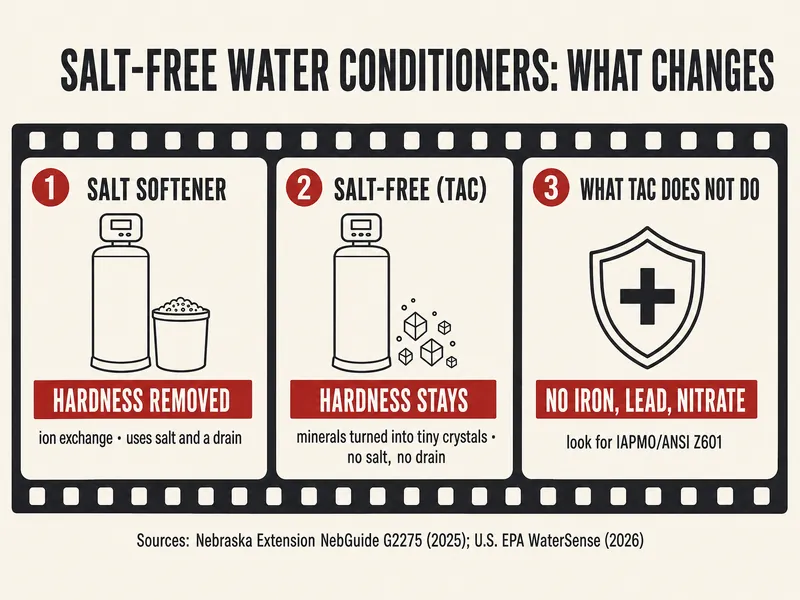
What do salt-free conditioners not do?
Salt-free conditioners do not lower hardness and do not treat contaminants. G2275 lists what they do not manage: bacteria, hydrogen sulfide, silt or sand, lead, nitrate, pesticides "and many other organic and inorganic compounds," and, generally, iron and manganese. It adds that TAC usually needs fairly clean water going in and may need pretreatment for iron, manganese or sediment.
Two more limits matter in the Valley. A TAC unit does not reduce chloramine, which LADWP, Burbank and Glendale use as their disinfectant; that job falls to the catalytic carbon covered on chloramine filters. And it does not stop spotting the way softened water can: G2275 notes that "a fine dust may form on dishes," though it wipes away.
The evidence is also thinner than for softeners. G2275 says "few conclusive studies confirm the efficiency of these devices for residential use" and that household test protocols were still being developed. EPA's pointer to IAPMO/ANSI Z601 is the closest thing to a certification to ask for.
Why do they appeal in Los Angeles County?
Salt-free conditioners appeal here because they need no salt, no drain and no regeneration water, and because one part of the county bans salt softeners. LA County Sanitation Districts prohibit automatic salt softeners throughout the Santa Clarita Valley and list TAC on their acceptable alternatives page. No similar rule covering the San Fernando Valley was found in October 2026; the details are on are water softeners allowed in Los Angeles.
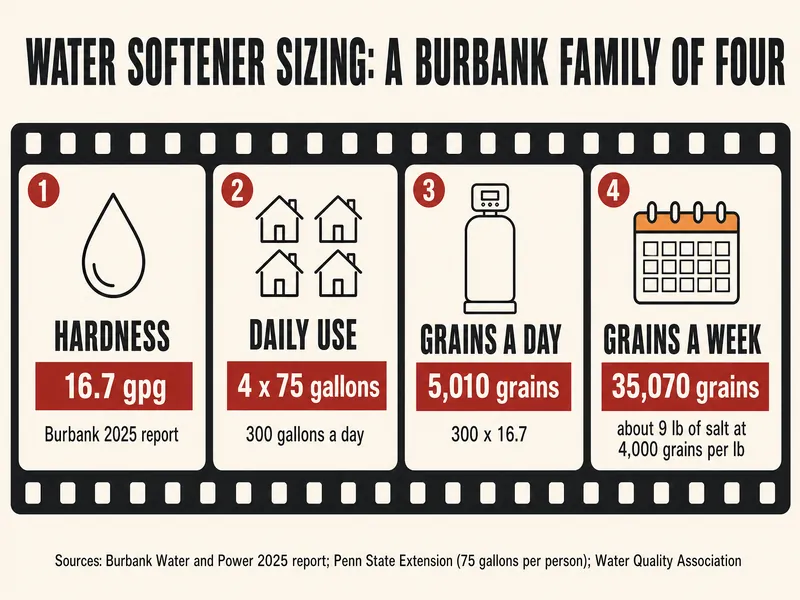
They also skip the trade-offs of softening. EPA says a typical regeneration uses 20 to 70 gallons, and Nebraska Extension's NebGuide G1491 puts added sodium at about 8 mg/L per gpg removed, roughly 134 mg/L on Burbank's 16.7 gpg water. A TAC unit adds neither. The scale problem itself is real on harder Valley water: Burbank averaged 286 mg/L in 2025, the City of San Fernando 190 mg/L and Glendale's groundwater plant 350 mg/L, all "very hard" on the USGS scale.
What the sources say
- 286 mg/LBurbank's 2025 average hardness, unchanged by a TAC unitBurbank Water and Power 2025 report
- Z601IAPMO/ANSI standard for scale reduction devices that EPA suggestsEPA WaterSense softener guide (2026)
- 2003Santa Clarita Valley ban on new salt softeners beganLA County Sanitation Districts
- 2.1 mg/LBurbank's average chloramine residual in 2025Burbank Water and Power 2025 report
- 8 mg/LSodium a salt softener adds per gpg removedNebraska Extension G1491
What upkeep does a salt-free conditioner need?
Upkeep is light: replace the media or cartridge on the maker's schedule, keep any sediment prefilter clean, and check the maker's water limits. G2275's warning about iron, manganese and sediment is the reason many systems put a prefilter ahead of the TAC tank.
Disinfectant levels are worth asking about. Valley utilities' 2025 reports show average residuals of 1.7 mg/L for LADWP, 2.1 mg/L for Burbank and 1.25 mg/L for Glendale (all under the 4 mg/L limit), so ask the maker what chlorine or chloramine level its media tolerates and whether a carbon stage should come first. Place the unit before the water heater, where scale does most of its harm; the heater side of the story is on water heater life in hard water.
If you own a tankless heater, read its manual before relying on TAC alone. Rinnai's manual names only a water softener or its own Scale Cutter as treatment, and calls treatment required above 200 mg/L, a line Burbank and Glendale water cross.
How do you judge whether one is working?
Judge a salt-free conditioner by scale, not by a hardness test, because the hardness reading should not change. Before installing, note where scale builds now: faucet aerators, the showerhead, kettle walls, and the sediment that comes out when you flush the water heater.
- Run a drop-test kit before and after install; the same number means it is a conditioner, not a softener (see testing tap water at home).
- Clean one aerator and one shower-glass panel, then check them after 4 to 8 weeks.
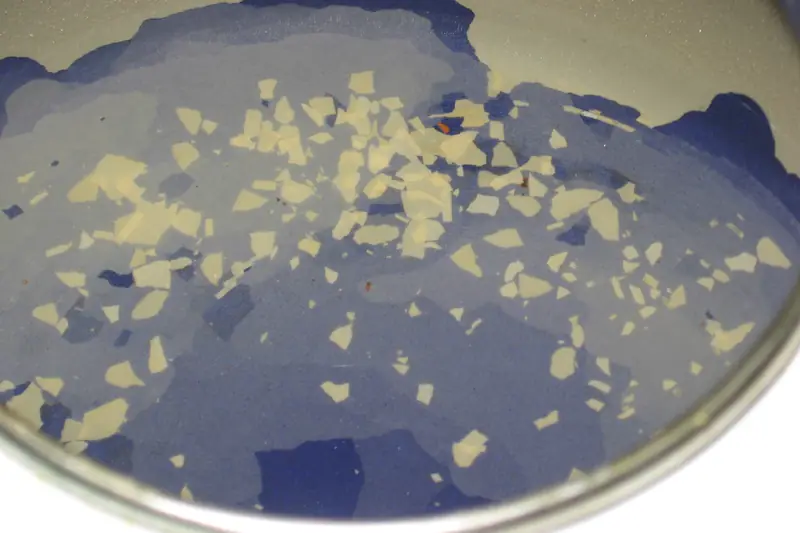
- Compare the white flakes in the next heater flush with the last one (how to flush a tank heater).
- Expect some wipeable dust on dishes, which G2275 describes as normal for TAC.
Three salt-free units appear in the catalogues of the shops that share this site's owners, described by the shops as reducing scale without salt (the listings do not say whether the media is TAC, so ask the maker before relying on LACSD's TAC rule): the SoftPro FORTRESS (sold by SoftPro Water Systems, which shares owners with this site) in Home (6 gpm, $229), Pro (10 gpm, $529) and Commercial (16 gpm, $1,259) sizes, and the SoftPro Elite salt-free conditioner ($1,299) at both shops, the listed prices in October 2026. The catalogue descriptions read in October 2026 did not name a Z601 certification, so ask before buying. They leave the hardness minerals in the water.
Where this page comes from
This page is based on Nebraska Extension NebGuides G2275 (December 2025) and G1491; EPA WaterSense's 2026 softener guide; LA County Sanitation Districts' Santa Clarita Valley pages; 2025 figures from the Valley suppliers' latest reports (Burbank, Glendale, LADWP and San Fernando, all published in 2026); the USGS hardness scale; and Rinnai's tankless manual, all read in October 2026. Product sizes and prices come from the two shops' catalogues as listed in October 2026 and are labeled as the shops' claims. Left out: scale-prevention percentages, mineral or health claims from product listings, and magnetic or electronic descalers.
Still asking
Will a salt-free conditioner make Burbank water feel soft?
No. It leaves Burbank's 286 mg/L of hardness in the water, so soap behaves much as before. Its aim is less scale on heaters and fixtures, not the slick feel of softened water.
Can a salt-free conditioner go in a Santa Clarita home?
Yes. LA County Sanitation Districts list template-assisted crystallization units among the systems acceptable in the Santa Clarita Valley, because they add no salt to the sewer.
Does a salt-free conditioner remove chloramine?
Not on its own. TAC media converts hardness minerals; chloramine reduction is a job for catalytic carbon. Some systems pair the two in one setup, so check what each stage is for.
Do salt-free conditioners work on very hard water?
Makers set their own hardness limits, so check the spec sheet against your number. Nebraska Extension notes few conclusive residential studies, which is why EPA points buyers to IAPMO/ANSI Z601.
Does a salt-free conditioner need a drain or electricity?
A TAC tank does not regenerate, so it does not need a drain line for brine. Some other no-salt devices, such as electrically induced precipitation units, use electricity, so check the type you are buying.
Will a salt-free conditioner remove existing scale in my pipes?
Do not count on it. Nebraska Extension describes TAC as preventing new scale from forming on surfaces; it makes no claim about dissolving old buildup. Flush or descale heaters separately.
Does a salt-free conditioner add sodium to the water?
No. It uses no salt, so the sodium level stays where your supplier's report puts it (38 mg/L in Burbank in 2025). A salt softener adds about 8 mg/L per gpg removed, per Nebraska Extension.
That is the end of this page. Back to the full list of Valley water and plumbing pages.