Under-Sink Reverse Osmosis for LA Tap Water
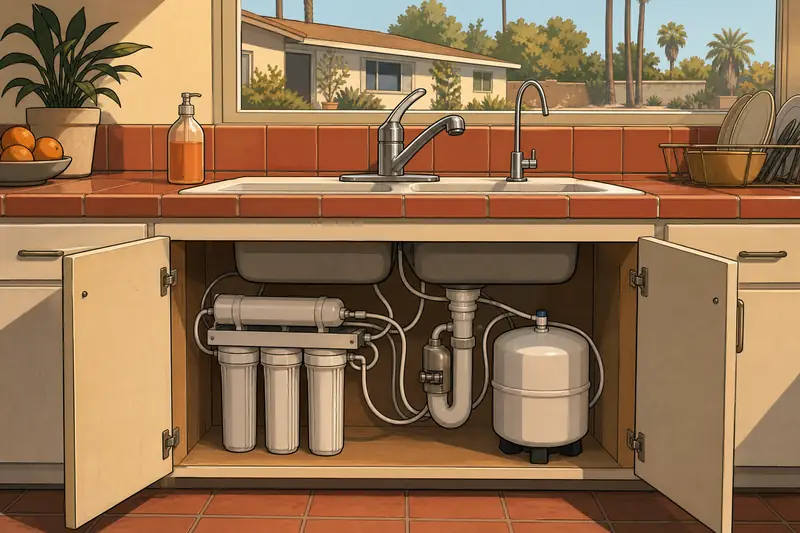
Under-sink reverse osmosis forces tap water through a membrane at one faucet; on Valley water it is a choice rather than a fix, and only the exact model's NSF/ANSI 58 listing says what it reduces.
About the shop links on this page: Shutoff Valley shares its owners with SoftPro Water Systems and Quality Water Treatment, the two water-treatment shops linked on this page. What a shop says about its own products is labeled as the shop's claim. How shop links work here
Call sheet: what this page covers
Before you scroll
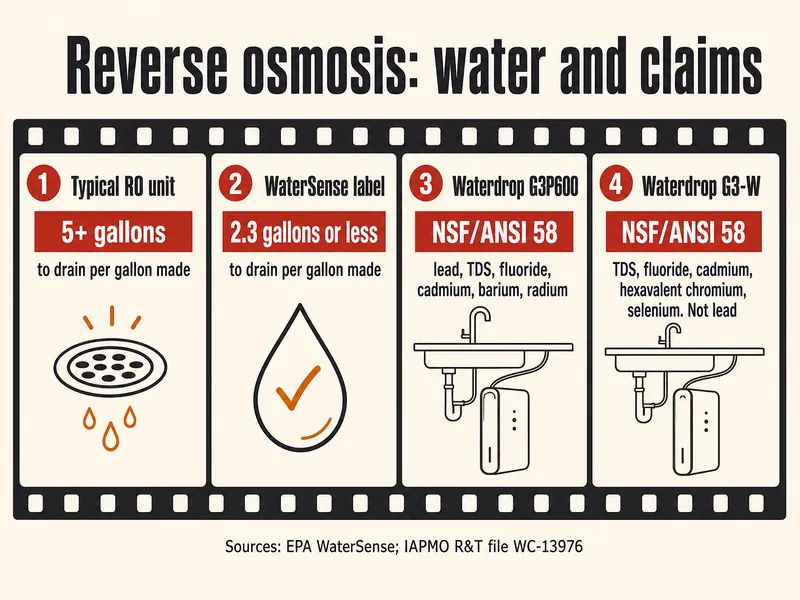
- A typical point-of-use RO system sends 5 gallons or more down the drain for every gallon it makes, says EPA WaterSense; WaterSense-labeled units send 2.3 gallons or less.
- Two of the RO units the linked shops sell, the G3P600 and the G3-W, are certified by IAPMO R&T to NSF/ANSI 58 under file WC-13976, but for different lists: only the G3P600 carries a lead claim.
- The WD-G3-W is certified for hexavalent chromium, TDS, fluoride, cadmium and selenium, and not for lead.
- Both units' carbon stage is certified to NSF/ANSI 42 for chlorine taste and odor, not chloramine, on IAPMO certificate WC-14301.
- Each of LADWP's three Valley sources tested below 0.1 µg/L of chromium-6 in 2025, so LADWP homes have no chromium-6 reason to buy RO.
- Waterdrop rates the G3P600 membrane at 24 months or 2,200 gallons and its prefilter at 6 months or 550 gallons.
Reverse osmosis (RO) is the strongest treatment most homes put under a sink, and also the one most often bought for the wrong reason. Before choosing one, find your supplier's numbers using reading your Valley water report. Then match what you want reduced against the certified claims of the exact model, not the box.
What does under-sink reverse osmosis remove?
Under-sink reverse osmosis removes what its certificate lists, and the list differs model to model. EPA WaterSense explains that pressure pushes water through a semi-permeable membrane, splitting it into treated water ("permeate") and reject water ("concentrate"), and says RO systems "can potentially remove" lead, VOCs, PFAS, arsenic, bacteria and viruses.
"Potentially" is the key word. A real model is tested for specific claims, and the IAPMO R&T certificate WC-13976 shows how far two units from the same maker can differ:
| Standard | Waterdrop WD-G3P600 (SoftPro) | Waterdrop WD-G3-W (Quality Water Treatment) |
|---|---|---|
| NSF/ANSI 58 (RO, file WC-13976) | TDS, fluoride, cadmium, barium, radium 226/228, lead | TDS, fluoride, cadmium, hexavalent chromium, selenium |
| NSF/ANSI 53 (carbon stage, WC-14805) | PFOA/PFOS, 0.5 gpm, 1,100 gallons | PFOA/PFOS, 0.5 gpm, 1,100 gallons |
| NSF/ANSI 42 (carbon stage, WC-14301) | Chlorine, taste and odor | Chlorine, taste and odor |
| NSF/ANSI 372 (WC-13977) | Lead-free materials | Lead-free materials |
| Daily production rate on the 58 certificate | 2,715 liters (about 717 gallons) | 1,885 liters (about 498 gallons) |
The table reads in one direction only: a claim that is missing was not tested, not proven absent. Waterdrop units are certified through IAPMO R&T, not NSF International, whatever a product page says. For the local picture on each contaminant, see chromium-6 in Valley water and lead in Valley tap water.
What does NSF/ANSI 58 certification mean?
NSF/ANSI 58 is the standard for reverse osmosis drinking water systems, and certification means an accredited body tested a model for each reduction claim it lists. The certifier can be IAPMO R&T, NSF, WQA, UL or CSA Group; the State Water Board's device page names all five.
California adds a second check. Its Residential Water Treatment Device program registers units that make health-related claims and requires proof of that certification, and its device FAQ says a maker "cannot market or sell" such a unit in California without registration. The registry can be searched by contaminant and by system type.
RO in numbers
- 5+ gallonsReject water per gallon of treated water, typical point-of-use ROEPA WaterSense
- 2.3 gallonsMost a WaterSense-labeled RO unit may send to drain per gallonEPA WaterSense
- 3,100 gallonsAverage yearly water saved by a labeled unit over a typical oneEPA WaterSense
- WC-13976IAPMO R&T NSF/ANSI 58 file covering both Waterdrop unitsIAPMO R&T
- 3.9 ppbLADWP lead 90th percentile at 105 home taps, 2023 roundLADWP 2025 water quality report
How much water does reverse osmosis waste?
A typical point-of-use RO unit sends 5 gallons or more down the drain for each gallon of treated water, and EPA says some inefficient units reach 10. WaterSense-labeled models must stay at 2.3 gallons or less, which EPA's November 2024 RO handout says saves more than 3,100 gallons a year on average.
Waterdrop's G3P600 product page states a 2:1 pure-to-drain ratio, which would mean about half a gallon to drain per gallon made; that is the maker's figure, not a WaterSense test. EPA also notes it does not want to push RO where plain filtration would do, because RO is water-intensive.
Does reverse osmosis handle chloramine?
The membrane is not what handles chloramine; the carbon stage is, and on these units it is certified for chlorine only. The Water Quality Association's chloramine technical sheet says chloramines are "difficult to remove by distillation, reverse osmosis, and ion exchange resins," and that carbon breaks them down instead.
Valley water carries chloramine: LADWP averaged 1.7 mg/L total chlorine in 2025 and Burbank 2.1 ppm. The Waterdrop carbon block (WD-G3-CB) is rated on IAPMO's NSF/ANSI 42 certificate for chlorine, taste and odor at 0.5 gpm for 1,100 gallons, with no chloramine claim. If chloramine taste is the reason for buying, compare against chloramine filters that list a chloramine reduction claim.
What upkeep does an RO system need?
An RO system needs its cartridges changed on schedule, enough water pressure and, for pump models, a power outlet. Waterdrop's product page gives these limits for the G3P600: the prefilter lasts up to 6 months or 550 gallons, the carbon block up to 12 months or 1,100 gallons, and the RO membrane up to 24 months or 2,200 gallons, whichever comes first.
Three checks keep a unit honest:
- Pressure. Waterdrop lists 14.5 to 87 psi for the G3P600. LADWP's service rules set a 25 psi minimum, and the California Plumbing Code calls for a regulator where street pressure tops 80 psi; see water pressure regulators.
- Power. The G3P600 uses a pump and ships with a power adapter, so plan an outlet under the sink.
- A TDS reading. Both units are certified for TDS reduction, so a meter reading at the cold tap and at the RO faucet should differ widely; a shrinking gap means the membrane is due. The home testing page explains what a TDS meter measures.
The State Water Board's consumer page adds that a filter stops reducing contaminants once it passes its rated gallons, so keep the dates and the gallon counter in view.
Is reverse osmosis worth it on Valley water?
On LADWP water, reverse osmosis is mostly a taste and preference purchase; on Burbank, Glendale or San Fernando water there are more measured reasons, though every supplier met its standards in 2025. LADWP's own FAQ says the water it delivers does not need more treatment, and that home plumbing is the usual reason to filter.
Here is what the 2025 reports (published in 2026) show, with reports printing ppm (mg/L) and ppb (µg/L):
- Chromium-6. LADWP's Valley water tested below 0.1 µg/L at every source. Burbank averaged 4.5 ppb (ND-8.3), Glendale's own treatment plant 5.1 ppb ahead of blending, San Fernando 3.4 ppb; California's limit is 10 µg/L. The G3-W is the unit certified for hexavalent chromium.
- Lead. Lead at a tap comes from home plumbing such as old solder and brass. LADWP's 2023 round put its 90th percentile at 3.9 ppb, and 3 homes out of 105 topped 15 ppb; Burbank and Glendale measured none at the 90th percentile. The G3P600 is the unit certified for lead.
- TDS. LADWP's Valley sources ran 234-297 mg/L, Burbank 448 and San Fernando 378. RO lowers TDS sharply, which many people notice as taste.
- Fluoride. LADWP adjusts fluoride to 0.7 ppm. Both units are certified to reduce it, so an RO tap will carry less fluoride than the cold tap.
The SoftPro G3P600 (sold by SoftPro Water Systems, which shares owners with this site) was listed at $429 in October 2026, and Quality Water Treatment's WD-G3-W (sold by Quality Water Treatment, which shares owners with this site) at $459. Pick by certificate, not price: lead points to the first, chromium-6 to the second.
Where this page comes from
This page is based on IAPMO R&T certificates WC-13976 (NSF/ANSI 58), WC-14805 (NSF/ANSI 53), WC-14301 (NSF/ANSI 42) and WC-13977 (NSF/ANSI 372), EPA WaterSense's point-of-use RO page and November 2024 consumer handout, the State Water Board's device registration pages, the Water Quality Association's chloramine sheet, Waterdrop's G3P600 product page, LADWP's FAQ, and the 2025 water quality reports from LADWP, Burbank, Glendale and San Fernando, all read in October 2026. Shop prices were checked October 26, 2026. Left out: the shops' and maker's broader marketing claims (PFAS at the whole house, health and savings percentages), because no certificate backs them.
Still asking
Does an RO system need a storage tank?
Not always. Both Waterdrop units on this page are listed as plumbed-in to a separate tap without a reservoir, so they make water on demand with a pump.
Does an RO unit keep working in a power outage?
Not a pump model. Waterdrop says the G3P600 runs a pump off a power adapter, so keep stored drinking water for outages; the emergency water storage page covers how much.
Is Valley water pressure high enough for RO?
Usually. LADWP's service rules promise 25 psi or more, which sits inside Waterdrop's stated 14.5 to 87 psi range for the G3P600; a house above 80 psi needs a regulator under the plumbing code anyway.
Will RO water taste flat?
Lower TDS changes taste, and people describe it differently. Some units add a remineralization cartridge; the linked units' certificates do not cover any such stage.
Does an RO system help with spots on glasses?
Only for water drawn from the RO faucet. Dishwasher and shower water still come from the main line, so whole-house hardness is a scale and spots question.
Do renters need permission to add an under-sink RO unit?
Check the lease; most units tap the cold line and the drain and need a hole for the faucet. A unit that can be removed cleanly is easier to agree with a landlord.
Is a WaterSense label more important than an NSF/ANSI 58 listing?
They answer different questions. NSF/ANSI 58 says what the unit reduces; WaterSense says how little water it wastes while doing it, and labeled units must also be certified for the claims they make.

That is the end of this page. Back to the Shutoff Valley front page.