Hard Water Scale and Spots
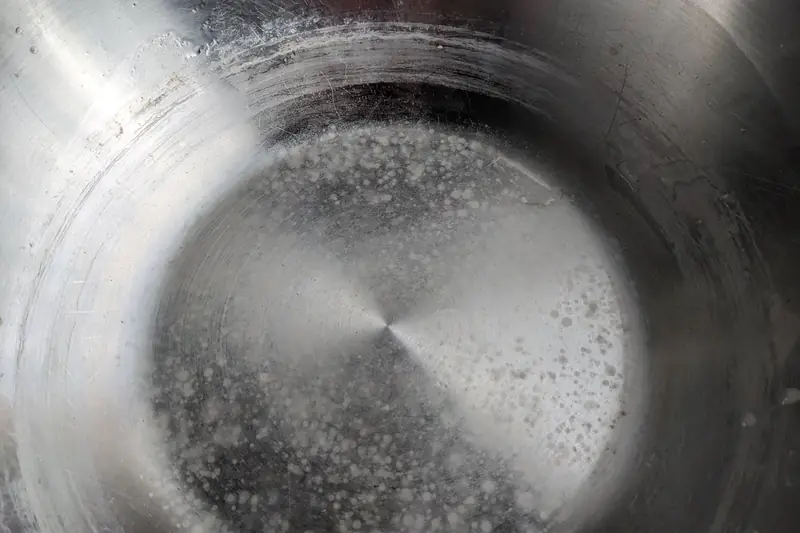
Hard water scale is the chalky calcium carbonate left when Valley water dries or heats, and Burbank's 286 mg/L water leaves far more of it than LADWP's 103-140 mg/L water does.
About the shop links on this page: Shutoff Valley shares its owners with SoftPro Water Systems and Quality Water Treatment, the two water-treatment shops linked on this page. What a shop says about its own products is labeled as the shop's claim. How shop links work here
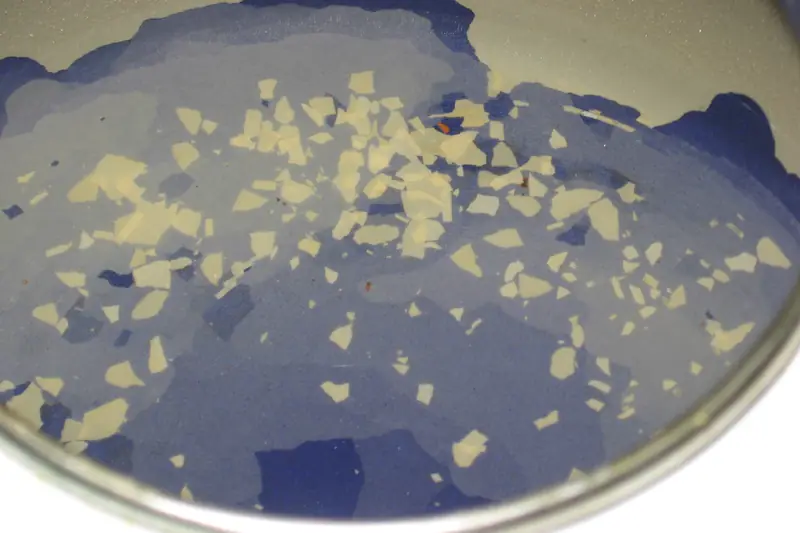
Call sheet: what this page covers
Before you scroll
- Burbank's blended water averaged 286 mg/L hardness (16.7 gpg) in 2025, according to the utility's report for that year; LADWP's Valley sources ran 103-140 mg/L (about 6-8 gpg).
- USGS calls anything over 180 mg/L "very hard," which covers Burbank, San Fernando (190 mg/L) and much of Glendale's water.
- Spots and film on dishwasher glasses are hard-water residue, "not dangerous, but unsightly," says the USGS.
- Rinnai's SENSEI RX tankless manual lists 200 mg/L as its maximum hardness and requires treatment above it.
- Red, black and blue-green stains are not scale: EPA ties them to iron, manganese and copper.
- Never mix bleach with vinegar or any other cleanser; the CDC warns against it.
White crust on a showerhead, a cloudy film on drinking glasses, flakes in the kettle: across the Valley these are everyday signs of hard water. How much you see depends on who supplies your water, because hardness ranges from moderately hard to very hard across the four suppliers. Check yours on San Fernando Valley water hardness before buying anything to fight it.
What is the white crust on faucets and showers?
The white crust is mostly calcium carbonate with some magnesium carbonate, the minerals that make water hard. LADWP's water quality FAQ calls this material "pipe scale" and says hardness is reported as the calcium carbonate dissolved in the water. When a drop dries on chrome or glass, the water leaves and the minerals stay.
Reports print hardness in mg/L (the same as ppm here), and sellers use grains per gallon (gpg); 1 gpg equals 17.1 mg/L. The 2025 figures, published in the 2026 reports:
- LADWP Valley neighborhoods: about 103-140 mg/L (6-8 gpg) depending on the source: the LA Aqueduct Filtration Plant 103, the Northern Combined Wells 115 and MWD's Jensen plant 140.
- Burbank: 286 mg/L (16.7 gpg, printed), range 148-300.
- Glendale: the city prints no single figure; water from its own treatment plant came in at 350 mg/L, roughly 20.5 gpg, and MWD Weymouth water at 234 mg/L.
- San Fernando's city wells: 190 mg/L, roughly 11.1 gpg.
The USGS draws its lines at 60, 120 and 180 mg/L: up to 60 is soft, up to 120 moderately hard, up to 180 hard, and anything beyond is very hard. That puts LADWP's Valley water in the middle bands and most of the other three suppliers' water in the top one.
Scale by the numbers
- 286 mg/LBurbank average hardness, 2025 (16.7 gpg)BWP report on 2025 water
- 103-140 mg/LAverages for LADWP's three Valley sources, 2025LADWP report on 2025 water
- 180 mg/LLine above which USGS calls water very hardUSGS Water Science School
- 200 mg/LMost hardness Rinnai's SENSEI RX tankless acceptsRinnai installation and operation manual
- 500 mg/LEPA secondary guideline for TDS, above which deposits showUS EPA
How do you remove hard water scale safely?
Remove hard water scale with a mild acid such as white vinegar, given time to work, and keep it away from bleach. The USGS explains that vinegar's acidity helps dissolve the mineral particles so they rinse away, and Glendale Water & Power's 2025 report says mild vinegar removes fresh white deposits.
A routine that fits most fixtures:
- Aerators and showerheads. Unscrew them and soak in white vinegar until the crust softens, then brush and rinse.
- Glass and tile. Wet the film with vinegar, let it sit, wipe and rinse with plain water so the acid does not dry on grout or stone.
- Kettles and coffee makers. Run a vinegar fill, then two plain-water rinses; USGS mentions coffee makers by name.
- Finishes. Check the fixture maker's care card first, since some coatings and natural stone do not tolerate acids.
Two safety rules matter more than technique. The CDC says "never mix bleach with ammonia or any other cleanser," and that includes vinegar; and open a window while cleaning. For appliances, use the maker's procedure: Rinnai's SENSEI RX manual circulates 4 gallons of undiluted food-grade white vinegar for at least 1 hour, covered step by step on descaling a tankless heater.
Why do dishes come out spotted?
Dishes come out spotted because hard water leaves its minerals behind as each drop dries, and hard water also makes detergent work less well. The USGS notes that soap reacts with calcium to form "soap scum" and that hard water needs more soap or detergent to get things clean.
Dissolved solids beyond hardness add to the film. EPA's secondary standards list total dissolved solids (TDS) above 500 mg/L under "hardness; deposits." Burbank's TDS averaged 448 mg/L in 2025 and San Fernando's 378, against 234-297 for LADWP's Valley sources, which lines up with where spotting is worst.
The USGS point about detergent is the practical one: follow the detergent maker's hard-water dose, and use rinse aid where the dishwasher manual calls for it. Those are cosmetic fixes; the water itself is unchanged.
Which hard water spots are not scale?
Stains that are red, orange, black or blue-green are not hardness scale; EPA ties them to iron, manganese and copper. The table sets out the colors EPA lists and the levels where they start to show.
| Stain or deposit | Likely cause | EPA secondary level | Where it often comes from at home |
|---|---|---|---|
| White crust, cloudy film | Calcium and magnesium carbonate (hardness) | No secondary level for hardness | The water supply |
| Reddish or orange staining | Iron | 0.3 mg/L | Rusting steel or galvanized pipe |
| Black to brown staining | Manganese | 0.05 mg/L | The water source |
| Blue-green staining | Copper | 1.0 mg/L | Corroding copper plumbing |
| White deposits, salty spots | Total dissolved solids | 500 mg/L | The water supply |
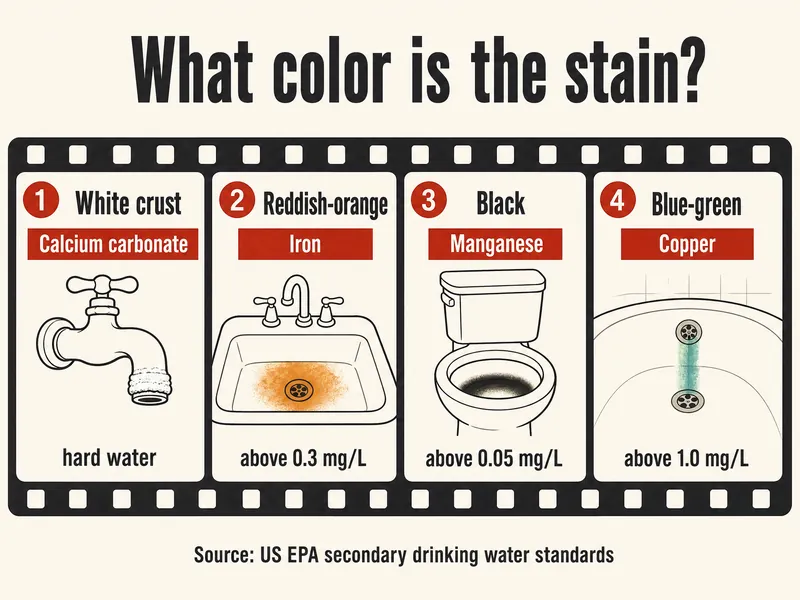
Blue-green stains under a faucet usually point to home plumbing, not the supply. LADWP's 2023 tap sampling found a copper 90th percentile of 529 ppb, below the 1,300 ppb action level; Glendale's was 760 ppb, with 3 sites above the action level. Rust-colored water often traces to old steel pipe; see galvanized pipes.
Some white or tan grit is not crust at all. LADWP's FAQ says uniform beads can be resin escaping a broken water softener, and hard black specks can be carbon from a spent filter cartridge.
Does scale cost money beyond cleaning?
Yes: scale builds up where water is heated, and the USGS lists four costs: shorter equipment life, higher water-heating costs, less efficient electric heaters and clogged pipes. No reliable dollar figure exists for a Valley home, so this site gives none.
The makers set the rules that matter. A. O. Smith's maintenance checklist says to service a water heater once a year, or twice a year with hard water, because minerals build up faster. Rinnai's manual recommends treatment and a yearly flush from 61 mg/L up, and requires treatment above 200 mg/L, its stated maximum. Burbank's 286 mg/L and Glendale's plant water at 350 mg/L both sit above that line; LADWP's Valley sources sit below it.
Tank heaters get the same mineral load. The hard water and water heater life page covers flushing, anodes and the 8-12 year tank life the makers give.
When is treating the water worth more than scrubbing?
Treating the water starts to beat scrubbing when the hardness is very hard and the scale reaches equipment, not just glass. On LADWP's 6-8 gpg water, treatment is mainly a comfort and cleaning choice; on Burbank, San Fernando or Glendale water above 180 mg/L, scale in heaters and on fixtures is a stronger reason.
There are two main routes, with different trade-offs:
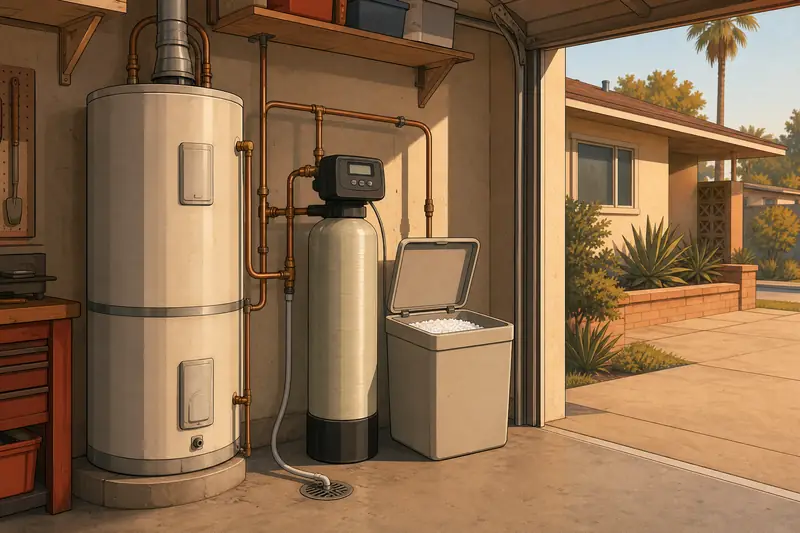
- A salt softener swaps calcium and magnesium for sodium by ion exchange, LADWP's FAQ explains. Quality Water Treatment lists the SoftPro ECO softener (sold by Quality Water Treatment, which shares owners with this site) in 32,000, 48,000 and 64,000 grain sizes at $967 to $2,677 (the shop's listed price in October 2026). Sizing is on softener sizing.
- A salt-free conditioner leaves the hardness minerals in the water; the shops say it reduces scale buildup without salt. SoftPro lists the Fortress conditioner (sold by SoftPro Water Systems, which shares owners with this site) at $229 for a 6 gpm cartridge model up to $1,259 for a 16 gpm commercial tank, as listed in October 2026. How they differ is on salt-free conditioners.
One caution from LADWP: once water is softened, it can start to re-dissolve old scale in the pipes, and pieces may break loose for a while. This site found no Valley rule that restricts softeners, but ask your city before installing one; are water softeners allowed has the details.
Where this page comes from
Hardness, TDS and copper figures come from each supplier's 2026 report on 2025 data (LADWP, Burbank, Glendale, San Fernando). Cleaning and cost points come from the USGS hardness page, LADWP's FAQ, Glendale's report, the CDC cleanup page, Rinnai's SENSEI RX manual and A. O. Smith's maintenance checklist; stain colors come from EPA's secondary standards table. Everything was read in October 2026, and listed shop prices date from October 26, 2026. Not included: yearly costs of scale, energy-loss percentages or any skin and hair claims, since no primary source for the Valley backs them.
Still asking
Is the white residue in a kettle harmful?
The USGS describes hard-water residue as unsightly rather than dangerous. Descale the kettle with vinegar and rinse it well.
Why does scale come back a week after cleaning?
The water carries new minerals every day, and each drop that dries leaves some. Wiping glass and chrome dry after use slows the buildup more than stronger cleaners do.
Does boiling water make it softer?
Heating drops some calcium carbonate out as scale, which is why kettles crust up, but the tap water itself stays hard. It is not a way to treat a house.
Can a filter pitcher stop spots on glasses?
Only on water poured from the pitcher. Spots come from the dishwasher and faucet water, which come from the main line.
Why is one bathroom crustier than another?
Hot water and slow-drying surfaces build scale faster. A shower that stays wet or a fixture fed mainly by hot water will show crust first.
Will a softener remove scale that is already there?
LADWP says softened water can start to re-dissolve old mineral deposits in pipes. Fixtures still need one last thorough cleaning after a softener goes in.
Does a TDS meter tell me how hard my water is?
No. TDS counts all dissolved solids, of which hardness is only part; a drop-count hardness kit measures hardness directly, as the home testing page explains.
That is the end of this page. Back to every Valley water and plumbing page.