Testing Tap Water at Home
Testing tap water at home works well for hardness and TDS, but lead, nitrate and bacteria call for a state-accredited (ELAP) lab, and your supplier's yearly report already covers hundreds of constituents.
About the shop links on this page: Shutoff Valley shares its owners with Quality Water Treatment, the water-treatment shop linked on this page. What a shop says about its own products is labeled as the shop's claim. How shop links work here
Call sheet: what this page covers
Before you scroll
- LADWP's 2025 water quality report counts over 100,500 tests covering 240 constituents, the free starting point for any home test.
- A self-test kit "will only let you know if a constituent is present," while a lab gives concentrations, says the State Water Board.
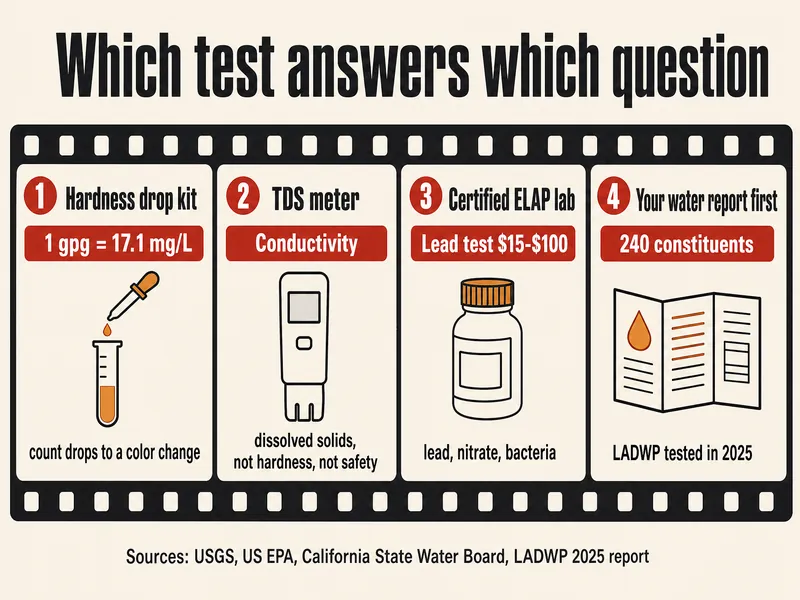
- EPA recommends a certified laboratory for lead and puts the cost at $15 to $100 on its Protect Your Tap page.
- One grain per gallon equals 17.1 mg/L of hardness, so Burbank's 286 mg/L reads about 16.7 gpg on a drop kit.
- A TDS meter reads electrical conductivity, which rises with dissolved ions, per the USGS; it is not a hardness or safety test.
- California accredits drinking water labs through ELAP and maps them on the State Water Board site.
Most Valley homes test their water for one of three reasons: to size a softener, to check a filter, or to settle a worry about lead. Each needs a different tool, and only one of them happens at the kitchen table. The cheapest first step costs nothing: your supplier's annual report, explained on how to read your Valley water quality report.
What can a home water test tell you?
A home water test can tell you whether something is present or roughly how much of a common property such as hardness or TDS is in the water, but not whether the water meets health standards. The State Water Board's testing page draws the line plainly: "a lab will be able to provide concentrations of contaminants while a self-test kit will only let you know if a constituent is present."
Your utility already does the heavy testing. LADWP's 2025 report counts more than 100,500 tests covering 240 constituents, and its FAQ says that testing your own tap for everything it tests would cost "well over $3,000." What the supplier cannot see is your own plumbing, which is where a home test or a lab sample earns its keep.
Testing in numbers
- 240Constituents LADWP tested for in its 2025 reportLADWP 2025 water quality report
- $15-$100EPA's cost range for a certified-lab lead testUS EPA, Protect Your Tap
- $100-$400Basic lab sampling cost on the State Water Board's well-testing pageCalifornia State Water Board
- 17.1 mg/LHardness in one grain per gallonLADWP water quality FAQ
- 500 mg/LEPA secondary guideline for TDSUS EPA secondary standards
How does a hardness drop test work?
A hardness drop test is a small titration: you measure a water sample into a tube, add an indicator that colors it, then add a second reagent drop by drop until the color changes. The number of drops converts to grains per gallon on the kit's chart, and multiplying by 17.1 gives mg/L as calcium carbonate, the unit water reports use.
The kit linked here, Quality Water Treatment's Pro Products 2403 hardness field test kit (sold by Quality Water Treatment, which shares owners with this site), is listed with three hardness reagents, a test bottle and a measuring tube, at $150 (the shop's listed price in October 2026). Check that a kit's reagents are in date before trusting a reading.
What to expect, from the 2026 reports on 2025 water:
- LADWP Valley neighborhoods: about 6-8 gpg (103-140 mg/L), depending on whether the aqueduct, the local wells or MWD's Jensen plant fed your tap.
- Burbank: about 16.7 gpg (286 mg/L), ranging 148 to 300 mg/L.
- San Fernando: about 11.1 gpg (190 mg/L).
- Glendale: anywhere from about 8.2 gpg on MWD Jensen water to about 20.5 gpg on the city's own groundwater plant water, since Glendale prints no single figure.
A reading far from your supplier's number is worth a second look: a softener, a blend change or a reading error can all explain it. Sizing a softener from your result is covered on softener sizing.
What does a TDS meter measure?
A TDS meter measures how well water conducts electricity and converts that to an estimate of total dissolved solids in mg/L. The USGS explains that pure water barely conducts, while dissolved salts split into charged ions that carry current, so conductivity rises with dissolved minerals.
That makes TDS a mixed bag of everything dissolved: calcium and magnesium, but also sodium, chloride, sulfate and more. It cannot separate hardness from salt, and it says nothing about lead, bacteria or chromium-6. EPA's secondary standards treat 500 mg/L of TDS as a taste and deposits guideline, not a health limit.
| Test | What it measures | What it cannot tell you | Cost noted |
|---|---|---|---|
| Hardness drop kit | Calcium and magnesium hardness, in gpg | Lead, bacteria, chloramine, TDS | $150 for the linked kit (shop's listed price, October 2026) |
| TDS meter | Conductivity, shown as estimated mg/L of dissolved solids | Hardness on its own, or whether water is safe | $61 for the linked meter (shop's listed price, October 2026) |
| Hardware-store test strips | Whether a constituent is present, by color | Concentrations precise enough to compare with a standard (State Water Board) | Not priced here |
| ELAP-accredited lab | Concentrations of lead, nitrate, bacteria and more | Nothing about other taps unless sampled | Lead $15-$100 (EPA); basic sampling $100-$400 (State Water Board) |
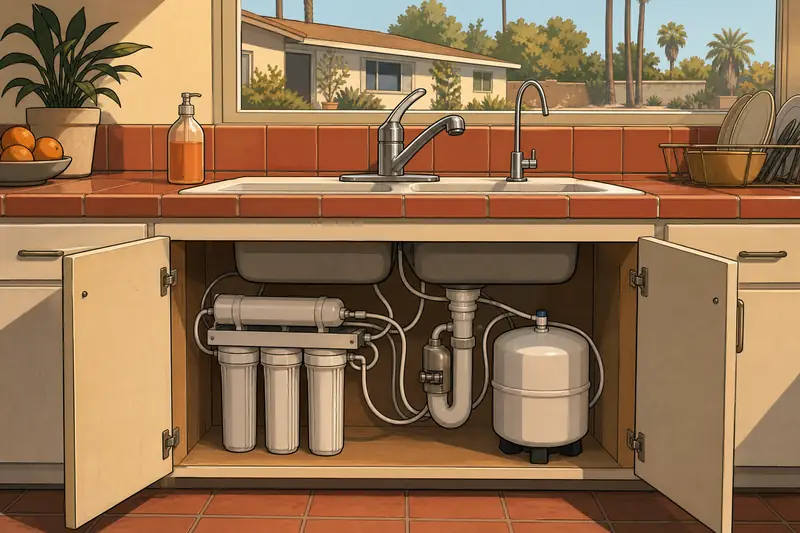
Where a meter shines is checking a reverse osmosis unit. Compare the cold tap with the RO faucet: the 2025 reports put TDS at 234-297 mg/L for LADWP's Valley sources, 448 for Burbank and 378 for San Fernando, and a working RO unit certified for TDS reduction should read far lower. Quality Water Treatment lists the Pocket Pal TDS meter (sold by Quality Water Treatment, which shares owners with this site) at $61 (October 2026). More on RO upkeep is on under-sink reverse osmosis.
When do you need a certified lab for testing?
You need a certified lab whenever the question is about health: lead, nitrate, bacteria, arsenic or anything with a legal limit. EPA's lead page says testing "is the only way to confirm if lead is present" and recommends a certified laboratory; LADWP's FAQ puts a typical lead test at around $50.
California accredits drinking water labs through its Environmental Laboratory Accreditation Program (ELAP), and the State Water Board's ELAP page links a map of accredited labs. Ask for a written estimate before sampling, as the Board's testing page suggests.
Lead is the test most Valley homeowners ask about. LADWP reports no lead service lines in its system, including customer-owned lines, so lead at a tap would come from home plumbing such as old solder or brass. In LADWP's 2023 round, the homes sampled were built 1982-1987 with original copper plumbing, chosen because they were expected to have lead solder; the 90th percentile was 3.9 ppb. Lead in Valley tap water has the full numbers.
How do you take a good tap water sample?
Take the sample exactly the way the lab's instructions say, from a faucet you actually drink from. That is EPA's advice on its lead page, and it matters because labs design their bottles and timing around specific rules.
A few habits help any sample:
- Use the lab's bottle. The State Water Board notes that labs supply the sampling bottles.
- Ask about first draw. LADWP's own lead sampling used first-draw samples from home taps, so ask the lab whether it wants the first water out of the faucet.
- Separate supply from plumbing. LADWP suggests comparing the front hose bib with an indoor tap when chasing a taste or odor; a difference points to the house, not the supply.
- Write it down. Note the date, time, faucet and how long the water sat, so a retest can match it.
Under EPA's newer lead rule, utilities sampling homes with lead service lines must test both the first and fifth liter and use the higher result, which shows how much timing can change a lead reading.
Which test should come first?
Start with your supplier's report, then pick the test that answers your actual question. A softener decision needs a hardness reading; a filter check needs a TDS meter or the filter's own test; a lead question needs an ELAP lab.
A sensible order for most Valley homes:
- Read the 2025 report from LADWP, Burbank, Glendale or San Fernando, published in 2026.
- Drop-test hardness at a cold tap that bypasses any softener, if you are weighing treatment; see do you need a water softener.
- Meter TDS before and after an RO unit, if you own one.
- Send a lab sample for lead if your home has older solder or brass fixtures, or if anyone in the house is especially sensitive to lead.
Skip kits that promise a full lab analysis by mail unless the lab is named and its ELAP accreditation can be checked on the State Water Board's map.
Where this page comes from
Sources behind this page: LADWP's report on calendar 2025 (July 2026) and its water quality FAQ; the matching Burbank, Glendale and San Fernando reports; three EPA items (Protect Your Tap, the secondary standards table, the lead rule improvements summary); the USGS conductivity page; and the State Water Board's ELAP and well-testing pages. Each was read in October 2026, and the two shop prices were last checked on October 26, 2026. Not included: mail-in lab kits whose lab is not named, and any claim that a TDS meter measures hardness or safety.
Still asking
Can test strips replace a lab for lead?
No. The State Water Board says self-test kits show presence rather than concentration, and EPA recommends a certified lab for lead.
Should I test hot or cold water?
Test cold water for drinking questions; LADWP's lead advice says to use cold water for drinking. Test hot water only when chasing a water heater problem such as odor.
Why does my TDS reading differ from the water report?
Reports give averages and ranges over a year and by source, and Valley supplies blend different sources. A pocket meter is also an estimate from conductivity, so a reading within the report's range is normal.
Does a hardness kit work on softened water?
Yes, and it is the simplest way to check a softener. A reading near zero at a softened tap means the resin is working; a rising reading means it needs attention.
Can LADWP test my tap for free?
LADWP tested qualifying homes at no cost in its 2023 lead and copper round and planned the next round for June to September 2026. Ask LADWP whether a later round is open.
What about testing for chloramine?
Utilities report chloramine as total chlorine, so a total chlorine test picks it up; the Water Quality Association lists DPD methods for measuring it. They are most useful for checking whether a chloramine filter is still working.
Is a TDS of 448 mg/L in Burbank a problem?
It is below EPA's 500 mg/L secondary guideline, which concerns taste and deposits rather than health. Burbank's water met all drinking water standards in 2025.
That is the end of this page. Back to all five Shutoff Valley folders.