Copper vs PEX for Valley Homes
Copper vs PEX is a choice the code leaves to you: California's 2025 Plumbing Code allows both for drinking water, with Type L copper as the minimum and PEX kept away from water heaters and sunlight.
Call sheet: what this page covers
Before you scroll
- The 2025 California Plumbing Code (in force January 1, 2026) lists copper, PEX, PE-RT, CPVC, stainless steel and galvanized steel for water distribution in Table 604.1.
- California's Building Standards board (BSC) filed its decision allowing PEX statewide for hot and cold drinking water on August 16, 2010 (CEQAnet).
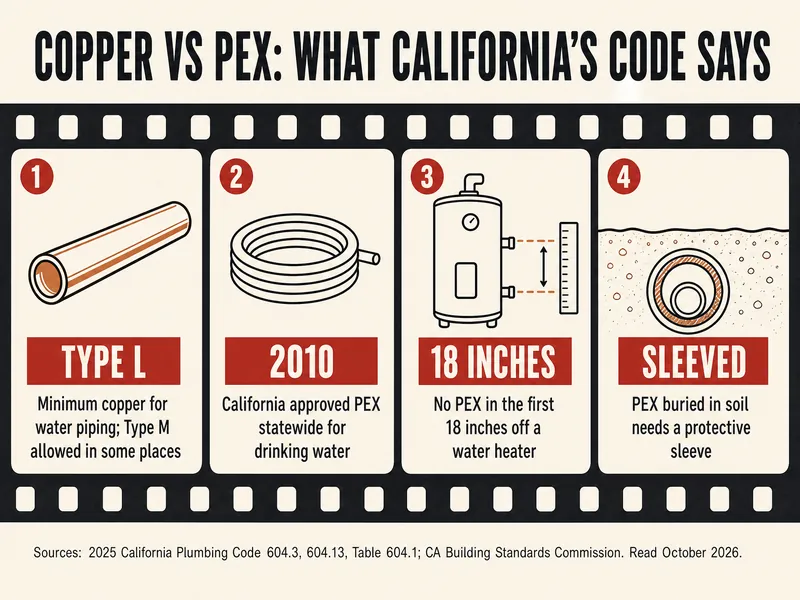
- Copper water piping must be at least Type L; PEX may not be installed within 18 inches of a water heater, and buried PEX must be sleeved (§§604.3, 604.13, Table 604.1).
- LADWP's water carried a total chlorine (chloramine) residual of 1.7 mg/L on average in 2025; this site found no study of chloramine and house PEX.
- A 2006 Virginia Tech review listed chloramine's effect on copper pitting as "not known."
- LADWP's 2023 tap sampling found copper at 529 ppb at the 90th percentile, under the 1,300 ppb action level.
What does California's plumbing code allow besides copper vs PEX?
California's code allows more than copper vs PEX: Table 604.1 of the 2025 California Plumbing Code also lists CPVC, PE-RT, PE-AL-PE, polypropylene, stainless steel, ductile and malleable iron, and ASTM A53 galvanized steel as water distribution materials. PE and PVC are limited to the building supply line or exterior cold water.
PEX came late to California. The BSC's notice for "Adoption of Statewide Regulations Allowing the Use of PEX Tubing" is dated August 16, 2010, covering hot and cold potable water in homes and other buildings. A 2006 Virginia Tech thesis noted that PEX had been banned in parts of California over concern about MTBE leaching, four years before the statewide adoption. One relative is still excluded: PEX-AL-PEX "is not adopted" for potable water in California (Table 604.1, note 5).
How do copper and PEX handle earthquakes?
No code rule or study this site found picks copper or PEX for earthquake performance; the rules focus on connections and shutoffs. In the 1994 Northridge earthquake, LADWP counted about 1,400 leaks in its own system, according to NIST's fire report, but that count covers utility mains, not house piping by material.
What the state does stress is flexibility at the water heater. The Division of the State Architect's older bracing guideline (2014) "strongly recommend[s]" flexible connectors on the water and gas lines. The 2025 code limits copper or stainless flexible connectors to 24 inches and keeps PEX out of the first 18 inches off the heater (§604.13). Pipe supports, two water heater straps and a main shutoff you can close matter whichever pipe you choose; the quake folder covers each.
Does chloramine affect copper vs PEX?
Chloramine's effect on either pipe is not settled in the sources this site could find. LADWP, Burbank and Glendale disinfect with chloramine; LADWP's 2025 water quality report lists a total chlorine residual of 1.7 mg/L on average (1.4-2), against a 4 mg/L limit.
For PEX, the test that exists is for chlorine. Uponor's FAQ says "all PEX manufacturers are required to test their pipe's resistance to hot, chlorinated water" and to print the PEX designation on the pipe, so read the print line on the tubing before it goes in. No chloramine-specific rating was found.
For copper, the 2006 Virginia Tech review of pinhole-leak research (Farooqi, Table 5) lists chloramine's effect on copper pitting as "not known." Copper at the tap stays well under the federal action level in LADWP's 2023 sampling (529 ppb at the 90th percentile), while Glendale's 2025 report shows 760 ppb with 3 of 51 sites over the 1,300 ppb action level. The chloramine page explains the disinfectant itself.
Which lasts longer, copper or PEX?
No primary source gives a service life in years for either pipe in Valley water, so this site does not print one. LADWP's FAQ, comparing copper with galvanized steel, says copper pipes "last longer and generally do not significantly affect water quality as they age." Uponor says its PEX systems "last the life of the structure," a maker's claim.
What shortens either pipe's life is better documented. Failure reports reviewed by Virginia Tech link copper erosion corrosion to pressure over 80 psi, flow faster than 4 to 5 feet per second, and hot water above 160°F. LADWP adds that copper corrosion can come from electrical grounding to water pipes and from hot-water recirculating systems that are undersized or pumped too fast. Keeping house pressure at or under 80 psi, as §608.2 requires, protects both materials; see the pinhole leak page.
What are PEX's weak points?
PEX's main weak points are sunlight, heat at the water heater and solvents in soil. Uponor rates its white tubing for one month of UV exposure and its red and blue tubing for six months, so PEX should not be left in the sun on a job site or run exposed outdoors.
The code adds its own limits: no PEX within 18 inches of a water heater, PEX in continuously recirculating hot water systems must meet ASTM F876-2015a, and PEX buried for drinking water must be sleeved with material "impermeable to solvents or petroleum products" (Table 604.1, notes 3-4). Copper's own weak point is the pinhole leak, covered on the pinhole page.
Which is easier to install in an existing house?
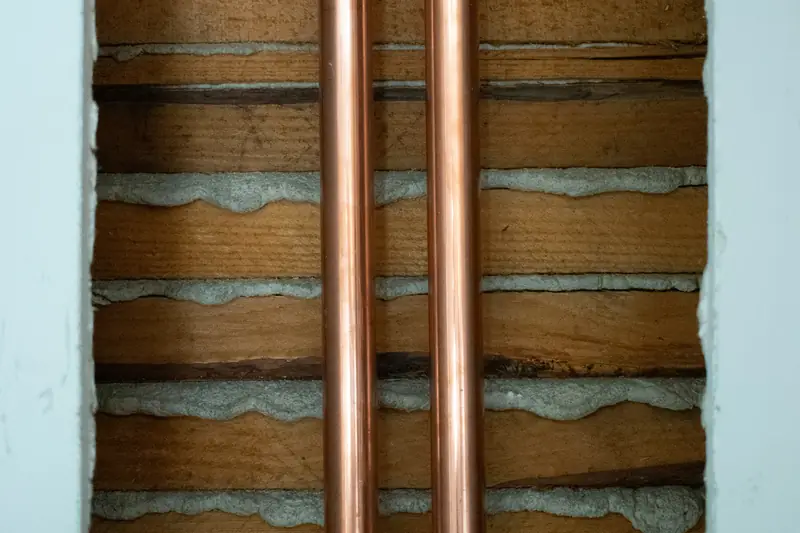
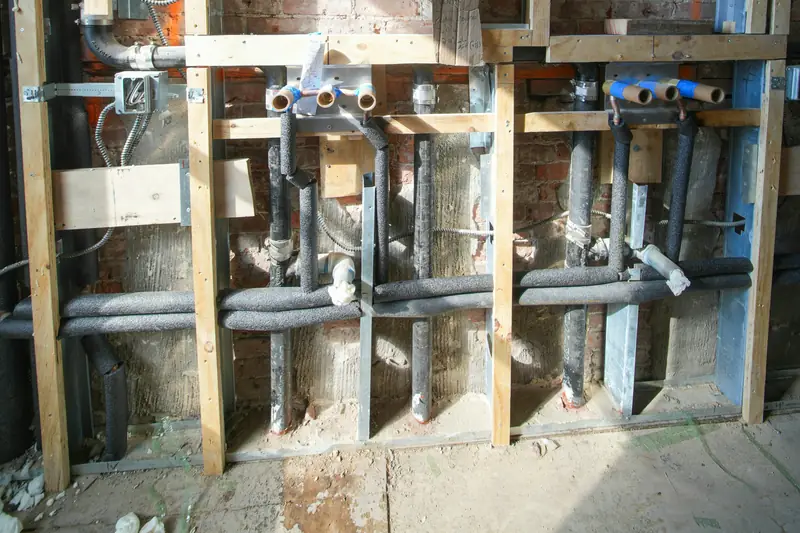
PEX is usually easier to route through finished walls and attics, because it comes in coils and bends around framing, while copper needs rigid runs joined by solder or press fittings. Both need the same permit, inspection and hot-water insulation (§609.12).
In Los Angeles, a full repipe must also bring hot water to each fixture with no more than 0.6 gallons delivered first (LAMC 94.610.4.1.1), so routing and pipe size count for either material. The repiping page walks through permits and contracts.
Copper and PEX rules with sources
- Type Lminimum copper tube for water piping in California2025 California Plumbing Code §604.3
- 2010year California adopted statewide rules allowing PEXCEQAnet state clearinghouse notice, August 16, 2010
- 18 inlength of pipe off a water heater where PEX may not be used2025 California Plumbing Code §604.13
- 1.7 mg/LLADWP average total chlorine residual from chloramine, 2025LADWP 2025 Drinking Water Quality Report
- 529 ppbcopper at LADWP taps, 90th percentile, 2023 (action level 1,300)LADWP water quality report on 2025 data, p.12
| Rule or trait | Copper | PEX | CPVC |
|---|---|---|---|
| Allowed for water distribution | Yes | Yes (ASTM F876, CSA B137.5, AWWA C904) | Yes |
| Minimum grade | Type L (Type M aboveground in a building) | Per listed standard | Per listed standard |
| First 18 in. off a water heater | Allowed | Not allowed | Not restricted by §604.13 |
| Buried in soil | Allowed (Type L, or Type M outside the structure) | Must be sleeved | Check the listing |
| Sunlight | No UV limit in code | Uponor: 1 to 6 months of UV exposure by color | Check maker |
| Chloramine data found | Effect on pitting "not known" (Virginia Tech) | Chlorine test only | None found |
Where this page comes from
Based on the IAPMO epub of the 2025 California Plumbing Code ( Table 604.1, §§604.3, 604.13, 608.2, 609.12), the CEQAnet record of the BSC's 2010 PEX notice, HCD's 2018 express terms, the LAMC hot-water delivery rule (Ordinance 188,797), LADWP's 2025 Drinking Water Quality Report and water quality FAQ, Glendale's 2025 water quality report, NIST-GCR-98-743 on Northridge, the DSA water heater bracing guideline (2014, archived), Uponor's FAQ and a 2006 Virginia Tech thesis, all read in October 2026. Left out: lifespans in years, installed prices, noise comparisons and any chloramine-PEX claim, for lack of a primary source.
Still asking
Does PEX make tap water taste like plastic?
This site found no primary source on taste from PEX in LADWP water. If a taste appears after a repipe, run the cold water and compare it with the front hose bibb, as LADWP suggests for other taste questions.
Can PEX connect directly to a water heater?
No. The 2025 California Plumbing Code keeps PEX out of the first 18 inches of piping off a water heater; a copper or stainless flexible connector up to 24 inches long, or rigid metal pipe, makes the connection.
Is Type M copper allowed in Los Angeles homes?
Yes, aboveground inside a building and underground outside the structure, under §604.3. Type L is required elsewhere.
Can copper and PEX be mixed in one house?
Yes, both are listed materials and are commonly joined with listed transition fittings. Where copper meets old galvanized steel, LADWP calls for a dielectric coupling.
Does PEX need to be strapped or supported?
Yes. All piping must be supported per the code's hanger and support rules; ask the installer how runs are fastened in walls and the attic.
Is CPVC a third option?
CPVC is listed in Table 604.1 for water distribution. This site found no Valley-specific data comparing it with copper or PEX.
That is the end of this page. Back to the full list of Valley water and plumbing pages.