Chloramine in LADWP Water
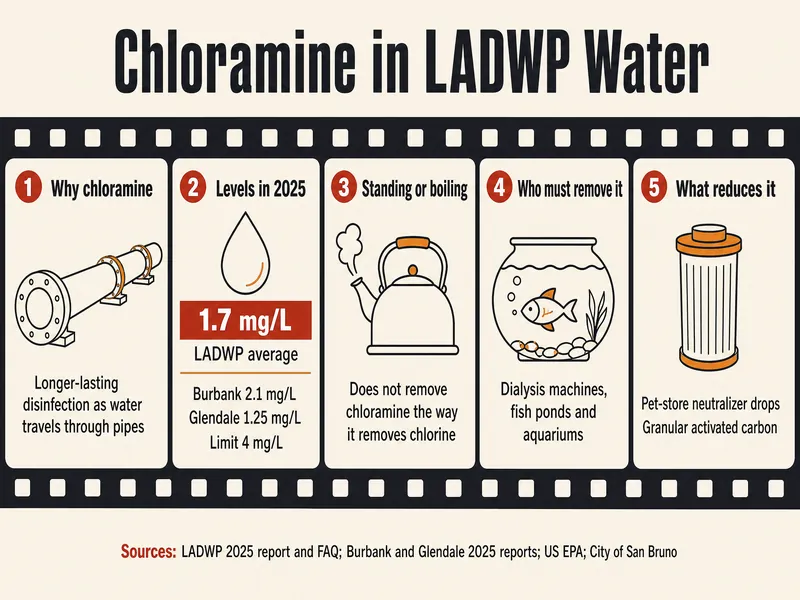
Chloramine in LADWP water is the disinfectant that keeps tap water protected on its way to you; it averaged 1.7 mg/L in 2025, under the 4 mg/L limit.
About the shop links on this page: Shutoff Valley shares its owners with SoftPro Water Systems and Quality Water Treatment, the two water-treatment shops linked on this page. What a shop says about its own products is labeled as the shop's claim. How shop links work here
Call sheet: what this page covers
Before you scroll
- LADWP's total chlorine residual, mostly chloramine, averaged 1.7 mg/L in 2025 (range 1.4-2), against a limit of 4 mg/L, per its 2025 Drinking Water Quality Report.
- Burbank's chloramine residual averaged 2.1 ppm and Glendale's total chlorine residual 1.25 ppm in 2025.
- EPA says chloramine gives longer-lasting disinfection as water moves through pipes.
- LADWP's report says dialysis users and anyone keeping fish must remove chloramine.
- The City of San Bruno notes that, unlike chlorine, chloramine cannot be removed by boiling or by letting water stand.
- LADWP's FAQ says granular activated carbon filters and pet-store neutralizers remove both chlorine and chloramine.
Chloramine is chlorine combined with a little ammonia. It is the reason LA tap water stays disinfected through miles of pipe, and the reason fish keepers and dialysis patients need an extra step. Reports print it as "total chlorine residual" in mg/L (the same as ppm).
Why do LADWP and other Valley suppliers use chloramine instead of chlorine?
Valley suppliers use chloramine because it lasts longer in the pipes and helps them meet disinfection byproduct rules. EPA's page on chloramines in drinking water says chloramines "provide longer-lasting disinfection as the water moves through pipes to consumers", and that some systems switched to them to meet disinfection byproduct requirements. LADWP's water quality FAQ says it is expanding chloramine to its entire system "to improve taste and odor, and to comply with more stringent water quality regulations."
At the Sylmar filtration plant, LADWP's booklet describes the last treatment step: chlorine goes in first, then ammonia is added to form chloramine before the water leaves for the city. MWD, which supplies more than half of LADWP's water, uses chloramine for the same reason. Burbank uses chloramine, Glendale uses chlorine and chloramines, and the City of San Fernando switches from chlorine to chloramine whenever it takes MWD water. Where that water comes from is covered on where Valley water comes from.
How much chloramine is in LADWP water?
LADWP's total chlorine residual averaged 1.7 mg/L city-wide in 2025, with a range of 1.4-2 mg/L. The limit, called the maximum residual disinfectant level (MRDL), is 4 mg/L as a running annual average. LADWP's Table III also lists ammonia plus chloramines, as nitrogen, at 0.4 mg/L for water from the filtration plant and 0.5 mg/L for the Northern Combined Wells.
Burbank Water and Power's 2025 water quality report (2025 data, published June 2026) shows a chloramine residual averaging 2.1 ppm, ranging from 0.2 to 3.4. Glendale's 2025 report gives a total chlorine residual averaging 1.25 ppm, from 0.00 to 3.10. Glendale notes that the taste is strongest in areas closer to its disinfection points, one reason the ranges are wide. For reading these tables, see how to read your water quality report.
Does chloramine evaporate or boil off?
Not the way chlorine does. The City of San Bruno, a Bay Area water supplier that also uses chloramine, says that "unlike chlorine, chloramine cannot be removed from water by boiling," and that it is not removed by letting an open container stand. That is why the old trick of leaving a bucket out overnight for a fish tank does not work on LA water.
For drinking, this does not matter: LADWP's FAQ explains that when people drink water, the chlorine or chloramine is neutralized by digestion before it reaches the bloodstream. It matters for anything where the water touches blood or gills directly.
Who needs to remove chloramine from LADWP water?
Two groups, according to LADWP's 2025 report: people using "specialized equipment, such as dialysis machines", who "should make necessary adjustments to remove chloramines"; and owners of a fishpond, tank or aquarium. LADWP warns that chloramines "can be harmful to fish." Its FAQ explains why: fish take the water across their gills, so the disinfectant enters their bloodstream directly.
For fish, LADWP's FAQ says neutralizing products sold at most pet stores handle both chlorine and chloramine. Home dialysis patients should follow their dialysis provider's water treatment instructions. No dialysis or aquarium guidance was found in Burbank's or Glendale's 2025 reports, so LADWP's advice is the best local reference.
Which filters reduce chloramine?
Activated carbon is the standard answer. LADWP's FAQ says granular activated carbon (GAC) filters "will effectively remove both chlorine and chloramine." Before buying, check that a filter's certification listing names chloramine for that exact model, not just "chlorine, taste and odor".
For a whole house, the two shops that share owners with this site sell catalytic carbon tanks they describe for chlorine and chloramine: the SoftPro Chlorine+ whole-house filter, listed at $1,097, and the SoftPro Whole House Chlorine+ Filter at QWT (sold by Quality Water Treatment, which shares owners with this site), listed at $917-1,097 (the shops' listed prices in October 2026). That chloramine claim is the shops' own; no certification listing for chloramine reduction was found for either filter. Compare options on chloramine filters and under-sink reverse osmosis.
Does chloramine affect pipes and rubber parts?
It can wear some rubber parts faster. San Bruno's FAQ says "rubber parts on some household plumbing and water heaters may degrade faster than with other disinfection methods." LADWP's FAQ describes the most common sign: small black, sooty specks in the water, often from the rubber lining of a braided flexible supply hose breaking down; the fix is a new hose, and newer hoses carry a disinfectant-resistant lining on the label.
Chloramine can also cause a bleach-like taste when it reacts with organic buildup in household plumbing. LADWP's home water quality page suggests taking off faucet aerators, running all the faucets at full flow for 5 minutes, then cleaning and refitting the aerators. If problems persist, the is LA tap water safe to drink page explains how to tell a supply issue from a house plumbing one.
Chloramine levels, 2025
- 1.7 mg/LCity-wide disinfectant residual, LADWP averageLADWP Drinking Water Quality Report 2025
- 2.1 ppmBurbank chloramine residual, running annual averageBWP 2025 Annual Water Quality Report
- 1.25 ppmGlendale total chlorine residual, city-wide averageGWP 2025 Water Quality Report
- 4 mg/LMaximum residual disinfectant level (MRDL)LADWP Drinking Water Quality Report 2025
| Supplier | Disinfectant | Average residual | Range |
|---|---|---|---|
| LADWP | Chloramine | 1.7 mg/L | 1.4-2 |
| Burbank Water and Power | Chloramine | 2.1 ppm | 0.2-3.4 |
| Glendale Water & Power | Chlorine and chloramine | 1.25 ppm | 0.00-3.10 |
| City of San Fernando | Chlorine; chloramine when using MWD water | not comparable (report figures conflict) | not comparable |
Where this page comes from
Sources: LADWP's 2025 Drinking Water Quality Report (the disinfectant and Table III tables, p.9), its water quality FAQ, its home water quality page and its filtration plant booklet; Burbank's, Glendale's and San Fernando's reports published in 2026 on 2025 data; EPA's chloramines page; and the City of San Bruno's chloramine FAQ, used only for the boiling, standing-water and rubber-parts points that no Valley source covered. All were read in October 2026. Store claims are labeled as the shops' own. Left out: health-effect claims about chloramine, and any filter claims beyond what a certification listing shows.
Still asking
Can I let LA tap water sit out to remove chloramine for my fish?
No. Chloramine does not leave standing water the way chlorine does. Use a pet-store neutralizer or a granular activated carbon filter, as LADWP's FAQ suggests.
Is chloramine the reason my water smells like a pool?
A slight chlorine odor is normal in some parts of LA, according to LADWP. A strong bleach-like smell more often comes from chloramine reacting with buildup in your plumbing, which flushing usually clears.
Does a water softener remove chloramine?
A softener exchanges hardness minerals and is not designed to remove chloramine. Some shop listings bundle a carbon stage with a softener for that purpose.
Is chloramine safe for people on dialysis?
Not in the dialysis water itself. LADWP's report tells dialysis users to remove chloramine, and San Bruno's FAQ notes that precautions are taken to remove or neutralize it in the dialysis process.
Do Burbank and Glendale use more chloramine than LADWP?
Burbank's 2025 average of 2.1 ppm was higher than LADWP's 1.7 mg/L, and Glendale's 1.25 ppm was lower. All three stayed under the 4 mg/L limit.
Will chloramine damage my water heater?
San Bruno's FAQ says rubber parts on some water heaters may wear faster under chloramine. LADWP's FAQ suggests replacing a failing flexible hose with one labeled as having a disinfectant-resistant lining.
That is the end of this page. Back to all five Shutoff Valley folders.