Who Owns the Sewer Lateral in Los Angeles?
The sewer lateral in Los Angeles belongs to the homeowner all the way from the house to the city main under the street, tree roots included, according to the city's Bureau of Engineering.
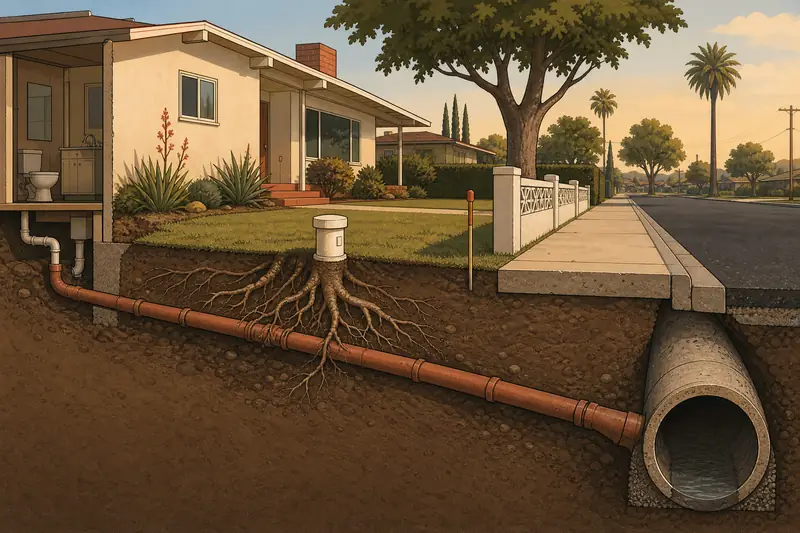
Call sheet: what this page covers
Before you scroll
- LA's Bureau of Engineering says the owner must "repair and maintain the HC lateral from the property line to the connection to the mainline sewer," on top of the building sewer on the lot (BOE).
- Laterals blocked by tree roots are the owner's responsibility "whether on private property or within the public right-of-way."
- Repairing a damaged lateral needs an S-Permit, and only a Bonded Sewer Contractor may do work in the public right-of-way (LAMC 64.15).
- The 2025 California Plumbing Code (§710.1) requires a backwater valve for fixtures on a floor lower than the next upstream manhole cover.
- Burbank's SLURP program lists a $150 rebate for cleaning plus video and a $500 rebate for replacing at least 10 feet in the right-of-way (City of Burbank).
- Glendale's Public Works FAQ says owners own the waste pipe "all the way up to the City's main line under the middle of the street."
Who owns the sewer lateral in Los Angeles?
In the City of Los Angeles the property owner owns and maintains the whole private sewer path: the building sewer from the house to the property line, and the house connection (HC) lateral from the property line to the city main. The Bureau of Engineering's S-Permit manual (revised July 2025) calls this "a long-standing City policy based on the opinion of the City Attorney."
The manual describes the layout plainly. Sewage leaves the house through the building sewer, which meets the house connection sewer "also known as a lateral connection or service connection" at the property line; the lateral then runs to "a local mainline sewer line in the middle of the street." Only the mainline belongs to the city. That means a lateral running under a city sidewalk and half a street is still the homeowner's pipe to repair.
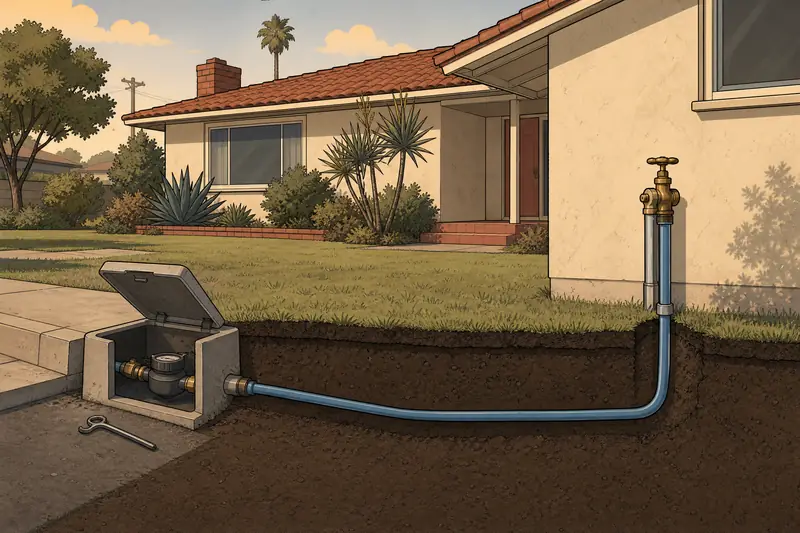
This page covers City of Los Angeles neighborhoods such as Van Nuys, Reseda, Sherman Oaks and Sylmar. Burbank and Glendale run their own sewers, covered below; the City of San Fernando and unincorporated areas have their own rules, so ask their public works departments. The water supply side has a similar split at the meter, explained on the main water shutoff page.
What goes wrong with old sewer laterals?
Old sewer laterals mostly fail at joints and cracks, where roots and soil get in. Burbank's SLURP FAQ notes that "tree roots will not affect a sewer lateral unless there is an open joint or a crack in the pipe," and Glendale's FAQ says root problems are "generally" the result of "a separation or deterioration of an old line."
Typical signs are slow drains on the lowest fixtures, gurgling toilets and backups after heavy use. Glendale's FAQ offers a useful test: if sewage keeps rising in a tub or shower with all the water in the house off, the blockage may be in the city's main; if it stops when the water is off, the problem is "likely in your private waste line." The LA Bureau of Engineering's manual also notes that some older laterals are judged "substandard" in material or diameter after a camera inspection, handled "on a case by case basis." Supply pipes age too, but they fail differently; the galvanized pipe page covers rusting water lines.
How is a sewer lateral inspected?
A sewer lateral is inspected by running a video camera through it from a cleanout, usually after the line is cleaned. Burbank tells owners to ask for the lateral to be cleaned and recorded "all the way to the connection to the public sewer main," and to keep a copy of the video showing the address. It notes that hydro-jetting "will generally produce better results over mechanical cutters" but can cost more.
A cleanout is the capped access pipe outside the house, like the white cap in the drawing above. Burbank says a cleanout is "not required" but recommended, and Glendale suggests lifting the cap to look for standing water when there is a sewer odor. Ask for the video file and a written note of where any break sits, measured from the cleanout, so a repair can target that spot. Burbank points out that "the entire pipeline does not need to be replaced" when damage is local.
Does Los Angeles require a backwater valve?
Los Angeles requires a backwater valve when fixtures sit on a floor lower than the next upstream manhole cover on the public sewer. Section 710.1 of the 2025 California Plumbing Code, which LA adopts in LAMC 94.700.0, says such fixtures "shall be protected" by an approved backwater valve (IAPMO).
Fixtures above that level must not drain through the valve, and cleanouts for it must be labeled "backwater valve downstream." Homes on lots below street level, or with a basement bathroom, are where this rule most often applies. To check, compare your lowest drain with the manhole cover uphill on your street, and ask a plumber to confirm before any sewer work.
What permits does sewer lateral work need?
Sewer lateral work in Los Angeles needs a city Sewer Connection Permit (S-Permit) for repairing a damaged house connection, and plumbing work on your lot needs a plumbing permit. The Bureau of Engineering lists three triggers for an S-Permit: building a new house connection, connecting to an existing lateral at the property line, and "repairing a damaged HC lateral."
Who may pull it depends on location. A plumber or contractor may get the "property line connection" permit, but any work in the public right-of-way requires a Bonded Sewer Contractor carrying the city's license, insurance and bond requirements (LAMC 64.15(e)), and the Bureau of Contract Administration inspects it. Building a new lateral from the main to the property line is limited to Bonded Sewer Contractors (LAMC 64.20). Work on the building sewer inside the lot falls under the general rule that replacing plumbing needs a permit (LAMC 94.103.1.1, amlegal); the repiping page explains who counts as a qualified installer. LA Sanitation's rebate pages could not be loaded for this page, so no LA rebate amounts are given; check them directly before hiring.
How do Burbank and Glendale handle laterals?
Burbank and Glendale also put the lateral on the owner, but each handles roots and help differently. Burbank's SLURP FAQ cites Burbank Municipal Code §8-1-107: "each property owner is responsible for their sewer lateral." If a parkway tree's roots have "crushed or misaligned" the lateral, Burbank reimburses that portion of the repair up to the limits in its fee schedule.
Burbank's FAQ lists a $150 rebate for cleaning plus a recorded video, and a $500 rebate (effective August 1, 2008) when at least 10 feet of lateral in the public right-of-way is replaced, once per ownership. It says lining is "not permitted in the City right-of-way," while pipe bursting is acceptable. Cleaning and video need no permit; replacement needs a plumbing permit on the lot, plus sewer connection and excavation permits outside it. Treat amounts as listed in October 2026 and confirm eligibility with Burbank Public Works.
Glendale's Public Works FAQ says you own the waste pipe up to the main "including the connection at the main." When roots from a city tree are found, call Maintenance Services so its Forestry Section can inspect "while it is exposed." No Glendale lateral rebate was found.
Sewer laterals in numbers
- Mainwhere the LA owner's responsibility ends: the connection to the street sewerLA Bureau of Engineering
- $150Burbank SLURP rebate for cleaning plus a recorded video, as listed October 2026City of Burbank
- $500Burbank rebate for replacing 10+ feet of lateral in the right-of-way, once per ownershipCity of Burbank
- 10 yearslongest cleaning interval Burbank mentions; it can be as often as twice a yearCity of Burbank
- §710.1California plumbing code section requiring backwater valves below the upstream manhole cover2025 California Plumbing Code
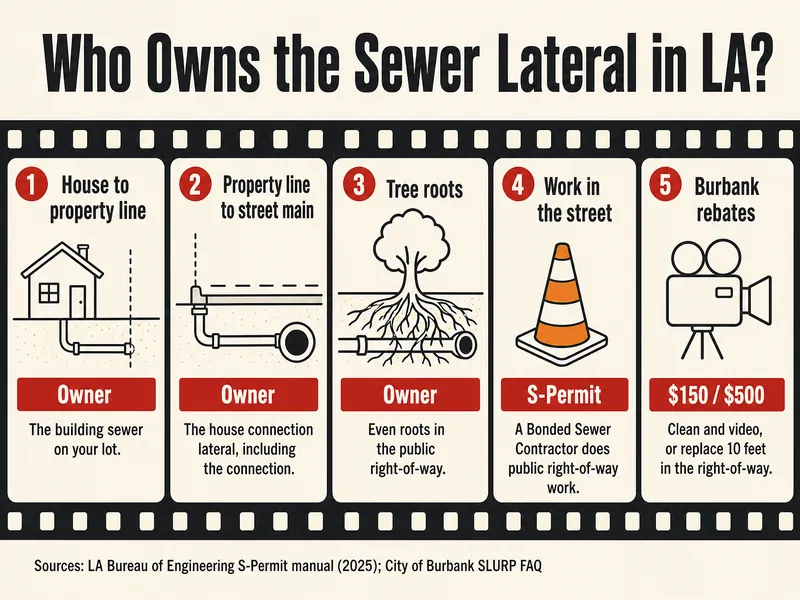
| City | Who owns the lateral | Roots from a city tree | Help listed |
|---|---|---|---|
| Los Angeles | Owner, house to the main, including the connection area | Owner's responsibility, even in the right-of-way (BOE) | LA Sanitation rebate pages could not be loaded |
| Burbank | Owner (Burbank Municipal Code §8-1-107) | City reimburses crushed or misaligned sections, up to fee-schedule limits | $150 clean and video; $500 replacement of 10+ feet in the right-of-way |
| Glendale | Owner, up to and including the connection at the main | Call Maintenance Services; Forestry inspects the exposed lateral | No rebate found |
Where this page comes from
Based on the LA Bureau of Engineering's S-Permit Purpose and Definition and General Conditions pages (revised July 2025), the Los Angeles Municipal Code (sections 64.12, 64.15, 64.20 and 94.103.1.1), the 2025 California Plumbing Code §710.1 (IAPMO read-only edition), the City of Burbank's SLURP FAQ and the City of Glendale's Public Works Maintenance Services FAQ, all read in October 2026. LA Sanitation's sewer pages blocked every request, so its rebate amounts are left out. Also left out: repair and camera prices, and lateral rules for San Fernando and unincorporated areas.
Still asking
Is the cleanout in my front yard my responsibility?
Yes. It is part of the private building sewer, which the owner maintains in Los Angeles, Burbank and Glendale alike.
Who pays if the city's street tree breaks my lateral in Los Angeles?
The Bureau of Engineering says root-blocked laterals are the owner's responsibility even in the public right-of-way. Burbank is different: it reimburses crushed or misaligned sections caused by parkway tree roots.
Can a lateral be lined instead of dug up?
It depends on the city. Burbank does not permit lining in its right-of-way but accepts pipe bursting; in Los Angeles, ask the Bureau of Engineering what methods it accepts for your S-Permit.
Do I need to scope the sewer when buying a house?
No Valley city rule requiring a camera inspection at sale was found. Because the buyer inherits the lateral to the main, a buyer may choose to ask for one before closing.
How do I know if a backup is my lateral or the city main?
Glendale's test works anywhere: turn off all water. If sewage keeps rising, call the city's sewer line; if it stops, the blockage is likely in your private line.
Does homeowners insurance cover a broken sewer lateral?
California's Department of Insurance lists wear and tear and maintenance among losses generally not covered, so read your policy's exclusions. The slab leak page quotes the department's wording.
Who can work on the lateral under the street in Los Angeles?
Only a contractor on the city's Bonded Sewer Contractor list, holding the S-Permit for work in the public right-of-way.
That is the end of this page. Back to all five Shutoff Valley folders.