Water Pressure Regulators: Checking and Adjusting
Water pressure regulators are required by California code wherever street pressure tops 80 psi; a gauge on an outdoor hose bibb shows which side of that line your house sits on.
Call sheet: what this page covers
Before you scroll
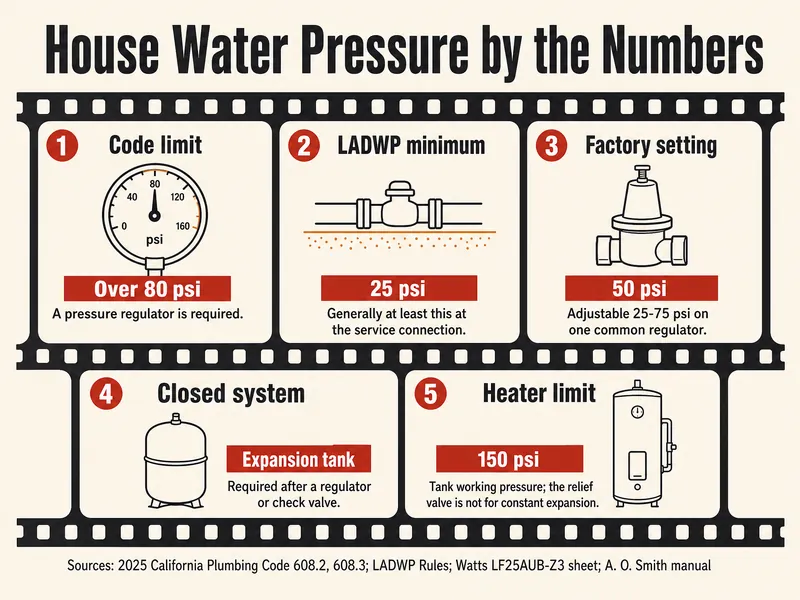
- The 2025 California Plumbing Code (§608.2) requires a pressure regulator, with a strainer ahead of it, where static pressure exceeds 80 psi, and the house must then run at 80 psi or less.
- Once a regulator is in, the system is "closed," and §608.3 requires a listed, sized expansion tank or similar device on the house side.
- LADWP's rules say it will generally keep pressure at the service connection at no less than 25 psi; no published maximum was found.
- Watts ships its LF25AUB-Z3 regulator preset to 50 psi, adjustable from 25 to 75 psi (Watts).
- A. O. Smith's manual says a tank water heater's relief valve "is not intended for the constant relief of thermal expansion."
- Regulating valves fall within the C-36 plumbing contractor's scope (CSLB).
When does a house need a water pressure regulator?
A house needs a water pressure regulator when the static pressure from the street is above 80 psi. Section 608.2 of the 2025 California Plumbing Code (IAPMO) says an approved regulator "preceded by an adequate strainer" must be installed and the pressure brought down to 80 psi or less. The regulator must meet ASSE 1003 or AWWA C530 and sit where it can be reached for service.
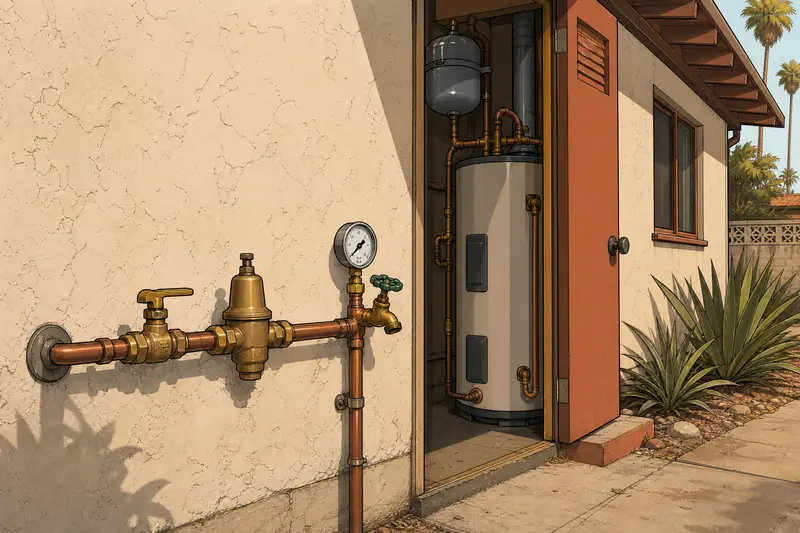
"Static" means no water is flowing, which is when pressure is highest. Regulators are often mounted where the supply line rises out of the ground near the front hose bibb, as in the drawing above. If you can't find one, the house may have been built without it, or the street pressure may never have needed it. Testing settles the question.
How do you test your water pressure?
You test water pressure with a gauge threaded onto an outdoor hose bibb, read with every fixture in the house turned off.
- Pick the hose bibb closest to where the line enters the house, after the regulator if there is one.
- Close every faucet and make sure the irrigation, washer, dishwasher and ice maker are idle.
- Screw on the gauge, open the bibb fully and read the needle.
- Compare it with 80 psi, the code ceiling.
A gauge with a second, "lazy" needle records the highest reading while it stays attached. Watts sells one for this purpose and says it "registers the highest pressure reading over the period of time it is left on the system." Leaving such a gauge on overnight can catch pressure that climbs while the water heater heats, which a single daytime reading misses.
How do you adjust a pressure regulator?
You adjust a typical bell-type regulator by loosening its lock nut and turning the adjusting bolt on top: clockwise raises pressure, counterclockwise lowers it. That wording comes from Watts' installation sheet for its LF25AUB-Z3 and IS-25AUB regulators (Watts PDF), which also says:
- the valve is factory preset to 50 psi "in a static condition";
- "any time a reducing valve is adjusted, use a pressure gauge to verify correct pressure setting";
- "do not bottom out adjusting screw on spring cage."
Turn in small steps, open a faucet briefly to let the setting settle, close it, then read the gauge again. Other brands differ, so follow the maker's sheet for the valve you actually have. The same Watts sheet says the valve "should be installed by a licensed contractor in accordance with local codes," and replacing one is plumbing work; the permits section of the repiping page explains who may do plumbing in Los Angeles.
What are the signs of a failing regulator?
The clearest sign of a failing regulator is house pressure that reads above its setting with no water flowing. Watts lists three causes for that: thermal expansion, "pressure creep," and dirt or debris on the valve seat.
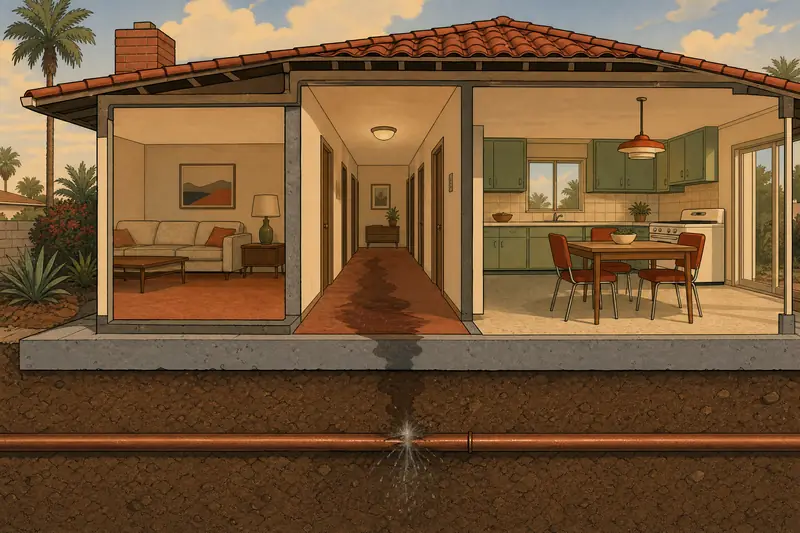
Watts gives a simple way to tell them apart. Briefly open a cold tap: if the high reading drops back to the set pressure at once, thermal expansion was the cause; if it creeps back up with no heater running, the seat or diaphragm may be worn. Its maintenance notes cover cleaning the strainer and replacing the seat disc and diaphragm. Other clues worth noting, though none is proof alone, include toilets that refill on their own, faucets that spit when first opened, and a water heater relief valve that drips. Pipes under constant strain can also leak in hidden places; the hidden leaks page and the slab leak page show how to check.
Why does a regulator need an expansion tank?
A regulator needs an expansion tank because it stops heated water from pushing back into the street main, so the extra volume has nowhere to go. Section 608.3 of the 2025 code says any system with "a check valve, backflow preventer, or other normally closed device" that keeps building pressure from dissipating into the main must have a listed, adequately sized expansion tank or similar device, whatever type of water heater is used, installed on the building side.
A. O. Smith's water heater manual (PDF) says "a properly-sized thermal expansion tank should be installed on all closed systems" and that the relief valve "is not intended for the constant relief of thermal expansion." The relief valve's setting may not exceed the tank's 150 psi working pressure. Some regulators also carry a built-in bypass; Watts says its feature keeps downstream pressure from rising "more than 10psi above the supply pressure," which limits but does not replace a tank. Tank care, including draining sediment, is on the water heater flushing page.
Who handles low pressure at the street?
LADWP handles pressure up to its service connection at the meter, and you handle everything after it. LADWP's rules (PDF, Rule 2-W) say the department "will maintain operating pressures at the Service Connection of not less than 25 pounds per square inch," and that pressure may run lower at peak demand or at high elevations.
If the whole house is weak, read the gauge at the hose bibb nearest the meter. A low reading there, with the regulator set correctly, is a question for LADWP; its water service guide lists a line for pressure inquiries. A good reading outside but weak flow at certain taps points to house plumbing: clogged aerators, old galvanized pipe (see the galvanized pipe page) or a partly closed valve. The same rules also bar customers from installing quick-closing devices that cause "excessive pressure surges" in LADWP's system.
Water pressure in numbers
- 80 psistatic pressure that triggers California's regulator ruleCPC §608.2 (2025 edition)
- 25 psigeneral LADWP floor where its pipe meets yoursLADWP Rule 2-W
- 50 psifactory setting of a common residential regulatorWatts LF25AUB-Z3
- 25-75 psithat regulator's adjustable rangeWatts LF25AUB-Z3
- 150 psitank water heater working pressure the relief setting may not exceedA. O. Smith manual 185762
| Static reading at the hose bibb | What it means | What to do |
|---|---|---|
| Over 80 psi, no regulator | Above the code limit in §608.2 | Have a regulator and expansion tank installed under the code |
| Over the regulator's setting | Thermal expansion, pressure creep or debris on the seat (Watts) | Run the cold-tap check; clean the strainer or service the valve |
| About 50 psi with a regulator | The common factory setting | Usually leave it; adjust in small steps with a gauge if needed |
| Under 25 psi at the front bibb | Below LADWP's general minimum | Check the regulator setting, then ask LADWP |
Where this page comes from
Based on the 2025 California Plumbing Code sections 608.2, 608.3 and 608.5 (IAPMO read-only edition), LADWP's Rules Governing Water and Electric Service (Rule 2-W and service continuity rules) and water service guide, Watts' LF25AUB-Z3 product page, specification sheet and installation instructions, A. O. Smith's water heater manual 185762, and CSLB's C-36 classification, all read in October 2026. Left out: typical street pressures in Valley neighborhoods (LADWP publishes no maximum), regulator prices and lifespans, and the water-savings figure in the Watts sheet, which this site could not check.
Still asking
What pressure should a house regulator be set to?
California code sets only a ceiling of 80 psi. Watts ships its common residential model at 50 psi, which many homes keep; any setting at or under 80 psi meets §608.2.
Can I replace a pressure regulator myself in Los Angeles?
Plumbing work in LA is limited to qualified installers, which includes an owner of a single-family home they live in under LAMC 94.219's conditions. Watts recommends a licensed contractor, and C-36 plumbers cover regulating valves.
Why did my pressure jump after a new water meter or backflow device?
A check valve or backflow preventer closes the system just like a regulator does, so heated water can push pressure up. Section 608.3 requires an expansion tank in that case.
Does a pressure regulator lower my water bill?
This site found no primary source tying a regulator to bill savings it could verify. Its job under the code is to keep pressure at or below 80 psi.
Where is the regulator on a typical Valley house?
Often where the supply line rises from the ground near the front hose bibb, after the house shutoff, but placement varies. Follow the line from the meter box toward the house to find it.
How long should a gauge stay on for an accurate test?
A single reading with all water off shows static pressure. A gauge with a maximum needle left on overnight also catches pressure that rises while the water heater runs.
Is banging pipes a pressure problem?
It can be. Sudden valve closures cause surges, which is why LADWP bars quick-closing devices that send surges into its system; high static pressure makes them worse, so test first.
That is the end of this page. Back to every Valley water and plumbing page.