Finding Hidden Water Leaks at Home
Hidden water leaks show up first at the meter: with every tap and appliance off, any movement means water is escaping somewhere, and a few drops of food coloring will tell you whether a toilet is the culprit.
Call sheet: what this page covers
Before you scroll
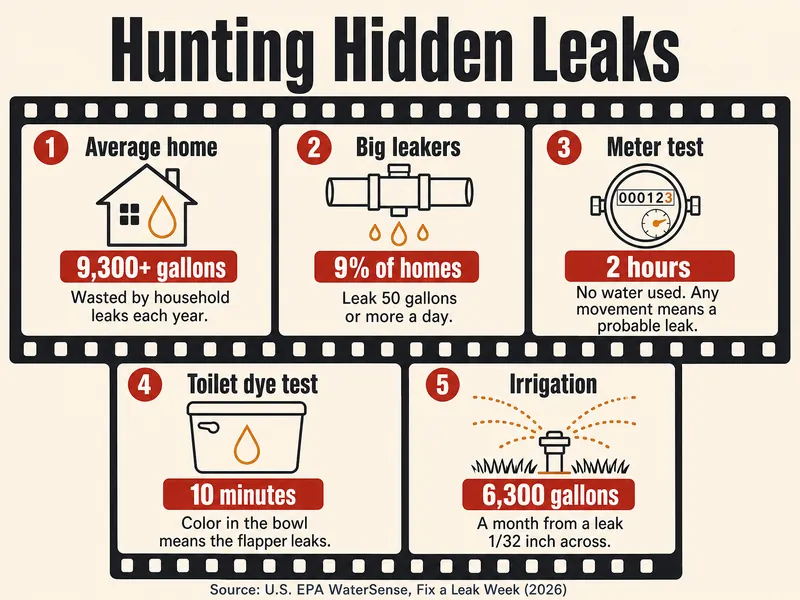
- EPA WaterSense estimates that leaks cost an average home over 9,300 gallons yearly, and that in 9 percent of homes the daily loss reaches at least 50 gallons (EPA).
- EPA's meter test: read the meter before and after two hours with no water in use; the City of San Fernando's 2025 report uses a 15-minute version.
- A few drops of food coloring in a toilet tank show a leak if color reaches the bowl within 10 minutes (EPA); Burbank's and Glendale's 2025 water reports give the same test.
- An irrigation leak 1/32 inch across can waste about 6,300 gallons a month, EPA says.
- LADWP's October 2026 rebate list offered up to $150 toward a Wi-Fi leak or flow device and $250 for a toilet using 1.1 gallons per flush or less; check before buying.
- LADWP will test a meter whose accuracy a customer questions; its rules treat 98 to 102 percent of true flow as accurate.
How much water do hidden leaks waste?
Hidden leaks waste more than most households expect: EPA WaterSense's estimate for a typical home is over 9,300 gallons lost per year, and in roughly one home in eleven the loss is at least 50 gallons daily. Nationwide, EPA says household leaks waste "nearly 1 trillion gallons" a year.
The common sources are small: "worn toilet flappers, dripping faucets, and other leaking valves," in EPA's words. A faucet dripping once a second wastes more than 3,000 gallons a year, and a showerhead dripping 10 times a minute more than 500. The leaks that cost the most are the ones nobody sees: a toilet running silently, an irrigation line under the lawn, or a pipe under the slab.
How do you use the water meter to find hidden leaks?
You use the water meter by stopping every planned use of water, then checking whether the meter still moves. LADWP meters live in curbside concrete boxes, and the pipe from there to your house is yours to maintain (LADWP water service guide).
- Turn off faucets, the dishwasher, washer, ice maker, softener regeneration and the sprinkler controller.
- Lift the meter box lid and write down the reading, plus the position of the small low-flow dial if there is one.
- Wait. The City of San Fernando's 2025 water quality report says to check again after 15 minutes; EPA suggests a two-hour window for slower leaks.
- Any change means water is going somewhere.
- Close the house shutoff valve and watch the meter again. If it stops, the leak is inside; if it keeps moving, the loss is between the meter and the house, often a yard line or irrigation feed.
The drawing on the main water shutoff page shows the meter box, yard line and house valve in one view.
How do you find a toilet leak?
You find a toilet leak with a dye test: put a few drops of food coloring in the tank, wait 10 minutes without flushing, and look in the bowl. EPA says any color there means a leak, and to flush afterward so the tank does not stain. Burbank Water and Power's and Glendale Water & Power's 2025 water quality reports print the same check.
The usual cause is the flapper, the rubber seal at the bottom of the tank. EPA says it should be checked periodically and replaced "at least every five years." If a toilet is old enough that a new flapper doesn't fix it, LADWP listed a $250 rebate in October 2026 for replacing a 1.6-gallon-or-more toilet with one using 1.1 gallons per flush or less (LADWP Water$mart); check the terms before buying.
Where else do hidden leaks hide?
After toilets, hidden leaks most often hide in irrigation, outdoor faucets and pipes inside floors and walls. EPA says an irrigation leak "1/32nd of an inch in diameter (about the thickness of a dime)" can waste about 6,300 gallons a month, and recommends checking the system each spring.
- Sprinklers and drip lines: a soggy patch, a head that weeps after the cycle ends, or green strips in a dry lawn. LADWP limits standard sprinkler stations to 8 minutes per watering day under Phase 2, so a zone that stays soggy long after its short cycle deserves a look.
- Hose bibbs and hoses: EPA suggests replacing the hose washer if the connection leaks while the hose runs.
- Water heater: check the relief valve's discharge pipe for drips and the floor around the tank.
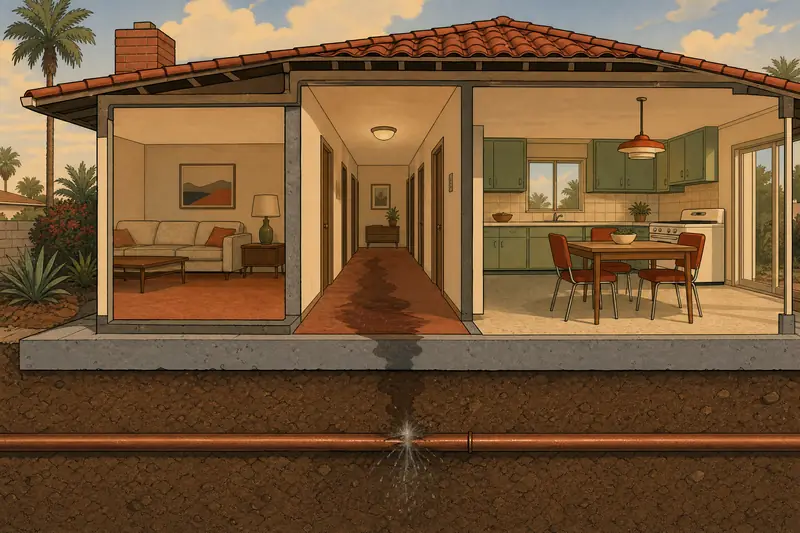
- Under the slab: a meter that moves with the house valve open but no fixture running, plus warm or damp floor spots. The slab leak page covers what comes next.
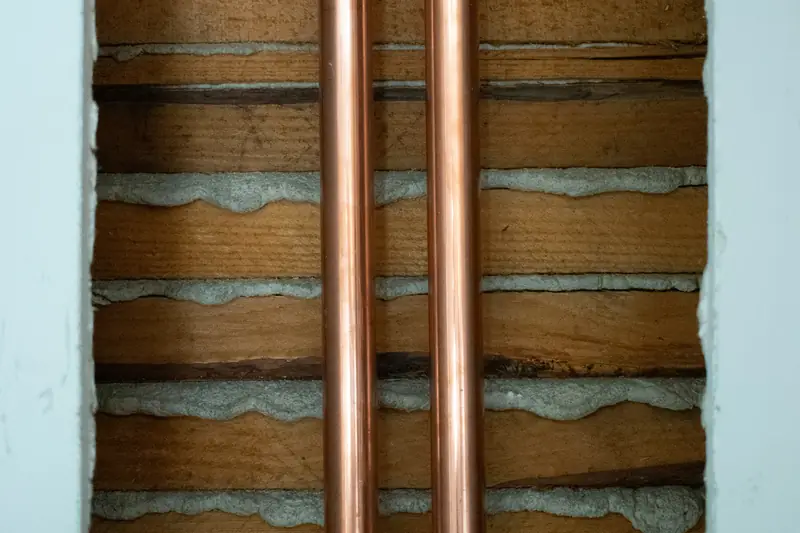
- Inside walls: stains, soft drywall or a musty smell near plumbing walls. Repeated pinholes in copper have their own pinhole leak page.
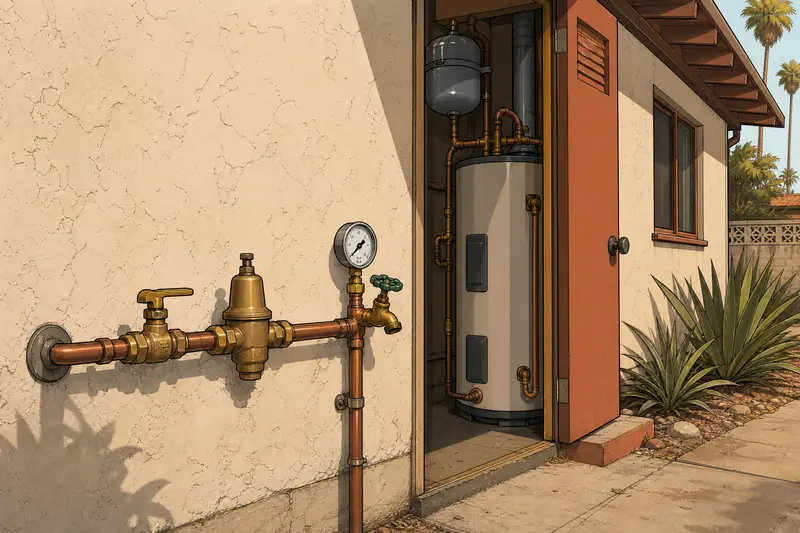
High house pressure strains all of these. A hose-bibb gauge reading above 80 psi breaks the California code limit; the pressure regulator page shows the test.
What does a sudden high water bill mean?
A sudden high water bill means either more water passed through the meter or the meter or bill is wrong, and the meter test tells you which to chase. If the meter moves with everything off, you have a leak. If it does not, compare the bill's usage with the same period last year and look for new uses such as a pool fill or a longer irrigation schedule.
EPA's winter yardstick: if four people go through over 12,000 gallons in a January or February billing month, serious leaks are possible. If you still think the meter is wrong, LADWP's rules (Rule 17) say the department will test a questioned meter. A meter registering more than 102 percent of true flow earns a refund or credit, and the test fee for a repeat request within 12 months is waived if the meter falls outside 98 to 102 percent.
When do you need leak detection help?
You need leak detection help when the meter shows a loss you cannot trace after ruling out toilets, faucets, irrigation and the water heater. That usually means a line under the slab, inside a wall or buried in the yard, where finding the exact spot takes equipment.
A flow or leak monitor can catch the next one sooner. EPA's WaterSense program describes devices that "alert you to irregular water use," and LADWP's October 2026 list offered as much as $150 toward a Wi-Fi monitor for a single-family home; Burbank Water and Power listed $150 for a flow monitor in its June 2026 newsletter. For the repair itself, a C-36 plumbing contractor's license can be checked on the CSLB site.
Hidden leaks in numbers
- 9,300+ galwater the average household's leaks waste each yearEPA WaterSense
- 9%homes with leaks of 50 gallons or more per dayEPA WaterSense
- 10 minwait before checking the bowl in a toilet dye testEPA WaterSense
- 6,300 galmonthly waste from an irrigation leak 1/32 inch wideEPA WaterSense
- 3,000+ galyearly waste from a faucet dripping once a secondEPA WaterSense
| Check | How long | What a positive result points to |
|---|---|---|
| Meter test, house valve open | 15 minutes to 2 hours | A leak somewhere past the meter |
| Meter test, house valve closed | 15 minutes | Yard line or irrigation feed between meter and house |
| Toilet dye test | 10 minutes | Worn flapper or tank seal |
| Winter bill review | January or February bill | Over 12,000 gallons a month for a family of four suggests serious leaks |
| Irrigation walk-through | One full cycle | Broken heads, weeping valves or a buried line leak |
Where this page comes from
Sources read in October 2026: EPA WaterSense (Fix a Leak Week); the 2025 water quality reports of the City of San Fernando, Burbank Water and Power (printed in its June 2026 Currents) and Glendale Water & Power; from LADWP, its water service guide, Rule 17 of its service rules, its conservation ordinance page and its Water$mart rebate list; and CSLB's C-36 class page. Rebate amounts are as listed then. Left out: leak detection prices and any LADWP leak-adjustment policy, which this site did not find published.
Still asking
Can a running toilet really show on the water bill?
Yes. EPA counts worn flappers among the most common household leaks, and a dye test takes 10 minutes. A failed test usually points to the flapper.
Does the meter test work in a house with a water softener?
Yes, as long as the softener is not regenerating during the test. Check its schedule, often overnight, and test at another time.
Why does my meter move only at night?
Something on a timer is running: sprinklers, a softener regeneration, a pool fill or an ice maker. Test again with those switched off before suspecting a leak.
Where is the low-flow indicator on a water meter?
Many meters carry a small low-flow dial, often a triangle or star shape, that spins with even a trickle. If yours has one, watch it during the test; it moves long before the main numbers change.
Is a yard-line leak LADWP's job?
No. Under LADWP's water service guide the customer is responsible for piping on the house side of the meter, so the owner fixes a yard-line break.
Do smart leak monitors stop leaks or just report them?
EPA's WaterSense guide describes devices that alert you to unusual use, so read what a given model does before buying, and confirm it qualifies for LADWP's rebate.
How often is a leak check worth repeating?
EPA's annual Fix a Leak Week is in March, which makes a convenient yearly reminder, and a check is worth repeating whenever a bill jumps.
That is the end of this page. Back to the full list of Valley water and plumbing pages.