Chromium-6 in San Fernando Valley Water
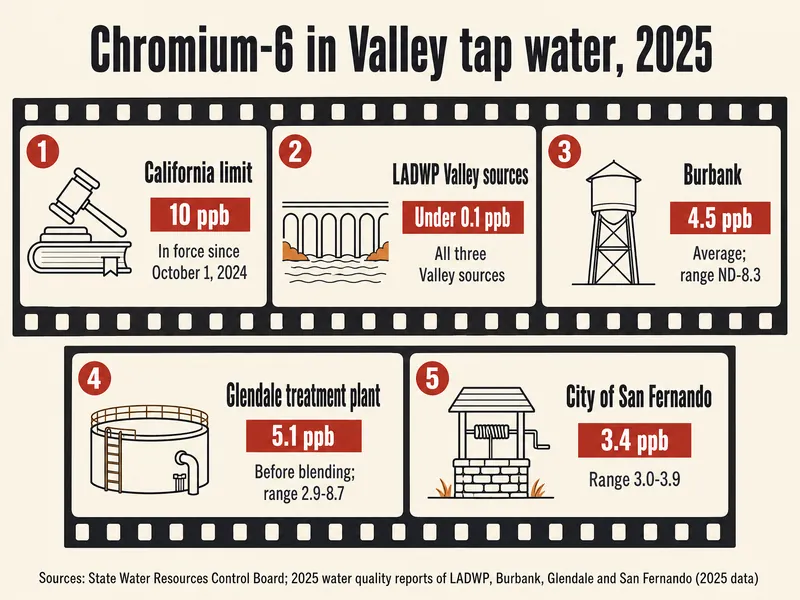
Chromium-6 in San Fernando Valley water stayed under California's 10 µg/L limit in 2025: LADWP's Valley sources tested below 0.1 µg/L, Burbank averaged 4.5 and San Fernando 3.4.
About the shop links on this page: Shutoff Valley shares its owners with Quality Water Treatment, the water-treatment shop linked on this page. What a shop says about its own products is labeled as the shop's claim. How shop links work here
Call sheet: what this page covers
Before you scroll
- California's chromium-6 limit (MCL) is 10 µg/L and took effect October 1, 2024, per the State Water Board; the public health goal is 0.02 µg/L.
- Water systems with more than 10,000 service connections had until October 1, 2026 to comply.
- LADWP's three Valley sources each averaged below 0.1 µg/L in 2025, the lowest level labs must report.
- Burbank's blended water averaged 4.5 ppb (ND to 8.3) and Glendale's groundwater plant 5.1 ppb before blending, in their 2025 reports.
- The chromium comes mostly from old industrial pollution in the eastern Valley's groundwater, now split into four EPA Superfund areas first listed in 1986.
- At home, reverse osmosis is one of three treatment methods the state names for chromium-6; check that your exact model is certified for it.
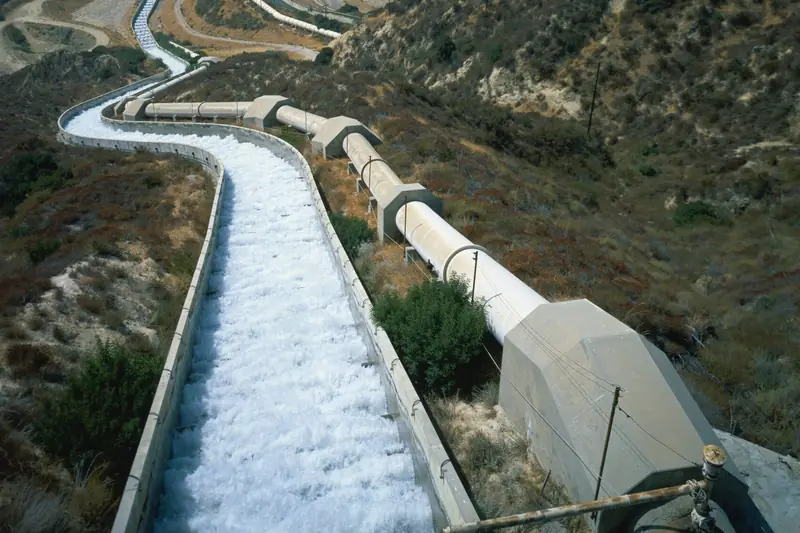
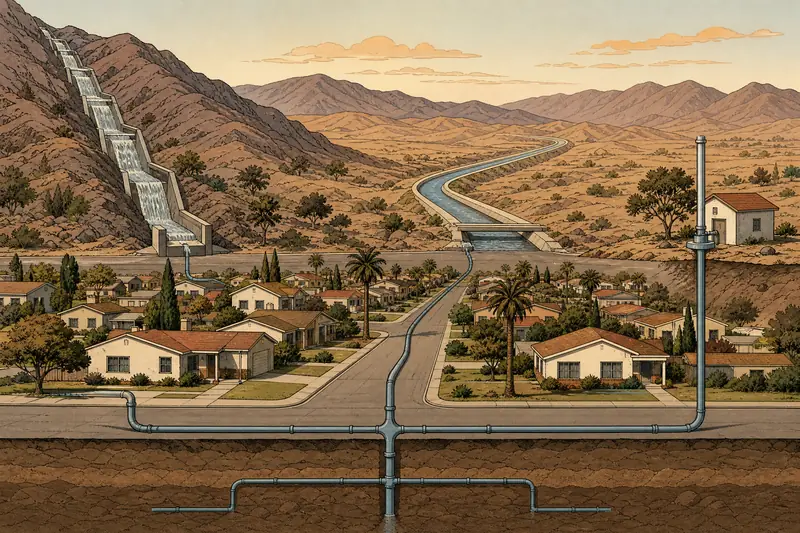
Chromium-6, also called hexavalent chromium, is the form of chromium that drinking water rules target. In the Valley it is a groundwater story: the imported water that arrives by aqueduct carries almost none, while wells in the eastern basin still draw on pollution left by decades of industry. Reports print it in ppb, which is the same as µg/L.
What is California's chromium-6 limit?
California's limit is 10 µg/L, and it has applied since October 1, 2024. The State Water Board's chromium-6 page also lists a public health goal (PHG) of 0.02 µg/L, set by OEHHA in 2011. The PHG is a health target, not an enforceable limit.
This is the state's second try. A 10 µg/L limit first took effect in 2014, but a Sacramento court threw it out in 2017 because the rule had not shown why it was economically feasible. Until the new rule, chromium-6 was covered only by the total chromium limit of 50 µg/L, which California has kept since 1977 (the federal total chromium limit is 100 µg/L).
The state gave water systems time to build treatment. Its chromium-6 rule FAQ sets October 1, 2026 for systems with more than 10,000 connections, October 1, 2027 for 1,000 to 10,000, and October 1, 2028 for smaller ones. The rule covers public water systems, not private wells.
How much chromium-6 is in San Fernando Valley water?
In 2025, chromium-6 in San Fernando Valley water ranged from under 0.1 µg/L on LADWP water to a few parts per billion in Burbank, Glendale and San Fernando. Every supplier's average sat below the 10 µg/L limit, and so did every single result printed.
LADWP's Drinking Water Quality Report 2025 (2025 data, published July 2026) shows less than 0.1 µg/L at the LA Aqueduct Filtration Plant, the Northern Combined Wells and the MWD Jensen plant, the three columns that apply to the Valley. The wells reached 0.6 µg/L at their highest.
Burbank Water and Power's 2025 water quality report (2025 data, published June 2026) gives an average of 4.5 ppb, from not detected (ND) up to 8.3. Those figures describe the blend of imported water and treated local groundwater that Burbank delivers.
Glendale reports chromium-6 only for its own groundwater plant: 5.1 ppb on average, 2.9 to 8.7, measured before that water is blended with imported supply. The imported water it buys tested ND. The City of San Fernando's report lists 3.4 ppb, with a range of 3.0 to 3.9, from its Sylmar Basin wells.
| Supplier | Average | Range | What the figure measures |
|---|---|---|---|
| LADWP (Valley) | under 0.1 µg/L | under 0.1 to 0.6 µg/L | Aqueduct plant, Northern Combined Wells and MWD Jensen water |
| Burbank Water and Power | 4.5 ppb | ND to 8.3 ppb | Blended imported water and treated groundwater |
| Glendale Water & Power | 5.1 ppb | 2.9 to 8.7 ppb | Groundwater plant output before blending |
| City of San Fernando | 3.4 ppb | 3.0 to 3.9 ppb | Sylmar Basin wells |
Where did the Valley's groundwater contamination come from?
It came from industry. Testing between 1981 and 1987 found contamination in more than half of the supply wells in the eastern San Fernando Valley basin, and EPA began listing Valley areas as Superfund sites in 1986; there are now four. The main chemicals are solvents (TCE and PCE), 1,4-dioxane and chromium-6.
EPA's Area 1 cleanup page describes about 20 square miles of polluted groundwater, mostly under North Hollywood and Burbank. Area 2 covers about 10 square miles under Glendale, and in 2007 EPA created a separate Glendale Chromium unit for total and hexavalent chromium there. Area 4 sits near LADWP's Pollock wells.
This is why the figures split the way they do. Burbank and Glendale lean on that basin: Glendale drew 31.3% of its 2025 water from it. LADWP drew only about 1% of its 2025 supply from local groundwater, so the Valley's LADWP taps mostly carry aqueduct and imported water. The water sources page has the full mix.
How is the groundwater being cleaned up?
Pumping and treating, for more than 35 years. The North Hollywood system began in 1989, and the Burbank plant has run since 1996 and treated about 36 billion gallons, according to EPA. A second North Hollywood plan adds treatment for chromium-6 and 1,4-dioxane at the wellhead.
Glendale's groundwater plant uses ion exchange, air stripping and activated carbon, and Glendale says it was a pioneer in researching how to remove chromium-6 from groundwater. LADWP has three larger plants, Tujunga Central plus North Hollywood Central and West, that LADWP describes as being built and commissioned in 2025 and 2026. Its groundwater remediation page and 2024-25 briefing book say the three together would let it pump about 104,000 acre-feet a year, roughly 20 percent of the city's water use.
Chromium-6 numbers to know
- 10 µg/LCalifornia's chromium-6 limit, in force since October 1, 2024State Water Resources Control Board
- 0.02 µg/LPublic health goal set by OEHHA in 2011State Water Resources Control Board
- 4.5 ppbBurbank's 2025 average (ND to 8.3)BWP 2025 Water Quality Report
- 5.1 ppbGlendale groundwater plant, before blending, 2025GWP 2025 Water Quality Report
- 36 billion galGroundwater treated by the Burbank plant since 1996U.S. EPA, San Fernando Valley Area 1
How do you check chromium-6 at your own tap?
Start with your supplier's yearly report, because chromium-6 results must be printed there. Find your supplier's column, then compare the average and range with the 10 µg/L limit; the page on reading your water quality report walks through the table.
If you want your own sample tested, the state's FAQ points to labs accredited by its Environmental Laboratory Accreditation Program (ELAP) for chromium-6. Ask the lab for a method that reports down to 0.1 µg/L, the state's reporting limit, or a low reading may come back as simply "not detected".
Which home filters are certified for chromium-6?
The State Water Board names three treatment methods that reliably bring chromium-6 under the limit: ion exchange, reduction-coagulation-filtration and reverse osmosis. Only a filter certified for chromium-6 reduction on that exact model is worth paying for this purpose, and the state's FAQ notes that under-sink (point-of-use) units are far more common than whole-house ones.
California requires any device sold with a health claim to be certified by an accredited body and registered. The State Water Board's device database can be searched by contaminant or model number.
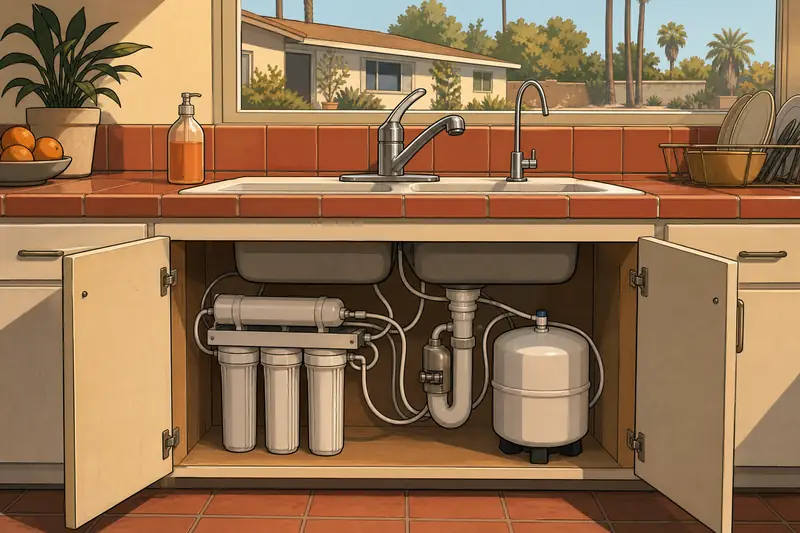
One example sold by a shop that shares owners with this site: Quality Water Treatment lists the Waterdrop G3-W under-sink reverse osmosis system at $459, the shop's listed price in October 2026. IAPMO R&T certifies it to NSF/ANSI 58 (file WC-13976) for reduction of TDS, fluoride, cadmium, hexavalent chromium and selenium. It is not certified for lead, so if lead is your concern, read the lead page first.
On LADWP water, with chromium-6 under 0.1 µg/L, a filter for this purpose has little to work on. In Burbank or Glendale it is a personal choice, not a fix for a violation. The under-sink reverse osmosis page covers upkeep, wastewater and the other certified model.
Where this page comes from
This page rests on the State Water Board's chromium-6 page and its November 2024 rule FAQ, the 2026 water quality reports (2025 data) from LADWP, Burbank, Glendale and San Fernando, EPA's San Fernando Valley Superfund pages, LADWP's groundwater remediation page and 2024-25 briefing book, and IAPMO R&T's certificate for the Waterdrop G3-W, all read in October 2026. It gives no health-risk estimates, does not say how Burbank treats its chromium-6 (its report does not say), and does not confirm whether LADWP's new plants are running yet.
Still asking
Is chromium-6 in Burbank water over the limit?
No. Burbank's 2025 average was 4.5 ppb and its highest result 8.3 ppb, both under California's 10 ppb limit. The figures describe the blended water Burbank delivers.
Why does Glendale report chromium-6 "before blending"?
Its figure of 5.1 ppb was measured on water leaving its groundwater plant, before it is mixed with imported water that tested ND. The water reaching homes is a blend of the two.
Is chromium-6 the same as the chromium on a lab report?
Not quite. Total chromium counts both the trivalent form, a nutrient, and the hexavalent form. Burbank's 2025 report lists total chromium at 4.8 ppb and chromium-6 at 4.5 ppb.
Does boiling water remove chromium-6?
None of the agency sources used here lists boiling as a way to reduce it. The methods the State Water Board names are ion exchange, reduction-coagulation-filtration and reverse osmosis.
Does a whole-house carbon filter remove chromium-6?
No whole-house carbon unit sold by the two linked shops is certified for chromium-6. Use the State Water Board's device database to see which models are certified for it.
Why was the 2014 chromium-6 limit thrown out?
A Sacramento County court ruled in 2017 that the state had not documented why the limit was economically feasible. It made no finding about whether 10 µg/L protected health, and the state adopted a new 10 µg/L rule effective in 2024.
Does the chromium-6 limit cover a private well?
No. The State Water Board's FAQ says the rule applies to public water systems, not private or domestic wells. Well owners arrange their own testing, and the board points them to its groundwater monitoring program for help.
That is the end of this page. Back to the full list of Valley water and plumbing pages.