Is LA Tap Water Safe to Drink?
Is LA tap water safe to drink? By the 2025 results, yes: LADWP reports it complied with every primary drinking water standard, and Burbank says its water met or beat all state and federal standards.
Call sheet: what this page covers
Before you scroll
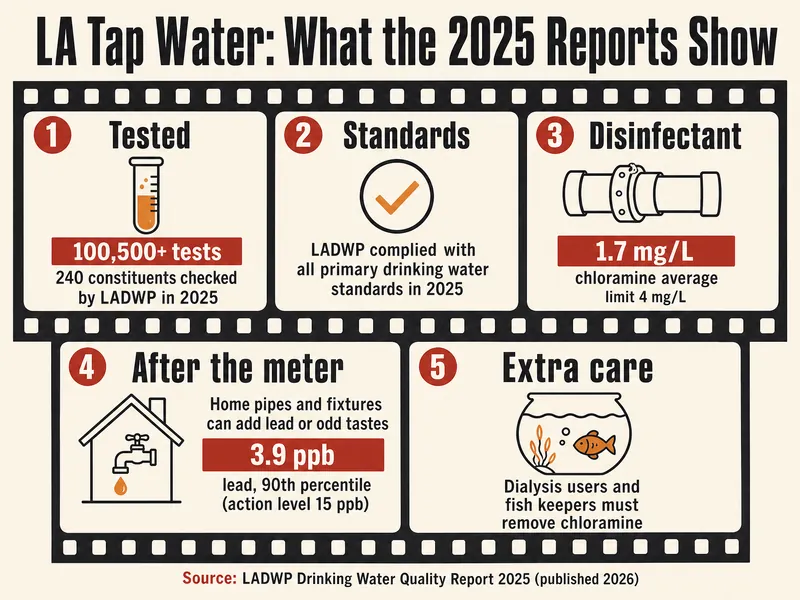
- LADWP ran more than 100,500 tests for 240 constituents in 2025 and complied with all primary drinking water standards, per its 2025 Drinking Water Quality Report.
- Burbank Water and Power reports no coliform violations, no assessments and no MCL violations in 2025.
- Chloramine keeps the water disinfected on its way to you; LADWP's residual averaged 1.7 mg/L, under the 4 mg/L limit.
- Lead at a faucet comes from home plumbing: LADWP found no lead service lines, yet 3 of 105 homes tested in 2023 were over 15 ppb.
- LADWP's report tells dialysis users and fish keepers to remove chloramine, and people with weakened immune systems to ask their doctor.
- A tank in Tujunga showed chlorate of 1,120 ppb in January 2026, above an 800 ppb advisory level, and was drained and cleaned.
The short answer covers the water as it leaves the supplier. What happens in the last stretch, inside your own pipes and faucets, is the part you control, and it is where most taste and lead questions start. Water reports print amounts in ppm (mg/L), ppb (µg/L) and ppt (ng/L).
Did LA tap water meet drinking water standards in 2025?
Yes. LADWP's report states that it "complied with all the primary drinking water standards in 2025", the enforceable health-based limits called MCLs. Burbank's 2025 water quality report (2025 data, published June 2026) says its water continues to meet or exceed all state and federal standards, with no coliform triggers, no Level 1 assessments and no MCL violations.
Glendale's 2025 report shows zero months in violation of the coliform standard, though it did complete one Level 1 assessment, a required check of its system, on December 9, 2025. The City of San Fernando's 2025 tables mark every regulated result "No" in the violation column.
Two LADWP notes are worth knowing. Its highest arsenic result was 7.0 µg/L, under the 10 µg/L MCL but above the 5 µg/L point where the report must print an arsenic advisory. And in January 2026 LADWP found chlorate above California's 800 ppb notification level, which is an advisory level rather than an enforceable standard, in two storage tanks; the Highway Highland Tank had served Tujunga from September 2025 and was taken out of service, drained and cleaned.
What do the Valley water reports test for?
The reports cover microbes, metals, nitrate, disinfection byproducts, radioactivity, PFAS and dozens of unregulated chemicals. LADWP tested for 240 constituents in 2025, and its water quality FAQ says crews sample about 300 locations around the City. Glendale's report counts more than 80,000 tests on over 375 constituents.
Each table lists the limit (MCL), the public health goal (PHG), the average and the range. Valley readers on LADWP water should read three columns: MWD Jensen, Northern Combined Wells and the LA Aqueduct Filtration Plant. For a walk through the terms, see how to read your water quality report.
Why does LA tap water taste of chlorine?
A faint chlorine smell comes from the disinfectant, which is meant to stay in the water all the way to your faucet. LADWP's FAQ says a slight chlorine odor may be noticeable "in some parts of the City", but it "should never be overwhelming". Glendale says the taste is strongest near its disinfection points and that running the taps usually clears it.
A strong bleach or chemical taste is different. LADWP's page on improving water quality at home says it often comes from chloramine reacting with organic buildup in household plumbing. Its fix: remove the faucet aerators, run all the faucets at full flow together for 5 minutes, then clean and refit the aerators. More on the disinfectant itself is on the chloramine page.
Where can tap water pick up problems after the meter?
After the meter, the pipes, valves and faucets belong to you, and they shape what comes out of the tap. LADWP's responsibility ends at the meter box near the curb; the service line from the meter to the house is the owner's. LADWP's FAQ suggests running the front hose bib wide open for a full two minutes, with any garden hose removed, then sampling it: if that water is fine and the kitchen tap is not, the cause is inside the house.
Lead is the main concern. LADWP's water quality page says its October 2024 inventory found no lead service lines, including customer-owned ones. Even so, its 2023 round found a 90th percentile of 3.9 ppb with 3 of 105 homes above 15 ppb, because lead can leach from old solder and brass fittings. The lead page covers testing your own tap.
Rubber parts wear too. LADWP's FAQ says black, sooty specks are often bits of a braided flexible supply hose whose rubber lining has broken down from chlorine or chloramine, and the fix is a new hose. Rusty or discolored water in an older house can point to galvanized pipe, covered on the galvanized pipes page.
Who should take extra care with LA tap water?
Three groups get specific advice in LADWP's report. People using dialysis machines "should make necessary adjustments to remove chloramines", and anyone with a fishpond, tank or aquarium must treat the water because chloramine harms fish. People with weakened immune systems, such as those on chemotherapy, transplant patients and some elderly people and infants, are told to ask their health care providers about drinking water.
Older homes deserve a thought too: if you are unsure what solder and fixtures your plumbing has, a certified lab test for lead is a sensible step. Federal rules under EPA's Lead and Copper Rule Improvements lower the action level to 10 µg/L from November 1, 2027.
When does a home filter make sense?
A filter makes sense when it solves a problem you have measured, not as a blanket fix. Taste is the most common reason in the Valley, and a carbon filter rated for chlorine taste and odor handles that. If a lab test finds lead at your tap, look for a filter certified to NSF/ANSI 53 or 58 for lead reduction for that exact model.
Hardness is a separate question: it is about scale on fixtures and water heaters, not safety. The City of San Fernando's report puts it plainly, calling hardness "a quality issue, not a safety concern". See under-sink reverse osmosis and testing tap water at home before you buy anything.
LA tap water, 2025 results
- 100,500+Tests LADWP ran in 2025, covering 240 constituentsLADWP Drinking Water Quality Report 2025
- 1.7 mg/LLADWP total chlorine residual average (limit 4)LADWP Drinking Water Quality Report 2025
- 3.9 ppbLADWP lead, 90th percentile, 2023 roundLADWP Drinking Water Quality Report 2025
- 0Burbank MCL violations in 2025BWP 2025 Water Quality Report
| Supplier | Primary standards | Notes for 2025 | Lead, 2023 round |
|---|---|---|---|
| LADWP | Complied with all | Arsenic advisory (highest 7.0 µg/L); chlorate in two tanks, January 2026 | 3.9 ppb; 3 of 105 over 15 ppb |
| Burbank (BWP) | Met or exceeded all | No coliform triggers or assessments | ND; 0 of 55 over |
| Glendale (GWP) | 0 months in coliform violation | One Level 1 assessment, completed December 9, 2025 | ND; 0 of 51 over |
| City of San Fernando | No violations marked | Hardness called a quality issue, not a safety concern | 2.3 ppb; 0 of 30 over |
Where this page comes from
Sources read in October 2026: the yearly reports published in 2026 by LADWP, Burbank, Glendale and San Fernando (calendar 2025 data); three LADWP web pages (the FAQ, the water quality page and the page on improving water quality at home); and EPA's page on the 2024 lead rule. It does not rank or grade the utilities, makes no health claims beyond the reports' own advisories, and does not cover private wells or suppliers outside these four.
Still asking
Can I drink LA tap water straight from the faucet?
LADWP reports that its 2025 water complied with all primary standards, so the water arriving at your meter is drinkable. If your tap tastes odd, run it and test at the front hose bib to see whether your house plumbing is the cause.
Is bottled water safer than LA tap water?
The reports do not compare the two. LADWP's report notes that both tap and bottled water can contain small amounts of some contaminants, and that their presence does not necessarily mean a health risk.
Why does my water look milky for a moment?
LADWP's FAQ says milky water is usually tiny air bubbles, often in spring as the weather warms or after a shutoff. Its test: fill a clear glass and watch for 2 or 3 minutes; if it clears from the bottom up, it is air.
Which homes did LADWP test for lead?
The 2023 round used 105 first-draw samples from single-family homes built between 1982 and 1987 with original plumbing, chosen because their copper pipes are expected to have lead solder. LADWP's report says the next round is due in summer 2026.
Was the Tujunga chlorate finding a violation?
No. Chlorate has a California notification level of 800 ppb, which is advisory and not enforceable. LADWP drained and cleaned the Highway Highland Tank and says it is adding testing and changing chemical storage.
Do Burbank and Glendale residents get the same answer?
Both reports show no MCL violations for 2025, with Glendale noting one Level 1 assessment. Their water is harder than LADWP's, which affects scale but not safety.
That is the end of this page. Back to every Valley water and plumbing page.