Are Water Softeners Allowed in Los Angeles?
Are water softeners allowed in Los Angeles? In the San Fernando Valley, no rule restricting them was found in October 2026; the county's ban on salt softeners applies to the Santa Clarita Valley and Newhall Ranch.
About the shop links on this page: Shutoff Valley shares its owners with SoftPro Water Systems and Quality Water Treatment, the two water-treatment shops linked on this page. What a shop says about its own products is labeled as the shop's claim. How shop links work here
Call sheet: what this page covers
Before you scroll
- California Water Code § 13148 lets a sewer or water-recycling agency ban self-regenerating softeners only after a Regional Board finding and a public hearing.
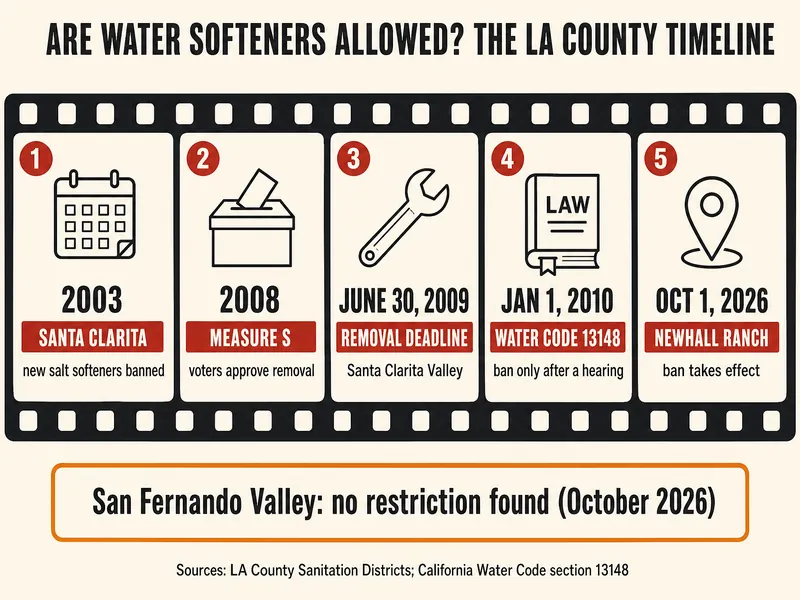
- LA County Sanitation Districts prohibit automatic salt softeners throughout the Santa Clarita Valley; new installations have been banned there since 2003.
- Santa Clarita voters passed Measure S on November 4, 2008, which required existing units to be removed by June 30, 2009.
- The Newhall Ranch Sanitation District's ban took effect on October 1, 2026.
- No restriction covering the San Fernando Valley was found on LACSD, LA Sanitation, LADWP, Burbank, Glendale or San Fernando pages read in October 2026.
- Portable exchange tanks, carbon filters, reverse osmosis and salt-free (TAC) units are the alternatives LACSD lists as acceptable.
What does California law say about water softeners?
California law lets certain local agencies restrict water softeners, but only through a set process. Water Code § 13148, added by AB 1366 and in force since January 1, 2010, allows an agency that runs a community sewer system or water recycling plant to control salt from "residential self-regenerating water softeners." It can act only if its Regional Water Quality Control Board has made a finding about salinity, and only by ordinance or resolution after a public hearing.
The menu of options in the statute runs up to banning new installations and requiring removal of existing ones. An agency that orders removal must offer owners a compensation program for the reasonable value of the unit. The section applies in named hydrologic regions, including the South Coast, Central Coast, San Joaquin River and Tulare Lake regions. It "does not limit the use of portable exchange water softening appliances," the tanks a service company swaps and recharges off site.
Where are softeners banned in Los Angeles County?
In Los Angeles County, the ban on salt softeners covers the Santa Clarita Valley and, since October 2026, Newhall Ranch. The LA County Sanitation Districts say automatic, self-regenerating salt-based softeners "are prohibited throughout the Santa Clarita Valley," naming the City of Santa Clarita, Stephenson Ranch, Castaic and Valencia by FivePoint.
| Area | Agency | Rule found | Since |
|---|---|---|---|
| Santa Clarita Valley | LA County Sanitation Districts | New automatic salt softeners prohibited | 2003 |
| Santa Clarita Valley | LA County Sanitation Districts (Measure S) | Existing units removed | Deadline June 30, 2009 |
| Newhall Ranch | Newhall Ranch Sanitation District | Salt softeners prohibited | October 1, 2026 |
| LADWP Valley neighborhoods | LA Sanitation, LADWP | No restriction found | n/a |
| Burbank, Glendale, City of San Fernando | City utilities | No restriction found | n/a |
Installation has been prohibited in the Santa Clarita Valley since 2003. Measure S, approved by voters on November 4, 2008, required removal of residential automatic softeners that discharge chloride to the sewer by June 30, 2009. The Newhall Ranch Sanitation District adopted its own ordinance on September 1, 2026, effective October 1, 2026.
Why do sewer agencies care about softener salt?
Sewer agencies care because the salt a softener flushes out ends up in treated wastewater, and ordinary treatment plants do not remove it. EPA's WaterSense softener guide says regeneration creates "a salty brine that may pose problems for wastewater treatment and local water quality," and that some jurisdictions prohibit softeners for that reason.
In Santa Clarita the issue is chloride. Wastewater there goes to the Valencia and Saugus water reclamation plants, and LACSD's chloride program targets what reaches the sewer; it notes an advanced chloride treatment facility at the Valencia plant that has run since 2023. Switching to potassium chloride does not fix this: the Water Quality Association says it is not recommended for cutting chloride, because regeneration needs a 13-15% higher concentration of it.
Each regeneration also uses water: EPA puts a typical cycle at 20 to 70 gallons. That is why WaterSense pushes demand-initiated models that regenerate only after a set volume, rather than on a timer.
Are softeners allowed in the San Fernando Valley?
As of October 2026, no rule restricting water softeners in the San Fernando Valley was found. The pages read were from LACSD, LA Sanitation, LADWP, Burbank Water and Power, Glendale Water & Power and the City of San Fernando. LADWP's water quality FAQ discusses softeners as a homeowner's choice, and the City of San Fernando's 2025 report says "some households choose to install water softeners to reduce scaling."
"Not found" is not the same as "legal everywhere forever." Section 13148 lets a sewer agency adopt a ban after a hearing, so rules can change, and a homeowners association or a rental lease can add its own limits. Check with your city before installing. Whether a softener is worth it on your water is a separate question, covered on do you need a water softener in the Valley and Valley water hardness by supplier.
Rules at a glance
- 2003Year Santa Clarita Valley banned new automatic salt softenersLA County Sanitation Districts
- June 30, 2009Removal deadline under Measure SLA County Sanitation Districts
- Jan 1, 2010Water Code § 13148 took effect (AB 1366)California Legislative Information
- Oct 1, 2026Newhall Ranch softener ban effectiveLA County Sanitation Districts
- 20-70 galWater used in a typical regenerationEPA WaterSense softener guide (2026)
What are the salt-free alternatives?
The alternatives are any treatment that adds no sodium or potassium chloride to the sewer. LACSD's acceptable alternatives page, written for the Santa Clarita Valley, lists carbon filters, portable exchange tanks, reverse osmosis and template-assisted crystallization (TAC) units.
- Portable exchange tanks: a service company swaps them every 2 to 4 weeks, per LACSD, and recharges them off site. They do soften.
- Salt-free (TAC) conditioners: they reduce scale but leave the hardness minerals in the water. Details are on salt-free water conditioners.
- Reverse osmosis: an under-sink unit treats drinking water only; LACSD says sediment filters need changing every 6 months and the membrane every 3 to 5 years. See under-sink reverse osmosis.
- Carbon filters: they target chlorine and chloramine taste, not hardness.
For no-salt units, EPA WaterSense points buyers to Z601, the IAPMO/ANSI scale-reduction standard.
What should you check before installing one?
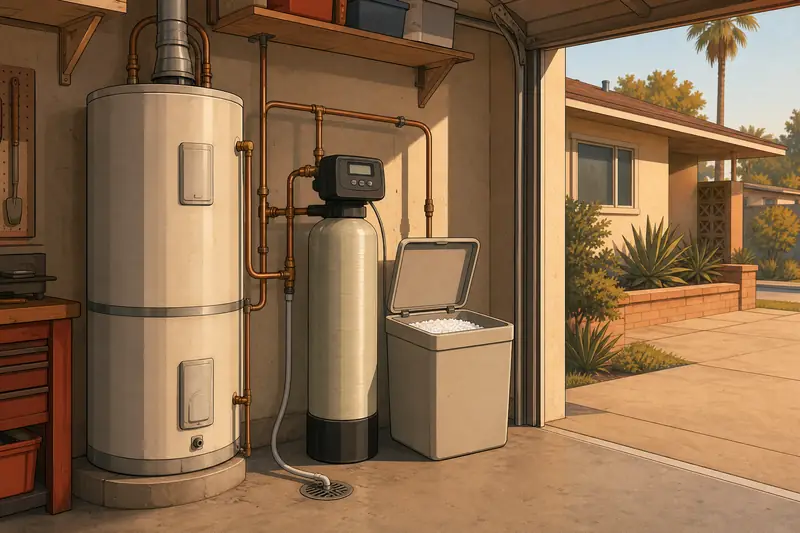
Before installing a salt softener, check local rules, your plumbing and the unit's efficiency. A short list:
- Ask your city's sewer or public works office whether any softener ordinance is pending; EPA's guide says to check local restrictions before buying.
- If the house is on a septic system, ask the septic maker or a local service provider whether regeneration brine will overload it, as EPA advises.
- Pick a metered (demand-initiated) model, ideally one certified to NSF/ANSI 44 at better than 3,350 grains of hardness per pound of salt.
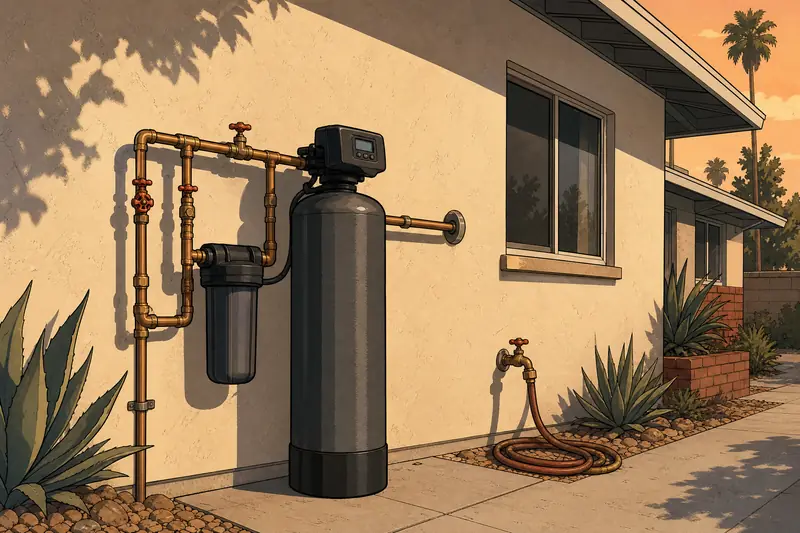
- Plumb it before the water heater and after the branch to irrigation and hose bibbs.
- Have a licensed plumber (C-36, checkable at cslb.ca.gov) make the connection if you are not doing the work yourself.
Both routes are sold by the two shops that share this site's owners: the SoftPro ECO city softener (sold by SoftPro Water Systems, which shares owners with this site) (from $967, the shop's listed price in October 2026) and a salt-free conditioner at Quality Water Treatment (sold by Quality Water Treatment, which shares owners with this site) ($1,299 listed). That unit is sold as a no-salt scale reducer. Whether its media counts as TAC under Santa Clarita's rules is something only the maker can confirm.
Where this page comes from
What this rests on: California Water Code § 13148 as published on leginfo.legislature.ca.gov; the LA County Sanitation Districts' Santa Clarita Valley chloride control and acceptable alternatives pages; EPA WaterSense's 2026 softener guide; the Water Quality Association's softener best practices; the City of San Fernando's 2025 water quality report; and LADWP's water quality FAQ, all read in October 2026. The "no restriction found" finding comes from those agency pages, not from a legal search of every ordinance. Left out: legal advice, permit fees and any statement that softeners are allowed everywhere.
Still asking
Are water softeners banned in California?
No statewide ban exists. Water Code § 13148 lets individual sewer and recycling agencies restrict self-regenerating softeners after a Regional Board finding and a public hearing. Santa Clarita Valley and Newhall Ranch are the Los Angeles County areas where that has happened.
Can I install a water softener in Burbank or Glendale?
No restriction was found on Burbank Water and Power or Glendale Water & Power pages read in October 2026. Ask the city's public works or building department before installing, since a rule could be adopted after a public hearing.
Is a portable exchange softener allowed in Santa Clarita?
Yes. LACSD lists portable exchange tanks as an acceptable alternative, and § 13148 says it does not limit portable exchange appliances. The tanks are recharged off site, so no brine goes into the local sewer.
Does using potassium instead of salt get around the Santa Clarita ban?
No. The ban covers automatic softeners that discharge brine, and LACSD's acceptable systems are those that add no sodium chloride or potassium chloride. The Water Quality Association also notes potassium chloride does not reduce chloride discharge.
What happens to a salt softener after a move to Santa Clarita?
LACSD says automatic salt softeners are prohibited throughout the Santa Clarita Valley, so the unit should not be reconnected there. A portable exchange service or a salt-free system are the listed alternatives.
Did Measure S pay owners to remove their softeners?
Section 13148 requires an agency that orders removal to offer compensation for the reasonable value of the unit. LACSD's current page does not describe a program open today, so ask the Sanitation Districts directly.
Could the San Fernando Valley get a softener ban later?
It could, but only through the process in § 13148: a Regional Board finding about salinity, then an ordinance or resolution after a public hearing. No such action covering the Valley was found in October 2026.
That is the end of this page. Back to the Shutoff Valley front page.