Water Heater Straps: California's Rules
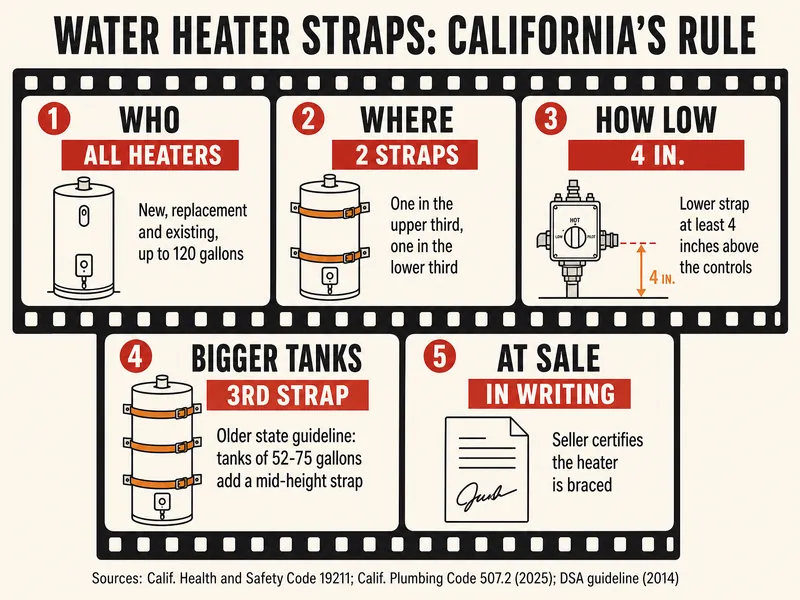
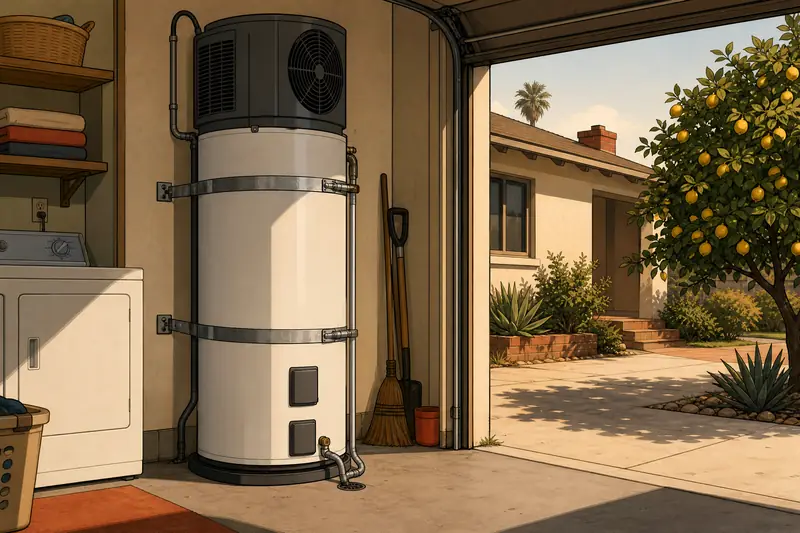
Water heater straps are required on every California home tank up to 120 gallons: one strap in the upper third, one in the lower third, the lower one at least 4 inches above the controls.
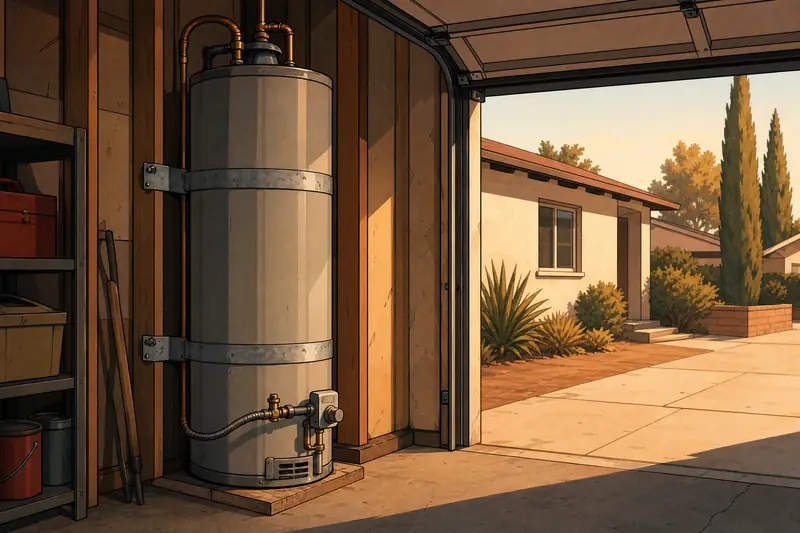
Call sheet: what this page covers
Before you scroll
- California Health and Safety Code § 19211 covers new, replacement and existing residential water heaters of not more than 120 gallons.
- The 2025 California Plumbing Code, in force since January 1, 2026, puts straps in the upper one-third and lower one-third of the tank (section 507.2).
- The lower strap sits at least 4 inches above the gas or electric controls.
- The state's older 2014 bracing guideline asked for two straps on tanks of 52 gallons or less and added a third, mid-height strap on tanks over 52 and up to 75 gallons.
- Anyone selling a home must certify in writing that the heater meets § 19211.
- Copper or stainless flexible water connectors at the heater may be no longer than 24 inches (CPC 604.13).
What does California law require for water heater straps?
Every home water heater in California has to be secured so shaking cannot tip it over or slide it sideways. The rule lives in Health and Safety Code § 19211(a), and it reaches new heaters, replacement heaters and existing ones, not only heaters installed after a certain year.
The statute sets a floor: at a minimum the heater must be secured as the California Plumbing Code says, or as a city's local amendment says. It applies to a "standard water heater" of not more than 120 gallons for which a pre-engineered strapping kit is readily available, which covers nearly every tank in a Valley garage or closet.
Two smaller rules sit beside it. Heaters made for sale in California since July 1, 1991 must say in their instructions that they must be braced, and the front label carries the warning "THIS WATER HEATER MUST BE BRACED, ANCHORED, OR STRAPPED" (§§ 19212-19213). A landlord also may not evict a tenant on the grounds that strapping requires it.
Where do water heater straps go?
Straps go in two bands: one within the upper third of the tank's height and one within the lower third. The 2025 California Plumbing Code, section 507.2 (read on IAPMO's code site), adds one placement rule: at the lower point, the strap must be at least 4 inches above the controls, so the gas valve or electric thermostat cover stays clear.
Measure the tank's height, divide by three, and mark both bands inside those zones. The state's older bracing guideline from the Division of the State Architect (2014) gave a working layout: mark the upper strap about 9 inches below the top of the tank and the lower one 4 inches above the top of the controls.
That same guideline described the hardware: 3/4-inch, 24-gauge perforated steel strap or 1/2-inch EMT conduit, fastened into wall studs with 1/4-by-3-inch lag screws and washers. Where the tank stood well away from the wall, it called for a steel ledger angle instead of a long loose strap. Treat these as the older state detail; the plumbing code itself names locations, not a brand of kit.
How many straps does a heater need?
Most home heaters need two straps, one in each third. The older state guideline said "a minimum of two sets of bracing straps" for tanks of 52 gallons or less and added a third set at mid-height for tanks up to 75 gallons. The guideline is no longer on the Department of General Services site, so cite it only as the state's earlier advice; the current code wording is the upper-third and lower-third rule.
FEMA's homeowner booklet, Earthquake Safety at Home (P-530, 2020), calls bracing a heater "relatively easy and inexpensive" and lists it among low-cost quake tasks.
| Rule | What it says | Source |
|---|---|---|
| Who must brace | New, replacement and existing residential heaters | H&SC § 19211(a), amended 2003 |
| Size covered | Standard heaters of not more than 120 gallons | H&SC § 19211(d) |
| Strap locations | Upper one-third and lower one-third of the height | 2025 CPC 507.2 (in force Jan 1, 2026) |
| Clearance at controls | Lower strap at least 4 inches above the controls | 2025 CPC 507.2 |
| Larger tanks | Third strap at mid-height up to 75 gallons | DSA guideline, 2014 (older) |
| Flexible connectors | Copper or stainless no longer than 24 inches | 2025 CPC 604.13 |
| Home sale | Seller certifies compliance in writing | H&SC § 19211(b) |
Do tankless and heat pump heaters need straps?
A heat pump water heater is still a storage tank, so it gets straps like any other tank; the heat pump water heater page covers its other needs. A tankless heater is different: it hangs on brackets screwed to the wall, and the maker's manual sets how it is mounted. Rinnai's SENSEI manual, for example, tells installers to screw the top and bottom brackets securely into the wall.
The § 19211 definition helps here. It covers a standard heater "for which a preengineered strapping kit is readily available," which describes tanks, not wall-hung units. If a tankless heater is being installed, ask the installer how it will be fixed to framing rather than to stucco or drywall alone.
What else should a quake-ready heater have?
A strapped tank still needs connections that can move. The older state guideline "strongly recommend[s]" code-compliant flexible connectors on the water, gas and electrical lines, and the 2025 plumbing code caps copper or stainless flexible water connectors at 24 inches and bars PEX, PE-RT and similar tubing within 18 inches of the heater's outlets (CPC 604.13).
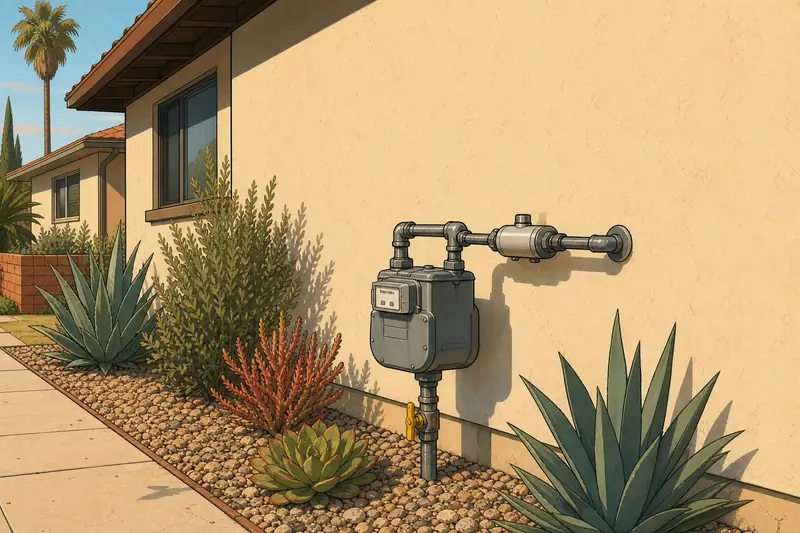
Gas is the part to think through calmly. In Los Angeles, a seismic or excess-flow gas shutoff valve on the house line is required in some cases, such as before a sale; the seismic gas shutoff valve page explains LAMC 94.1216. Where a leak would damage the home, as in an attic or over a ceiling, a pan with a drain of at least 3/4 inch is also required (CPC 507.5).
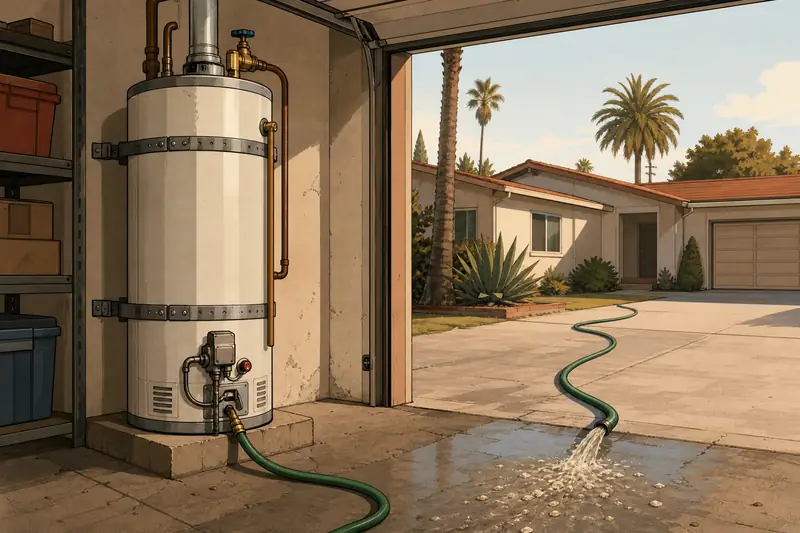
A braced, undamaged tank is also stored water. FEMA P-530 notes a heater "typically contains 40 gallons" usable in an emergency if it was properly restrained; the emergency water storage page shows how to draw it safely.
Who checks water heater straps?
Three moments bring a check. A replacement heater in Los Angeles needs a plumbing permit under LAMC 94.103.1.1, and the work must meet the plumbing code, strapping included; a certified licensed contractor swapping a same-size heater on a detached single-family home may file a Certificate of Compliance instead. Burbank treats a water heater as a Tier 1 permit, available over the counter or online. Glendale's building department sets its own process: ask there.
The second moment is a sale. Under § 19211(b), the seller must certify in writing that the heater is braced, often in the transfer disclosure statement or the Homeowner's Guide to Earthquake Safety. The third is you: look at the tank today. If a strap is missing, loose, or sits on top of the gas control, a licensed plumber (C-36) can redo it, and the plumbing checks after an earthquake lists what to look at once a quake is over.
The water heaters folder gathers the rest of this subject, including how long tanks last on Valley water.
Strapping in numbers
- 120 gallonsLargest heater covered by the strapping statuteCalif. Health and Safety Code § 19211(d)
- 4 inchesMinimum gap from the controls to the lower strap2025 California Plumbing Code 507.2
- 24 inchesLongest copper or stainless flexible connector allowed2025 California Plumbing Code 604.13
- 40 gallonsUsable water in a typical restrained heaterFEMA P-530 (2020)
Where this page comes from
This page is based on California Health and Safety Code §§ 19211-19216 (as amended in 2003), the 2025 California Plumbing Code sections 507.2, 507.5 and 604.13 read on IAPMO's site, the Division of the State Architect's 2014 bracing guideline (an archived official copy, since the live file is gone), FEMA P-530 (2020), Los Angeles Municipal Code 94.103 and the City of Burbank permits page; everything was read in October 2026. Not included: strap kit brands, prices, permit fees, and any count of heaters that fell in the 1994 Northridge earthquake, since no primary source gives one. Glendale's permit rules were not read.
Still asking
Does an old water heater that was never strapped have to be strapped now?
Yes. Section 19211 names "all existing residential water heaters," not just new installs. There is no age exemption for a tank that has stood unbraced for years.
Can plumber's tape alone hold a water heater?
The state's older guideline allowed 3/4-inch, 24-gauge perforated steel strap fastened into studs with lag screws. Thin hanger tape screwed into drywall is not that detail. Ask a licensed plumber to match the kit's instructions and the code's two locations.
Do straps need to go into wall studs?
The older state guideline fastened straps into studs with 1/4-by-3-inch lag screws and washers. Drywall or stucco alone does not hold a heavy tank in shaking.
Is a water heater in a closet strapped differently?
The same two-band rule applies. Where a closet tank stands away from the back wall, the older guideline used a steel ledger angle so the tank cannot rock in the gap.
What happens at escrow if the heater isn't strapped?
The seller must certify bracing in writing under § 19211(b), so a missing strap has to be dealt with before the seller can sign that statement truthfully.
Does a renter or the landlord strap the heater?
The statute puts the duty on the property, and § 19211(c) bars a landlord from evicting a tenant to comply. Tenants should ask the owner or manager in writing.
Are earthquake straps required in Burbank and Glendale too?
Yes. Section 19211 is state law, so it applies in Burbank, Glendale and San Fernando as well as Los Angeles. Each city's building department handles the permit for a replacement.
That is the end of this page. Back to all five Shutoff Valley folders.