Lead in San Fernando Valley Tap Water
Lead in tap water across the San Fernando Valley traces to home plumbing, not the mains: LADWP and Burbank report no lead service lines, and 2023 tap tests came in at 3.9 ppb or lower.
About the shop links on this page: Shutoff Valley shares its owners with SoftPro Water Systems, the water-treatment shop linked on this page. What a shop says about its own products is labeled as the shop's claim. How shop links work here
Call sheet: what this page covers
Before you scroll
- LADWP finished its service line inventory in October 2024 and found no lead lines, including the customer-owned stretch, per its water quality page.
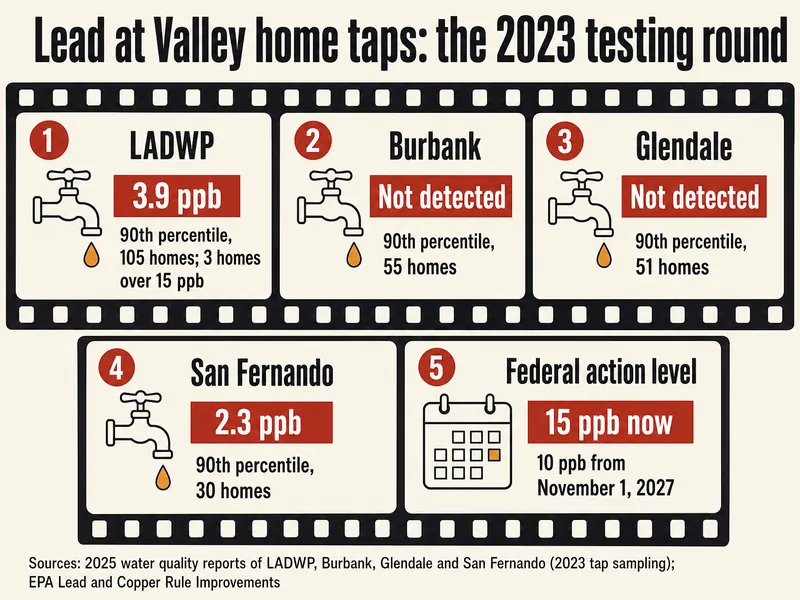
- In LADWP's 2023 tap round, 90% of 105 homes were at or under 3.9 ppb; 3 homes went over the 15 ppb action level.
- At the 90th percentile, lead was not detected in Burbank's 55 sampled homes or Glendale's 51; San Fernando's 30 homes came in at 2.3 ppb.
- EPA's new rule drops the action level from 15 to 10 µg/L on November 1, 2027.
- Brass faucets and lead solder are the usual sources in homes without a lead service line, according to EPA.
- A lab test costs about $20 to $100, by EPA's estimate, and is the only sure way to know.
Lead is the one tap water question where your house matters more than your supplier. The utility can keep lead out of its own pipes and make its water less corrosive, but it cannot change the solder, brass and fixtures behind your walls. Reports give lead in ppb, which equals µg/L.
Does LADWP have lead service lines?
No. LADWP says its October 2024 inventory found "no lead service lines or galvanized pipes requiring replacement" in its system, and that this includes privately owned and customer-owned lines. It checked the utility side in 2021, began on the customer side in 2022, and now holds a non-lead designation from the State Water Board.
That record is older than the inventory. LADWP's Drinking Water Quality Report 2025 (2025 data, published July 2026) says it removed about 12,000 lead goosenecks, short connectors at the main, by 2005, and had swapped more than 607,000 of its roughly 700,000 meters for lead-free ones by December 2025. The State Water Board rates its corrosion control as optimized.
Burbank Water and Power's 2025 report says it has no lead service lines and found none when it inspected the customer side. Glendale's 2025 report does not describe its inventory, and the City of San Fernando makes its inventory available on request from its Public Works Department rather than printing it.
What did lead testing at Valley taps find?
The latest round, sampled in 2023, found low lead at most homes. Results are reported as a 90th percentile: the level that 90% of sampled homes were at or under. Under EPA's rule, a system must take extra steps when more than 10% of its samples top the 15 ppb action level.
LADWP sampled 105 single-family houses dating from 1982 to 1987, picked because their copper pipes were expected to have lead solder, the homes most likely to show lead. Its 90th percentile was 3.9 ppb, and 3 of the 105 homes were above 15 ppb. LADWP's next round runs from June to September 2026, and its report invites owners of qualifying homes to call its water quality hotline to take part.
Burbank's 2025 water quality report shows lead not detected at the 90th percentile in 55 homes, with none over the action level. Glendale reports the same for 51 taps. San Fernando's 30 sites came in at 2.3 ppb, with a highest reading of 4.7 ppb.
| Supplier | Homes sampled | 90th percentile | Over 15 ppb |
|---|---|---|---|
| LADWP | 105 | 3.9 ppb | 3 |
| Burbank Water and Power | 55 | not detected | 0 |
| Glendale Water & Power | 51 | not detected | 0 |
| City of San Fernando | 30 | 2.3 ppb | 0 |
Where can lead in tap water come from inside a home?
Inside a Valley home, lead in tap water usually comes from brass or chrome-plated brass faucets and valves, or from lead solder on copper pipe joints. EPA's lead basics page names these as the most common problem in homes without a lead service line. LADWP's report says the same: lead in drinking water comes mainly from service lines and home plumbing, which the utility does not control.
Age is the main clue. EPA notes that lead pipes are more likely in homes built before 1986, and the rules for "lead-free" plumbing tightened in 2011 to a weighted average of 0.25% lead on wetted surfaces and 0.2% in solder and flux. A faucet or valve bought in the 2000s may contain more lead than one bought today.
Old galvanized pipe is a separate concern. EPA says lead particles can attach to the inside of galvanized pipes and later flake into the water, mainly where a lead line once ran upstream. Since LADWP found no lead lines, that risk is smaller here, but the galvanized pipes page explains what else old steel pipe does.
Lead numbers to know
- 3.9 ppbLADWP 90th-percentile lead across 105 homes (2023 sampling)LADWP Drinking Water Quality Report 2025
- 15 ppbFederal lead action level todayU.S. EPA
- 10 µg/LAction level from November 1, 2027 under the new federal ruleU.S. EPA, Lead and Copper Rule Improvements
- 12,000Lead goosenecks LADWP removed by 2005LADWP Drinking Water Quality Report 2025
- $20-$100Typical cost of a lead test at a certified labU.S. EPA
What changes with the 2027 federal lead rule?
EPA's Lead and Copper Rule Improvements, finalized October 8, 2024, lower the action level from 15 to 10 µg/L and require most systems to replace lead and certain galvanized service lines within 10 years. Compliance starts November 1, 2027.
For LADWP and Burbank, which report no lead service lines, the replacement part has little to do. The lower action level matters more: the same kind of tap sampling will be judged against 10 µg/L. EPA's goal for lead (its MCLG) is zero, because it says no safe level of exposure is known.
How do you test your own tap for lead?
Send a sample to a certified lab; you cannot see, taste or smell lead. In California, labs are accredited through the State Water Board's Environmental Laboratory Accreditation Program (ELAP). Follow the lab's own bottle and sampling instructions; LADWP's survey used first-draw samples, the water that comes out first after sitting in the pipes.
LADWP customers can also call the water quality hotline listed in LADWP's report to ask about testing, and owners of qualifying 1982-1987 homes can join the summer sampling round. The home testing page explains why drop kits and TDS meters cannot measure lead.
Until you have a result, LADWP's report gives three habits: drink and cook with cold water, run the tap for 1 to 2 minutes when water has sat (a shower or a load of laundry does the job), and use a filter certified for lead if you want one.
Which filters are certified to reduce lead?
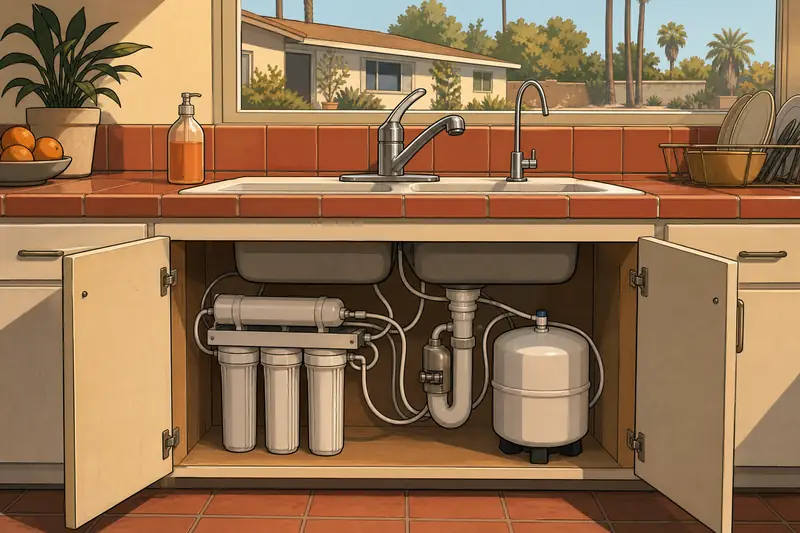
Look for certification to NSF/ANSI 53 or 58 for lead reduction on the exact model, from an accredited certifier. EPA keeps a consumer tool for lead-certified filters, and California's registered device database can be searched for lead. EPA adds two cautions: replace the cartridge on schedule, and never run hot water through it.
One example from a shop that shares owners with this site: SoftPro Water Systems lists the Waterdrop G3P600 under-sink reverse osmosis system at $429, the shop's listed price in October 2026. IAPMO R&T certifies it to NSF/ANSI 58 (file WC-13976) for lead, TDS, fluoride, cadmium, barium and radium reduction, and its carbon stage to NSF/ANSI 53 for PFOA and PFOS (file WC-14805). The similar G3-W model is not certified for lead.
A filter treats one tap. If a lab finds lead, finding the fixture or solder joint behind it is the lasting fix; the repiping page covers what replacing old supply pipe involves, and the reverse osmosis page compares the two certified under-sink models.
Where this page comes from
This page is built from LADWP's water quality page and its Drinking Water Quality Report 2025, the 2026 reports (2025 data, 2023 lead sampling) from Burbank, Glendale and San Fernando, EPA's lead basics page, its Lead and Copper Rule Improvements page and its 2017 lead infographic, the State Water Board's ELAP and device registration pages, and IAPMO R&T's certificates for the Waterdrop G3P600 and G3-W; everything was read in October 2026. The page does not give medical advice, does not print the phone numbers in the reports, and says nothing about Glendale's service line inventory, which its report does not describe.
Still asking
Why did LADWP test homes built from 1982 to 1987?
The tap sampling rule targets homes most likely to show lead. LADWP says homes from those years with original plumbing are expected to have copper pipes joined with lead solder.
If LADWP has no lead pipes, why did 3 homes test over 15 ppb?
The lead came from inside those homes, most likely solder or brass. LADWP's report says it cannot control the materials in home plumbing, which is why it urges owners to identify and replace high-lead parts.
Is hot tap water worse for lead?
LADWP's report tells customers to use cold water for drinking and cooking, and EPA says not to run hot water through a lead filter. Heat a pot of cold water instead of filling it from the hot tap.
Does boiling water remove lead?
No source used here recommends boiling for lead. EPA's advice centers on flushing, cold water and certified filters, and boiling is the advice for germs during a boil-water notice, not for lead.
Does a water softener or whole-house carbon filter remove lead?
Among the softeners and whole-house carbon units this site looked up, none carries a lead reduction certification. For lead, use a point-of-use filter certified to NSF/ANSI 53 or 58 for lead.
Can new faucets still contain lead?
Faucets sold today must meet the 0.25% "lead-free" limit, which is low but not zero. EPA publishes a guide to the lead-free certification marks to look for on faucets, fittings and solder.
Do renters get the same protection?
The utility's testing and service line rules cover the whole system, renters included. Inside the unit, the plumbing belongs to the owner, so ask your landlord before changing fixtures or adding a filter under the sink.
That is the end of this page. Back to all five Shutoff Valley folders.