Do You Need a Water Softener in the Valley?
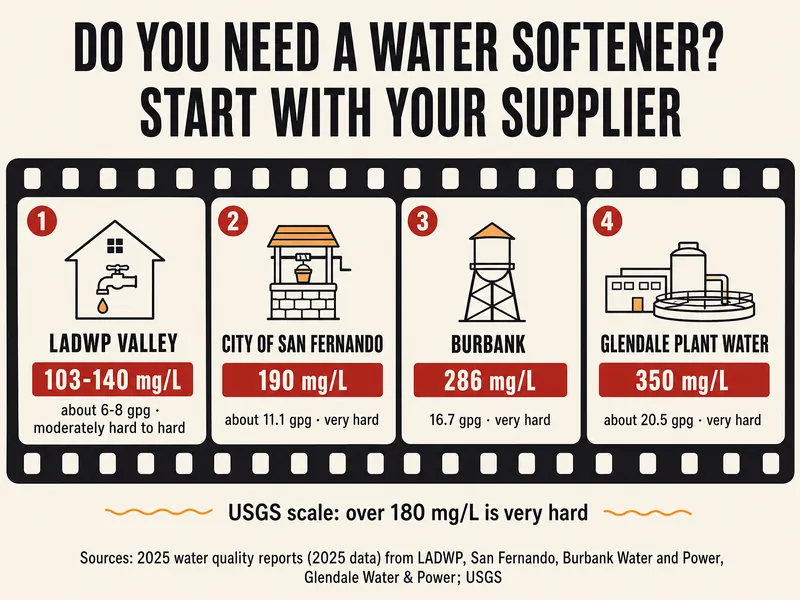
Do you need a water softener in the Valley? Usually not on LADWP water at 103-140 mg/L, but Burbank (286 mg/L) and Glendale's groundwater (350 mg/L) are hard enough that scale gives a stronger reason.
About the shop links on this page: Shutoff Valley shares its owners with SoftPro Water Systems and Quality Water Treatment, the two water-treatment shops linked on this page. What a shop says about its own products is labeled as the shop's claim. How shop links work here
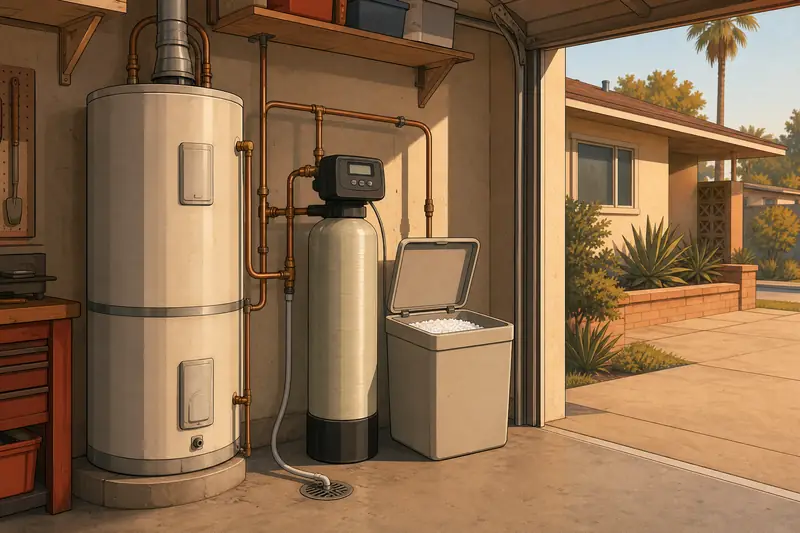
Call sheet: what this page covers
Before you scroll
- LADWP's Valley sources averaged 103-140 mg/L (about 6-8 gpg) of hardness in 2025, per its 2025 water quality report.
- Burbank's blended water averaged 286 mg/L (16.7 gpg) and the City of San Fernando's 190 mg/L (about 11.1 gpg) in 2025.
- The USGS calls anything over 180 mg/L "very hard"; EPA WaterSense says softeners are often recommended above 180 mg/L (10 gpg).
- Hardness is a scale and cleaning issue, not a safety one: the City of San Fernando's report calls it "a quality issue, not a safety concern."
- A softener adds about 8 mg/L of sodium for each gpg it removes, per Nebraska Extension: roughly 134 mg/L on Burbank water.
- Rinnai's tankless manual requires a softener or scale treatment above 200 mg/L, which covers Burbank and Glendale's local well water.
Does your supplier's water call for a water softener?
Whether you need a water softener depends first on which agency fills your pipes, because Valley hardness runs from about 6 gpg to over 20 gpg. LADWP serves the City of Los Angeles neighborhoods (Van Nuys, North Hollywood, Sherman Oaks, Northridge, Sylmar, Woodland Hills and the rest), Burbank Water and Power serves Burbank, Glendale Water & Power serves Glendale, and the City of San Fernando runs its own wells.
All four 2026 reports cover calendar-2025 data. Reports print hardness in mg/L (the same as ppm), and 1 gpg equals 17.1 mg/L. On the USGS scale, 61-120 mg/L is moderately hard, 121-180 hard, and over 180 very hard. That puts LADWP Valley water in the moderately hard to hard band, and Burbank, San Fernando and much of Glendale's water in the very hard band. The full supplier breakdown sits on Valley water hardness by supplier.
| Supplier or source | Average hardness | About gpg | USGS class | Rinnai tankless guidance |
|---|---|---|---|---|
| LADWP, LA Aqueduct Filtration Plant | 103 mg/L | 6.0 | Moderately hard | Treatment recommended |
| LADWP, Northern Combined Wells | 115 mg/L | 6.7 | Moderately hard | Treatment recommended |
| LADWP, MWD Jensen water | 140 mg/L | 8.2 | Hard | Treatment recommended |
| City of San Fernando | 190 mg/L | 11.1 | Very hard | Strongly recommended |
| Burbank Water and Power (blend) | 286 mg/L | 16.7 | Very hard | Required |
| Glendale, local groundwater plant | 350 mg/L | 20.5 | Very hard | Required |
Glendale prints no single city-wide figure: its 2025 report lists 350 mg/L for its own groundwater plant, 234 mg/L for MWD Weymouth water and 140 mg/L for Jensen water. Which mix reaches your street varies, so a home test settles it (see testing tap water at home).
What does a water softener actually change?
A water softener swaps the calcium and magnesium in your water for sodium (or potassium), so the water leaving it is close to zero hardness and no longer leaves scale. Nebraska Extension's NebGuide G1491 describes the resin beads trading ions until they are full, then a brine rinse recharges them.
What it changes in a Valley house: less white crust on faucets and shower glass, fewer spots on dishes, and less scale in the water heater and tankless heat exchanger. EPA WaterSense notes that scale cuts heat transfer, so heaters run less efficiently. What it does not change: chloramine, lead, nitrate or chromium-6. A softener is a scale tool, not a drinking-water filter, which is why the chloramine filter page and the under-sink reverse osmosis page are separate topics.
What are the downsides of a softener?
The main downsides are added sodium, salty brine down the drain, water used for regeneration and a faster-wearing water heater anode. Nebraska Extension puts the added sodium at about 8 mg/L per gpg removed, so softened Burbank water (16.7 gpg) gains roughly 134 mg/L and softened LADWP Jensen water (8.2 gpg) about 66 mg/L. Many owners plumb a cold line to the kitchen tap that skips the softener, a setup G1491 mentions.
Water heaters notice too. A. O. Smith's residential water heater manual says artificially softened water "is exceedingly corrosive" and "may decrease the life of the water heater tank," and asks for the anode rod to be checked every year when the water is softened. The brine is also why some sewer agencies restrict softeners; the rules are on are softeners allowed in Los Angeles.
What does a softener cost to run?
Running costs come down to salt and regeneration water, both of which scale with your hardness and household size. Penn State Extension's sizing example uses 75 gallons per person per day. A family of four on Burbank water removes about 5,010 grains of hardness a day (300 gallons x 16.7 gpg), or about 1.83 million grains a year. At the Water Quality Association's target of 4,000 grains per pound of salt, that is about 457 pounds of salt a year; at a heavy salt setting near 2,400 grains per pound, about 760 pounds.
The same family on LADWP Jensen water (8.2 gpg) removes about 2,460 grains a day, roughly 225 pounds of salt a year at 4,000 grains per pound. EPA's WaterSense softener guide says a typical regeneration uses 20 to 70 gallons of water. Salt prices vary by store, so price a 40-pound bag locally and multiply. The math behind these numbers is on water softener sizing.
What the numbers say
- 286 mg/LHardness of Burbank's blended supply, 2025 average (16.7 gpg)Burbank Water and Power 2025 report
- 103-140 mg/LLADWP Valley source averages in 2025LADWP Drinking Water Quality Report 2025
- 180 mg/LHardness above which EPA says softeners are often recommendedEPA WaterSense softener guide (2026)
- 8 mg/LSodium added per gpg of hardness removedNebraska Extension G1491
- 20-70 galWater used per typical regenerationEPA WaterSense softener guide (2026)
What can you try before buying a softener?
Before buying, confirm your hardness, then try cheaper fixes aimed at the spots that bother you. Read your supplier's 2026 report (the water report walkthrough shows where hardness hides), or run a drop-test kit at the kitchen tap.
- Wipe fresh white deposits with mild vinegar, which Glendale's 2025 report suggests for hardness residue.
- Use a rinse aid in the dishwasher and dry glassware by hand.
- Drain sediment from the tank heater as its maker schedules (how-to: flushing a water heater).
- For a tankless heater, follow Rinnai's manual: once-a-year flushing from 61 mg/L, with a softener or its Scale Cutter required above 200 mg/L.
If you live on LADWP water and these steps keep scale in check, a softener is a comfort choice rather than a need. On Burbank or Glendale groundwater, scale returns faster and treatment pays off in less scrubbing.
Which softener types fit city water?
On city water, a metered (demand-initiated) salt softener or a salt-free conditioner are the two realistic options. EPA WaterSense advises skipping time-clock models, choosing demand-initiated regeneration, and favoring NSF/ANSI 44 units that remove over 3,350 grains per pound of salt.
A salt-free (template-assisted crystallization) conditioner keeps the minerals in the water but changes their form to reduce scale; it uses no salt and no drain, and it does not soften. The trade-offs are on salt-free water conditioners. Portable exchange tanks, swapped every few weeks, are a third route that LA County Sanitation Districts lists as acceptable in Santa Clarita.
SoftPro Water Systems and Quality Water Treatment, which share this site's owners, sell city-water salt softeners in 32,000 to 64,000-grain sizes: the SoftPro ECO (sold by SoftPro Water Systems, which shares owners with this site) at $967 to $1,447 for the softener alone and the SoftPro Elite (sold by SoftPro Water Systems, which shares owners with this site) at $1,367 to $1,587, the shops' listed prices in October 2026. Know your number first: a two-person household on 8.2 gpg LADWP water removes about 1,230 grains a day, so even the smallest 32,000-grain size, at its nominal rating, holds more than three weeks of its hardness (real capacity depends on the salt setting, as the sizing page explains).
Where this page comes from
Sources: the four Valley suppliers' 2026 reports on calendar-2025 water (LADWP, Burbank, Glendale, San Fernando); the USGS hardness classes; EPA WaterSense's May 2026 guide to water-efficient softeners; NebGuide G1491 from Nebraska Extension; Penn State Extension on softening; WQA's Getting Smart with Softeners; and the Rinnai and A. O. Smith manuals, all read in October 2026. Salt and gallon figures are worked from those sources and rounded. Left out: health claims about hard or softened water, installed costs and salt prices (no primary local source), and any brand ranking.
Still asking
Is LADWP water hard enough to need a softener in Sherman Oaks or Van Nuys?
LADWP's Valley sources averaged 103-140 mg/L in 2025, which is moderately hard to hard, not very hard. Many households manage with cleaning and heater flushing. A softener there is a comfort and scale choice rather than a necessity.
Does Burbank water need a softener for a tankless water heater?
Burbank's 2025 average of 286 mg/L is above the 200 mg/L line where Rinnai's tankless manual says a softener or its Scale Cutter is required. Check your own heater's manual, since makers set their own limits. Without treatment, plan on more frequent descaling.
Will a softener make my tap water safer to drink?
No. Hardness is not a safety issue, and a softener does not reduce chloramine, lead, nitrate or chromium-6. For drinking water concerns, a certified point-of-use filter or reverse osmosis unit is the tool to compare.
How much sodium does softened Valley water carry?
Nebraska Extension estimates about 8 mg/L of sodium added per gpg removed. Softening Burbank's 16.7 gpg water adds roughly 134 mg/L on top of the 38 mg/L already there. A bypass line to the kitchen cold tap keeps drinking water unsoftened.
Can I use potassium chloride instead of salt?
Yes, most softeners can regenerate with potassium chloride. The Water Quality Association notes it takes a 13-15% higher concentration and bridges in the brine tank more readily, so expect to buy more of it.
Does Glendale's water hardness change by neighborhood?
Glendale blends its own treated groundwater (350 mg/L in 2025) with imported MWD water (140-234 mg/L), and the mix varies across its pressure zones. A drop-test kit at your kitchen tap gives your own number.
Should the softener treat the garden hose too?
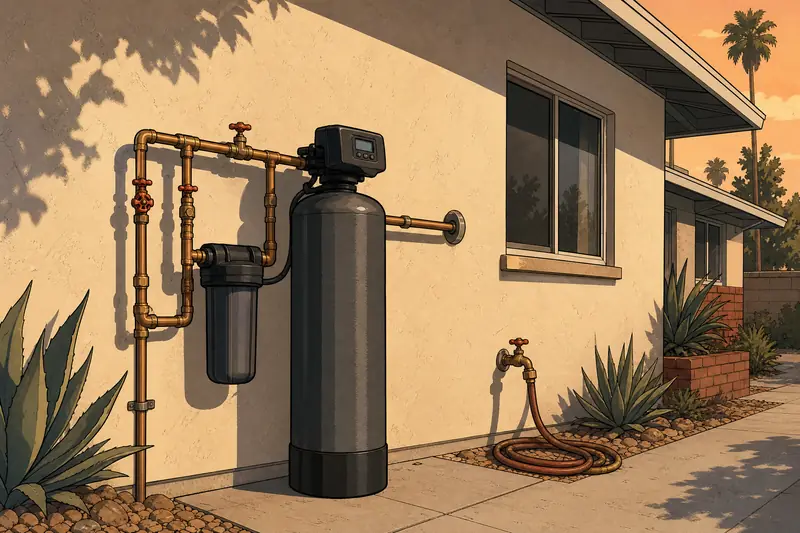
EPA WaterSense recommends installing the softener after the branch to outdoor hose bibbs and irrigation where possible. Softened water is not needed for landscaping, and skipping it saves salt and regeneration water.
That is the end of this page. Back to the Shutoff Valley front page.