Water Softener Sizing for Valley Water
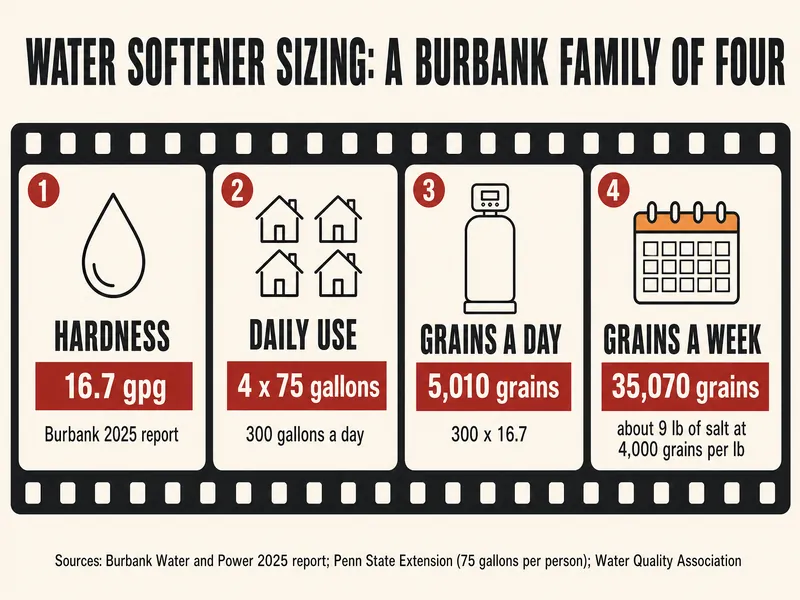
Water softener sizing in the Valley comes down to one sum: hardness in gpg times gallons used a day, so a family of four on Burbank water removes about 5,010 grains daily and on LADWP water about 2,460.
About the shop links on this page: Shutoff Valley shares its owners with SoftPro Water Systems and Quality Water Treatment, the two water-treatment shops linked on this page. What a shop says about its own products is labeled as the shop's claim. How shop links work here
Call sheet: what this page covers
Before you scroll
- Burbank's water averaged 16.7 gpg in 2025 and LADWP's Valley sources 6.0-8.2 gpg, so the same household can need twice the capacity across a city line.
- Penn State Extension sizes softeners with 75 gallons per person per day; its four-person example removes 3,000 grains a day at 10 gpg.
- The Water Quality Association asks installers to start from about 200 gallons a day for a household of four and to avoid oversizing.
- A Pentair data sheet rates one 2-cubic-foot softener at 23,900 grains on 6 lb of salt but 70,700 grains on 30 lb: capacity depends on the salt setting.
- WQA's target is 4,000 grains of hardness removed per pound of salt; EPA WaterSense asks for more than 3,350.
- California caps new showerheads at 1.8 gpm and kitchen faucets at 1.8 gpm, which helps you add up peak flow.
What numbers do you need to size a water softener?
To size a water softener you need three numbers: your water's hardness in grains per gallon, how many gallons the house uses a day, and the peak flow when several taps run at once. EPA's WaterSense softener guide puts it simply: a 32,000-grain softener removes 32,000 grains before it regenerates, and both hardness and household use decide the size you need.
Hardness comes from your supplier's 2026 water quality report (2025 data), such as Burbank Water and Power's 2025 report or LADWP's 2025 Drinking Water Quality Report. Reports print it in mg/L (ppm); divide by 17.1 for gpg. For daily use, Penn State's planning figure is 75 gallons per person, EPA WaterSense cites 82 gallons a day at home per American, and your LADWP or city bill shows your own use. EPA suggests leaving irrigation out of the sum, since landscape water does not need softening.
How many grains does a Valley home remove a day?
A Valley home removes roughly 1,200 to 7,700 grains of hardness a day, depending on supplier and household size. The arithmetic is gallons per day times gpg. The table uses Penn State's 75 gallons per person and each supplier's 2025 average; see Valley water hardness by supplier for where each figure comes from.
| Household | LADWP Jensen water (8.2 gpg) | City of San Fernando (11.1 gpg) | Burbank (16.7 gpg) | Glendale groundwater plant (20.5 gpg) |
|---|---|---|---|---|
| 2 people (150 gal) | 1,230 | 1,665 | 2,505 | 3,075 |
| 3 people (225 gal) | 1,845 | 2,500 | 3,760 | 4,610 |
| 4 people (300 gal) | 2,460 | 3,330 | 5,010 | 6,150 |
| 5 people (375 gal) | 3,075 | 4,160 | 6,260 | 7,690 |
LADWP water from the LA Aqueduct Filtration Plant (6.0 gpg) or the Northern Combined Wells (6.7 gpg) is softer than the Jensen column, so those homes land lower. Glendale prints no city-wide figure, and its imported water runs 8.2 to 13.7 gpg, so the Glendale column is a ceiling. A home hardness test gives your own number.
What grain capacity fits your household?
The grain capacity that fits is the one that covers several days of your daily grains at an efficient salt setting, without sitting half-used for weeks. Divide the capacity by your daily grains to get days between regenerations. Penn State's own example, a 20,000-grain unit and a household removing 3,000 grains a day, works out to about 6-7 days.
Worked examples, using rated capacities from Pentair's 5600SXT softener data sheet at its leanest salt setting:
- Two people on LADWP Jensen water (1,230 grains a day) with a 1-cubic-foot unit at 11,900 grains: about 9.7 days.
- Four people on LADWP water (2,460 a day) with a 1.5-cubic-foot unit at 17,900 grains: about 7.3 days.
- Four people in Burbank (5,010 a day) with a 2-cubic-foot unit at 23,900 grains: about 4.8 days, or 12.4 days on the 18-lb setting (62,200 grains).
- Five people on Glendale plant water (7,690 a day) with the same 2-cubic-foot unit: about 3.1 days lean, 8.1 days at 18 lb.
Retail listings name sizes by a single grain figure (32,000, 48,000, 64,000). Ask which salt setting that figure assumes, because the same tank can be rated at very different numbers.
How does salt setting change softener capacity?
More salt per regeneration buys more capacity, but each extra pound removes fewer grains. Pentair's data for its 2-cubic-foot model shows 23,900 grains on 6 lb of salt, 62,200 on 18 lb and 70,700 on 30 lb. That works out to about 3,980, 3,460 and 2,360 grains per pound.
Capacity versus salt, one 2-cubic-foot softener
- 23,900 grainsRated capacity on 6 lb of salt (about 3,980 grains per lb)Pentair 5600SXT data sheet
- 62,200 grainsRated capacity on 18 lb of salt (about 3,460 grains per lb)Pentair 5600SXT data sheet
- 70,700 grainsRated capacity on 30 lb of salt (about 2,360 grains per lb)Pentair 5600SXT data sheet
- 4,000 grains/lbSalt efficiency WQA asks installers to setWater Quality Association, Getting Smart with Softeners
- 75 galWater use per person per day in Penn State's sizing examplePenn State Extension
For the Burbank family of four (35,070 grains a week), that is about 8.8 lb of salt a week on the lean setting, 10.1 lb on the middle one and 14.9 lb on the heaviest. The trade-off is water: a lean setting regenerates more often, and EPA puts a typical regeneration at 20 to 70 gallons. EPA's efficiency bar for NSF/ANSI 44 models is over 3,350 grains per pound of salt and at most 5 gallons of water for every 1,000 grains. WQA also notes that high-efficiency settings need source water under 750 ppm TDS; Burbank's 2025 average was 448 mg/L and LADWP's Valley sources 234-297 mg/L.
What flow rate does a softener need?
A softener needs a rated service flow at least equal to the most water your house draws at once, or pressure drops when several taps run. Under the 2025 California Plumbing Code, new showerheads are limited to 1.8 gpm, kitchen faucets to 1.8 gpm and bathroom faucets to 1.2 gpm. Two showers, the kitchen tap and one bathroom faucet together come to 6.6 gpm before a washer or irrigation zone.
Pentair rates its three sizes at 10.0, 10.8 and 12.0 gpm, with a pressure drop of 14-15 psi at that flow. That drop matters on low-pressure streets: LADWP's rules promise at least 25 psi, and a home with a regulator set low has less to spare. If pressure is already weak, check it with a hose-bibb gauge first, as described on water pressure regulators.
What happens if a softener is too small or too big?
A softener that is too small regenerates very often and can let hard water through when its capacity runs out before the next cycle. Pentair's manual explains that metered controls hold a reserve so treated water keeps flowing between the moment capacity is used up and the scheduled regeneration; an undersized unit eats into that reserve fast on Burbank or Glendale water.
A softener that is too big wastes water and salt, which is why both EPA ("It is important not to oversize your system") and the Water Quality Association warn against it. Choose demand-initiated regeneration over a time clock, so the unit regenerates by volume used. If your hardness is moderate, as on most LADWP water, a smaller tank on a lean setting often matches the need; do you need a water softener covers whether to soften at all, and are softeners allowed in Los Angeles covers the local rules.
For reference, the two shops that share owners with Shutoff Valley offer these grain sizes: the SoftPro Elite in 32,000, 40,000, 48,000 and 64,000 grains ($1,367-$1,587 for the softener alone) and the SoftPro ECO at Quality Water Treatment (sold by Quality Water Treatment, which shares owners with this site) in 32,000, 48,000 and 64,000 grains ($967-$1,447), the shops' listed prices in October 2026.
Where this page comes from
Figures come from 2025 hardness averages in the suppliers' 2026 reports (LADWP, BWP, GWP and San Fernando); EPA WaterSense's softener guide and its Statistics and Facts page; Penn State Extension; WQA best practices for softeners; Pentair's 5600SXT softener manual and performance data sheet; and the 2025 California Plumbing Code fixture limits, all read in October 2026. Daily grains, days between regenerations and pounds of salt are calculated from those figures and rounded. Left out: rules of thumb such as "buy 1.5 times your weekly figure," which no primary source supports, and iron or manganese adjustments, which apply to wells rather than Valley city water.
Still asking
What size water softener does a family of four need in Burbank?
At 16.7 gpg and 300 gallons a day, a Burbank family of four removes about 5,010 grains a day, or 35,070 a week. A unit rated around 24,000 grains at a lean salt setting regenerates about every 5 days; one rated near 62,000 grains at a mid setting lasts about 12 days.
Is a 32,000-grain softener enough for LADWP water?
For most households, yes in capacity terms. Four people on 8.2 gpg LADWP water remove about 2,460 grains a day, so 32,000 grains lasts roughly 13 days. Check what salt setting the 32,000 figure assumes before relying on it.
Should I size the softener for my whole water bill?
Not if much of it goes to irrigation. EPA WaterSense suggests leaving outdoor uses out of the softening sum and installing the softener after the branch to the yard, which lets a smaller unit do the job.
Does a bigger softener save salt?
Only if it is set to an efficient salt dose. Pentair's data shows removal per pound falls from about 3,980 grains at the lean setting to about 2,360 at the heaviest. A big tank on a heavy setting uses more salt for each grain removed.
How often should a softener regenerate?
There is no fixed rule. Penn State's worked example lands at 6-7 days. Demand-initiated models regenerate when the metered volume runs out, which EPA prefers over a fixed timer.
Do I need to count hot water separately?
No. The softener treats all water entering the house before the water heater, so hot and cold use are counted together in your gallons per day.
Does my softener need resetting if the water source changes?
Yes, if your hardness changes. LADWP blends aqueduct, groundwater and imported water, and its Valley sources ranged from 6.0 to 8.2 gpg in 2025. Enter the highest typical figure from a home test or the report so the control does not run out early.
That is the end of this page. Back to the Shutoff Valley front page.